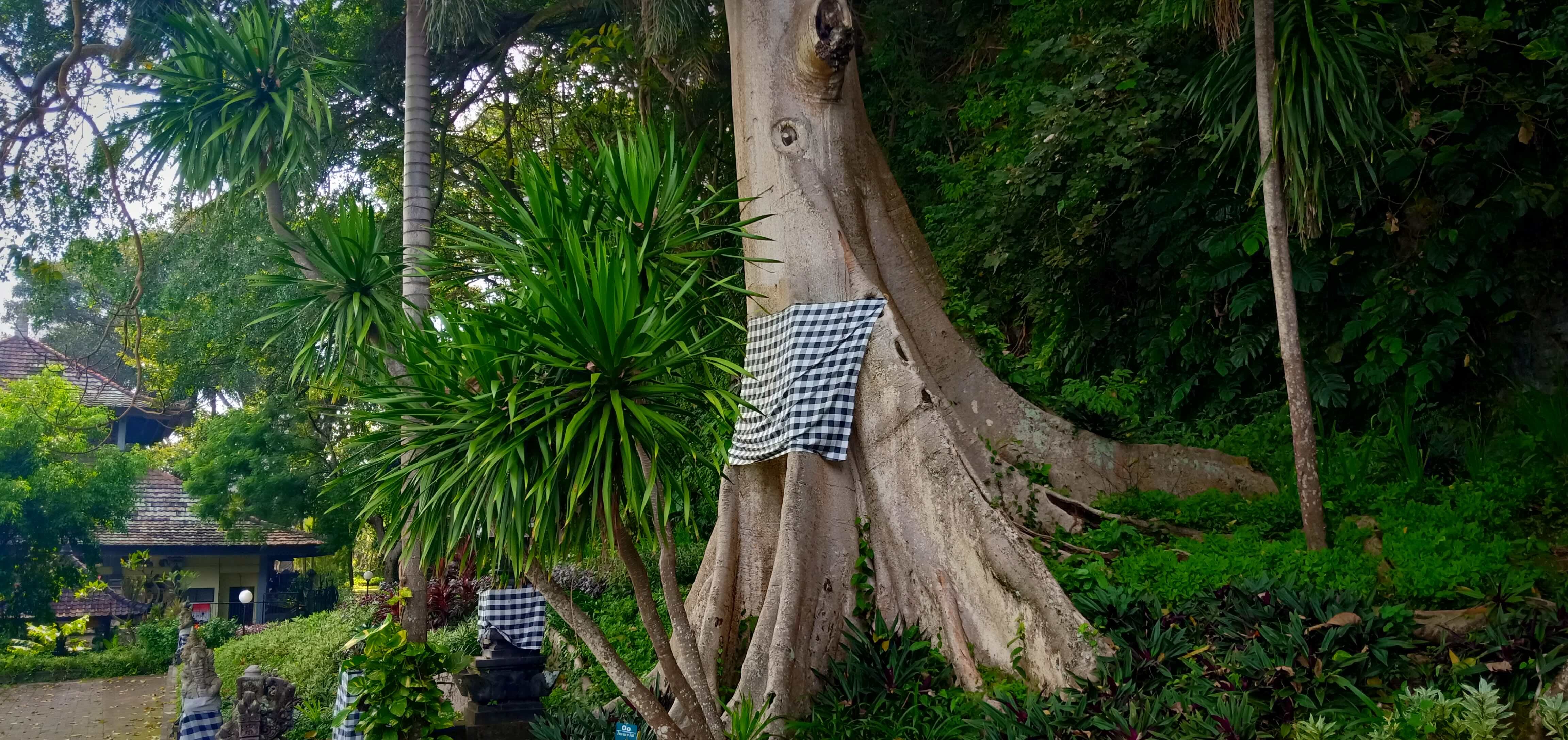
To encounter a sacred Beringin tree in Bali is to feel the weight of centuries. Its immense presence commands the landscape, casting a deep, cool shade that offers a physical and spiritual reprieve from the tropical sun. Beneath its dense canopy, the clamor of daily life softens to a respectful hush. This is not merely a tree; it is a living monument, a silent witness to the generations of ceremonies, conversations, and commerce that have unfolded at its base. In Balinese cosmology, the Beringin is far more than a biological specimen. It is a bio-cultural artifact, a living axis that stands at the intersection of the tangible, visible world known as sekala, and the unseen, potent spiritual realm of niskala. It is a bridge, a guardian, and a profound expression of the island's unique worldview, where the natural and the supernatural are inextricably intertwined.
Sacred Rituals
The Social space is integrated into the "worldly" economy. Even within the ritual context where, the tree facilitates the purification and ascent of ancestral spirits toward unity with the gods.

Editorial Team
January 28, 2026
1. The Arboreal Architecture: Bridging Earth and Sky
The Beringin, a member of the Ficus genus including species like Ficus benjamina, possesses a distinct physical architecture where every feature is imbued with metaphorical significance. Its form transcends mere botany, functioning as a semiotic text that encodes deep cosmological principles.
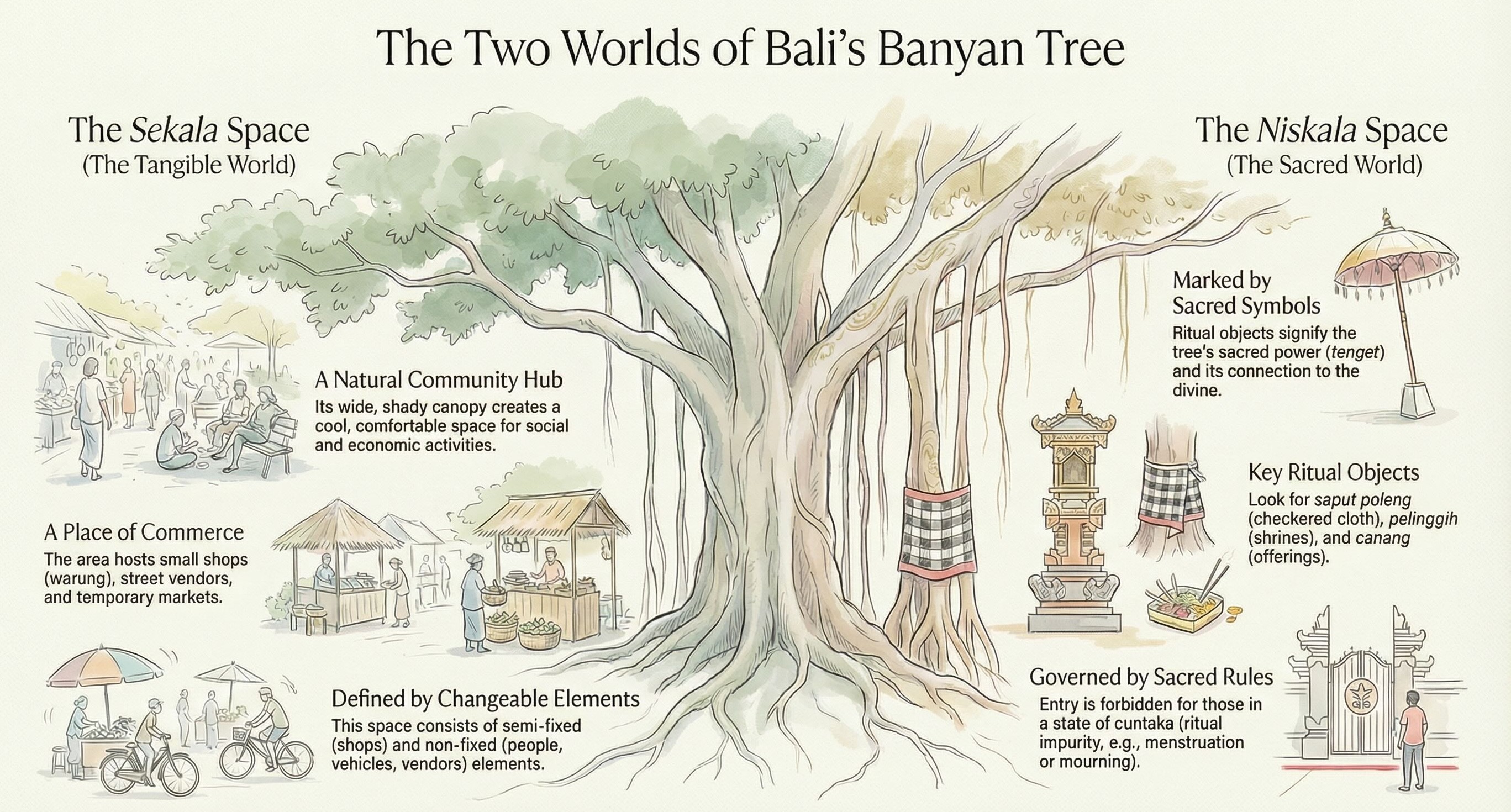
The massive girth of its trunk and its capacity to live for centuries visually symbolise strength, stability, and endurance, marking it as an axis mundi—a world axis anchoring the village to its ancestral past. From this stable core rises a broad, sprawling canopy that creates a vast area of shade, a quality the Balinese refer to as pengayoman, or guardianship.
This physical shelter is understood as a manifestation of its spiritual function: to guard the community and offer a sacred sanctuary. Finally, descending from the high branches, a curtain of aerial roots reaches back towards the earth, a striking feature interpreted as a direct, physical connection between the upper and lower worlds. These roots are visual evidence of the tree’s role as a mediator, a channel for energies to travel between the celestial and terrestrial planes.
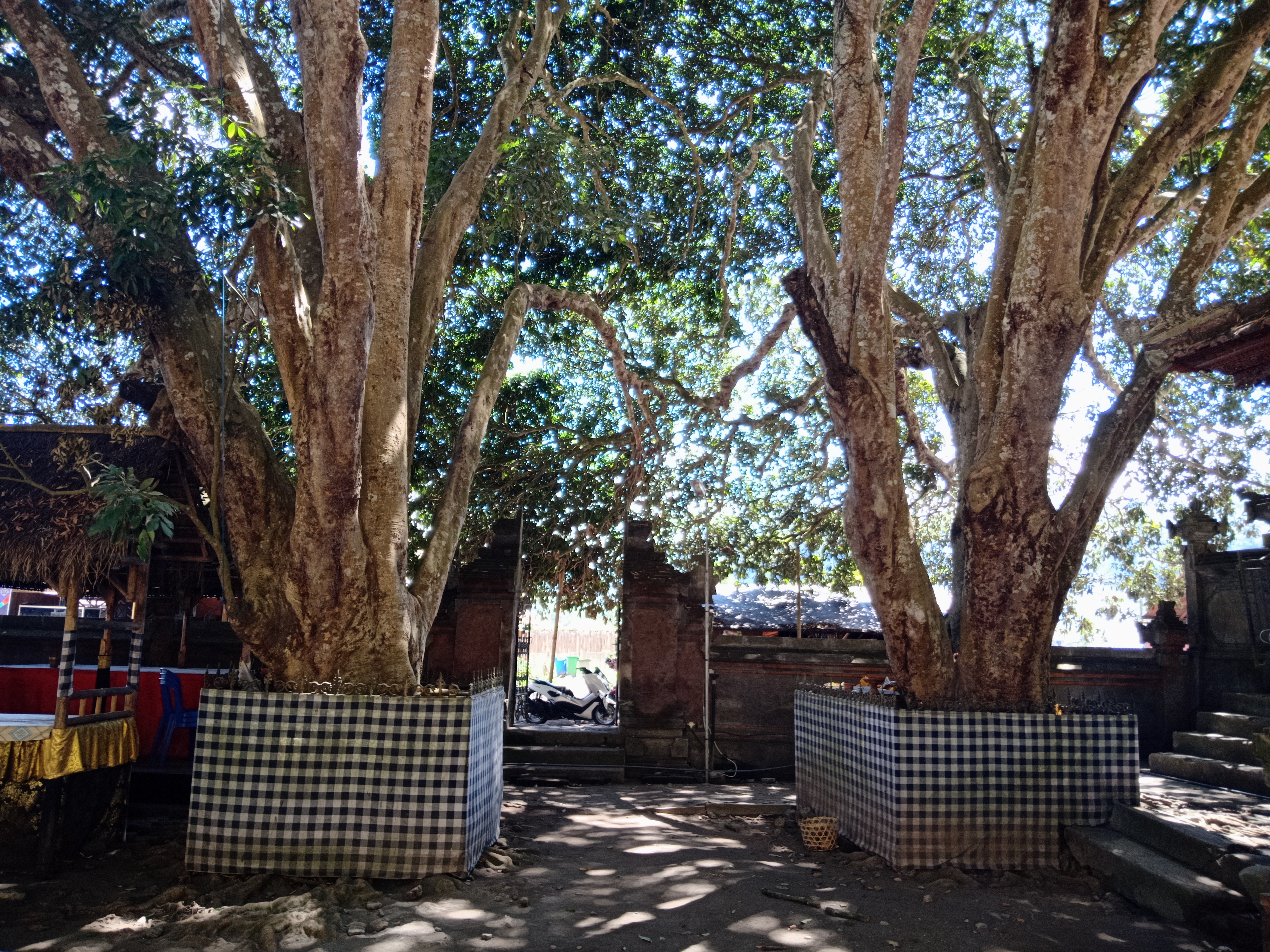
A close-up of a sacred tree's massive trunk adorned with the ceremonial Kain Poleng. A traditional stone guardian statue stands beside it, emphasizing the spiritual protection and sanctity of the site.
Photo by
Editorial Team
2. The Spiritual Core: Iconography and Ritual Worship
The sacred status of the Beringin is formalized through a system of visual markers and ritual practices that convert the tree from a natural object into a dynamic spiritual entity. This iconography makes its power visible and provides a focal point for community worship, articulating a complex spiritual meaning.
2.1 Tenget: The Manifestation of Sacred Power
The tree’s inherent sacred power, known as tenget, is perceived through its commanding physical form—its age, size, and unique root structure. This palpable energy marks it as a potent dwelling place for deities, ancestral spirits, and powerful, often ambivalent, natural forces known as butha. The Beringin is not just near a sacred site; it is a sacred site, a natural temple where the veil between the sekala and niskala worlds is thin. This understanding forms the foundation of its role in Balinese worship.
2.2 Kain Poleng: Weaving Duality onto the Landscape
To signify its tenget status, the trunk of a sacred Beringin is often wrapped in a kain poleng, a distinctive black-and-white checkered cloth. Dressing the tree in kain poleng is a deliberate semiotic act, visually articulating its role as a liminal space where cosmic forces converge.
The cloth is a direct visual symbol of Rwa Bhineda, the foundational Balinese principle of complementary dualities: good and evil, light and dark, sacred and profane. It serves not just as a symbol but as a visual warning and a tool for maintaining equilibrium, marking the tree as a place that is both dangerous and protective, whose ambivalent powers must be kept in balance.
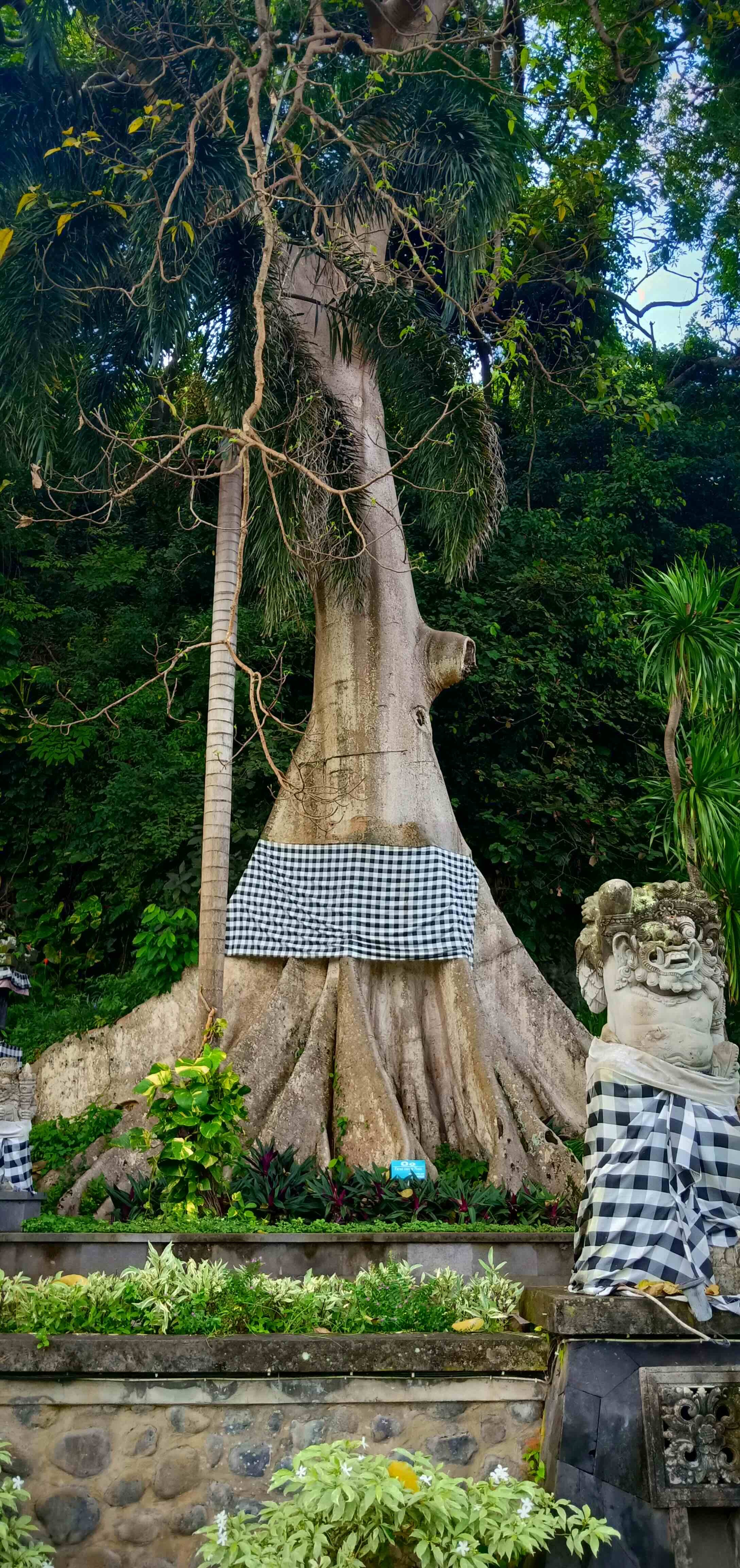
A close-up of a sacred tree's massive trunk adorned with the ceremonial Kain Poleng. A traditional stone guardian statue stands beside it, emphasizing the spiritual protection and sanctity of the site.
Photo by
Editorial Team
3. A Locus for Worship and Ancestral Rites
The Beringin's function as a center for worship is often formalized by the placement of small shrines (pelinggih) or sacred stones at its base, providing a dedicated point of interaction for making offerings. The tree is not merely decorated; it is transformed. The biological form provides the raw power (tenget), the kain poleng gives it a philosophical grammar (Rwa Bhineda), and the shrines (pelinggih) provide the formal syntax for ritual interaction.
Together, they create a single, potent bio-cultural statement. The tree plays a crucial role in specific rituals, most notably the pitra yadnya, or rites for the dead. The tree’s physical form makes it the logical, powerful conduit for these ceremonies; its longevity signifies ancestral continuity, and its aerial roots provide the symbolic bridge for the purification and ascent of ancestral spirits toward unity with the divine.
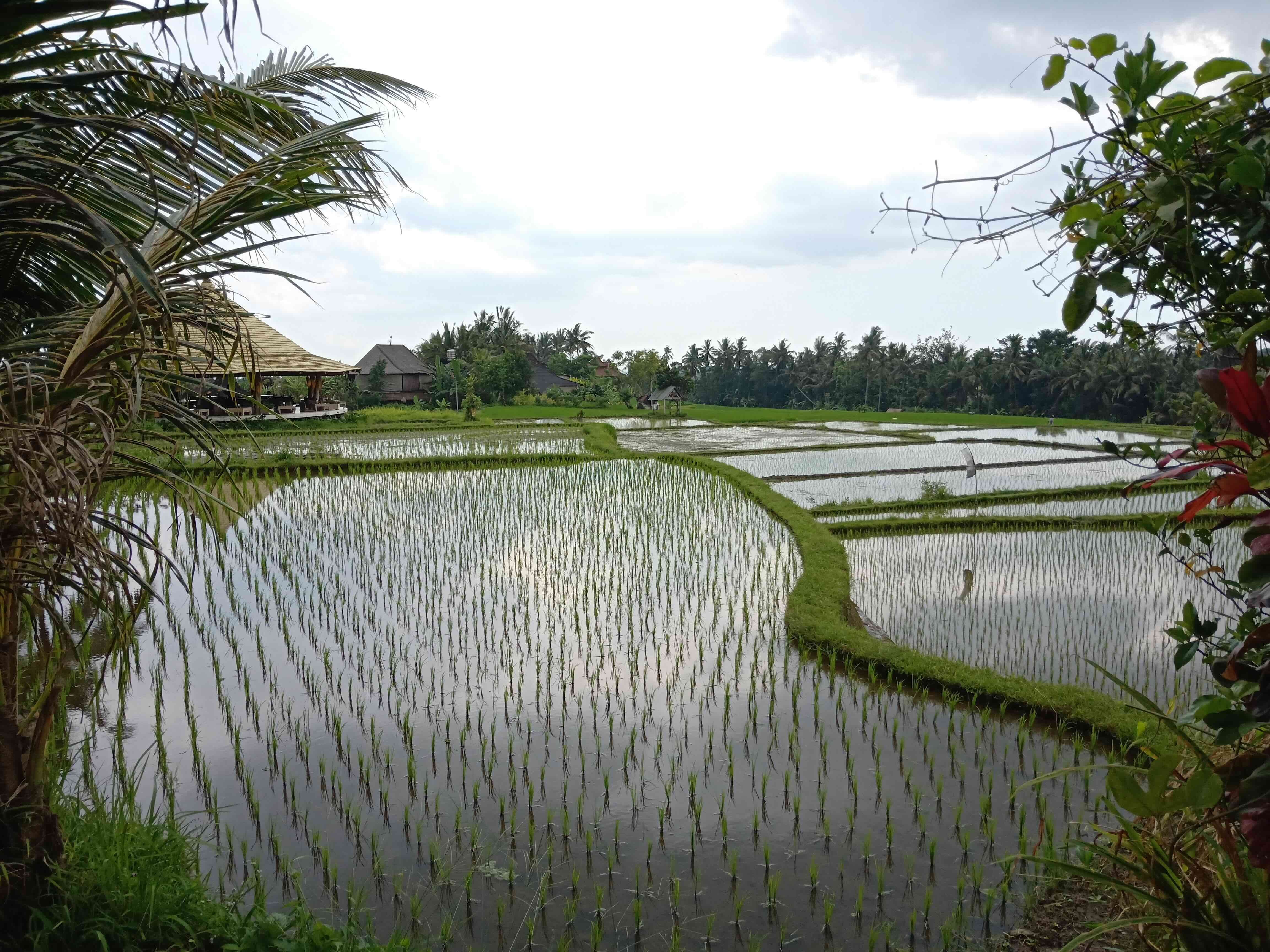
A serene view of the traditional rice terraces in Sebali, Ubud. The flooded paddies reflect the tropical sky, showcasing the peaceful rural landscape and the Subak irrigation system of Bali.
Photo by
Editorial Team
4. A Case Study in Sacred Geography: The Beringin of Denpasar
The significance of the Beringin is deeply embedded in the sacred geography of a Balinese village, where its placement is deliberate and meaningful. As studies from Denpasar show, the tree is rarely an isolated feature but a central node that organizes social, civic, and spiritual life. It is commonly found near key communal structures, such as the main village temple (pura)—especially the temple of the dead in the lower village zone—and the wantilan (village assembly hall) or the central marketplace.
This strategic placement allows the Beringin to function as a powerful dual-purpose landmark. It is at once a secular social hub and an active ritual center. Here, the sacred and the profane are not separated but layered; the shade that cools a gossiping merchant in the afternoon may, hours later, shelter a family presenting offerings to their ancestors.
The tree consecrates the mundane, making it a constant, living reminder of the Tri Hita Karana principle in action—the foundational Balinese philosophy of maintaining harmony between humans, nature, and the divine. By physically linking the spaces of social interaction, natural shelter, and spiritual worship, the Beringin makes this cosmological balance tangible in the heart of the village.
5. Conclusion: Conserving a Living Heritage
The profound cultural and spiritual reverence for the Beringin tree is the very foundation of its conservation in Bali. Protecting these ancient giants is not seen merely as an ecological act but as a crucial act of preserving cultural and spiritual heritage.
The ritual valuation of the tree—the myths that animate it, the ceremonies that honor it, and the kain poleng that marks its sanctity—is the primary driver that ensures its survival. These practices transform a biological organism into a cultural keystone. In a world of rapid change, these living monuments stand as a testament to the resilience of a cosmology that sees no separation between humanity and its environment.
To protect the Beringin is therefore not just to save a species, but to preserve the living archive in which the island’s ecological and spiritual philosophies are inextricably written.
POST
POST
POST

