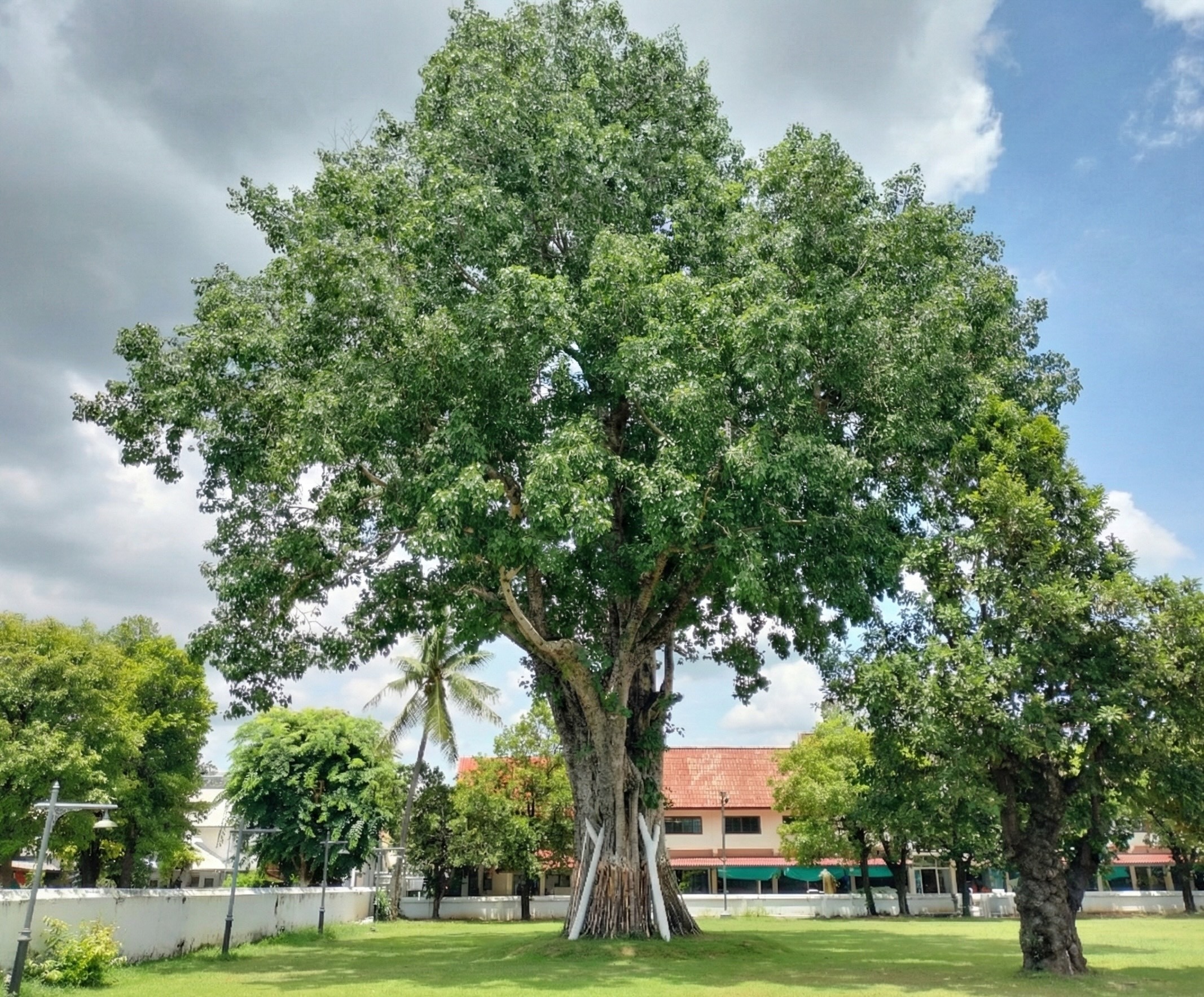
Towering Bodhi tree at Wat Suan Dok supported by traditional Lanna-style wooden crutches known as Mai Kham Sali under a blue sky.

Bodhi Tree Thailand: Spiritual Meaning, History & The 'Vegetal Saint'.

January 1, 2026

In Thailand, the Bodhi tree, Ficus religiosa , is far more than a botanical specimen. It is a living palimpsest, a surface where ancient animist reverence, Buddhist doctrine, and modern environmentalism are written one over the other, with traces of each layer remaining visible. To the casual observer, it is a source of shade in a temple courtyard; to the semiotician, it is a dense visual text. This article proposes to "read" the sacred tree as a complex sign system, decoding the layers of meaning embedded in its various elements, from the enlightened canopy to its architecturally disruptive roots.

Explore the Blog Post

Visual Semiotics

A semiotic analysis of sacred trees in Thailand. We decode the Bodhi tree's role in Thai Buddhist iconography and explore the meaning of Ficus religiosa.

A. Di Paolo

January 1, 2026

by Alma Lawson

In Thailand, the Bodhi tree, Ficus religiosa , is far more than a botanical specimen. It is a living palimpsest, a surface where ancient animist reverence, Buddhist doctrine, and modern environmentalism are written one over the other, with traces of each layer remaining visible. To the casual observer, it is a source of shade in a temple courtyard; to the semiotician, it is a dense visual text. This article proposes to "read" the sacred tree as a complex sign system, decoding the layers of meaning embedded in its various elements, from the enlightened canopy to its architecturally disruptive roots.

1. The Canopy: The Locus of Enlightenment


The canopy constitutes the opening chapter of the Bodhi tree's sacred text, a narrative of pure enlightenment that exists above the fray of worldly interaction. Its leaves and the shelter it provides are not merely physical attributes but carriers of profound religious significance.


1.1. The Leaf as Sacred Imprint

The Bodhi tree is, first and foremost, a living memoir of the moment Siddhartha Gautama achieved enlightenment and became the Buddha. For Buddhists, the tree is a direct, physical reminder of the place where he sat, meditated under its canopy, and reached nirvana.

The tree itself becomes an important component in the story of enlightenment, a silent witness and facilitator. It stands as a tangible link to the foundational event of the faith, transforming every Bodhi tree in every temple into a symbol of that ultimate spiritual potential.


1.2. A Shelter for the Mind

The broad canopy of the Bodhi tree provides a physical space conducive to spiritual practice, echoing the Buddha's own meditative act. In Thai temples, monks utilize the shade and privacy offered by these large trees for both walking meditation ( Jong-klom ) and sitting meditation.

This practice turns the temple garden into a microcosm of the forest, directly connecting the urban temple to the ascetic traditions of wandering Forest Monks ( Phra Tudong ), who sought out the solitude of nature to advance their spiritual discipline. The tree's canopy thus creates a sacred micro-environment, a natural hall for contemplation within the temple grounds.
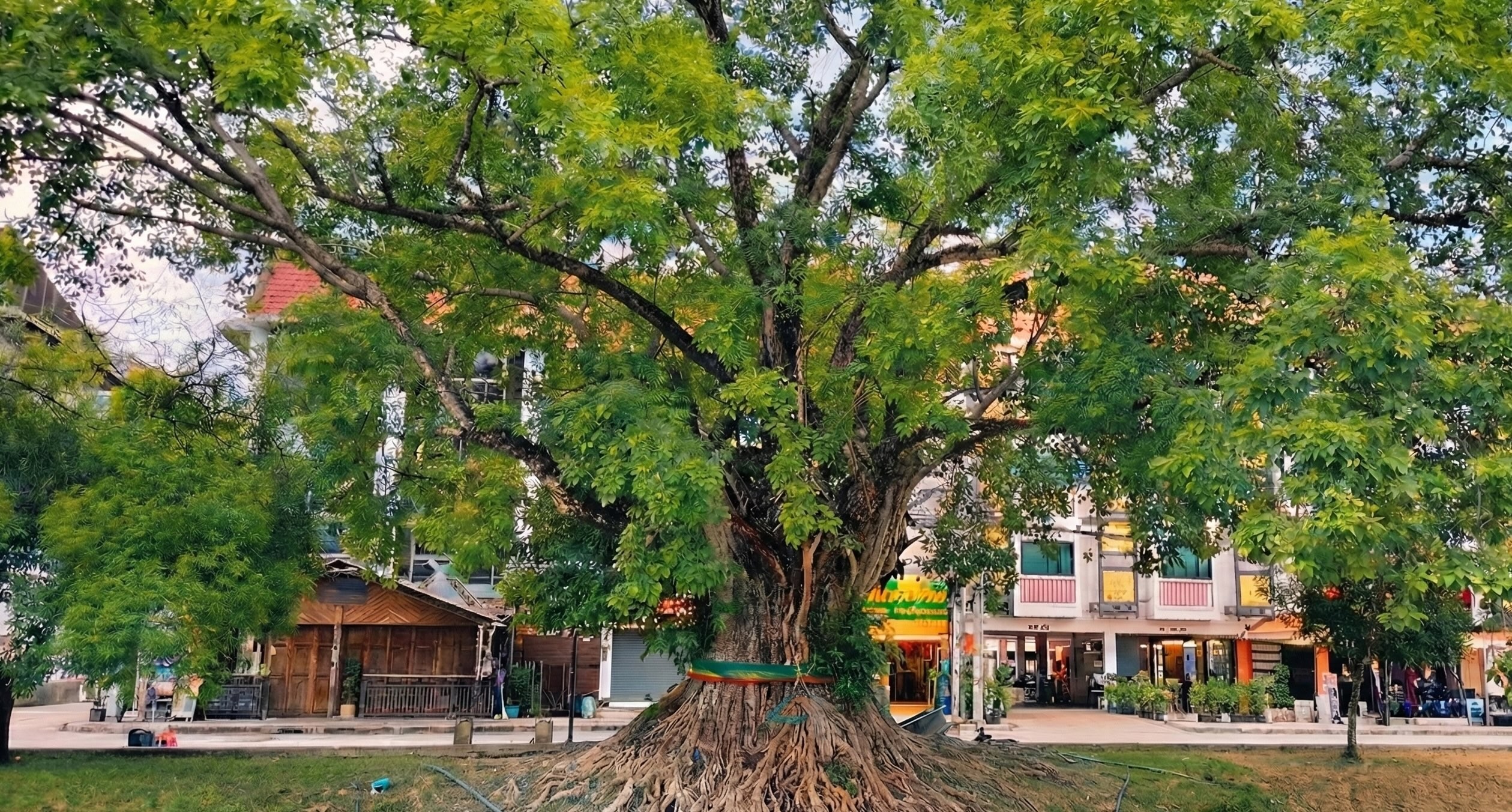
Large, spreading tree with a massive exposed root system wrapped in colorful sash cloths, located near the historic Chiang Mai Gate and city moat.
The Supported Giant at Wat Si Koet Within the courtyard of Wat Si Koet, the heavy branches of this sacred Bodhi tree are upheld by metal supports. These structures protect the ageing giant while symbolising the spiritual act of sustaining Buddhism itself.
Photo by
A. Di Paolo

2.1. The Axis Adorned


As the central, accessible column of the sacred tree, the trunk becomes a focal point for lay ritual. It is an axis where deep-rooted local beliefs in tree spirits ( Rukkha Thewada ) and other animist traditions merge with formal Buddhist practice. This ritual layering perfectly illustrates the syncretic genius of Thai popular religion, which rarely erases pre-Buddhist beliefs but instead subsumes them into a broader Buddhist cosmology.

This animist syncretism is a hallmark of Thai popular religion, where the adornment of the trunk becomes a visible manifestation of cultural blending.


2.2. Dressing the Sacred: Acts of Devotion

Laypeople engage in specific rituals centered on the tree's trunk, each a material expression of faith and a means of making merit. A semiotic reading of these acts reveals a profound impulse to transform the natural object into a social being.


  • Coloured Sashes:  Temple visitors frequently tie pieces of coloured fabric or scarves around the trunks of Bodhi trees. This is more than decoration; it is an act of "dressing" the tree, anthropomorphizing it into a figure worthy of clothing. This gesture elevates the tree from mere flora to a respected social and spiritual actor, visually marked for reverence.
  • Support Sticks (Mai Kham):  Another common practice involves placing long wooden sticks against a Bodhi tree. This act functions as a form of sympathetic magic. By physically "supporting" the sacred tree—a symbol of the Buddha's achievement—the devotee hopes to receive metaphysical support and prosperity in their own life. The physical gesture is a prayer for reciprocal spiritual reinforcement.
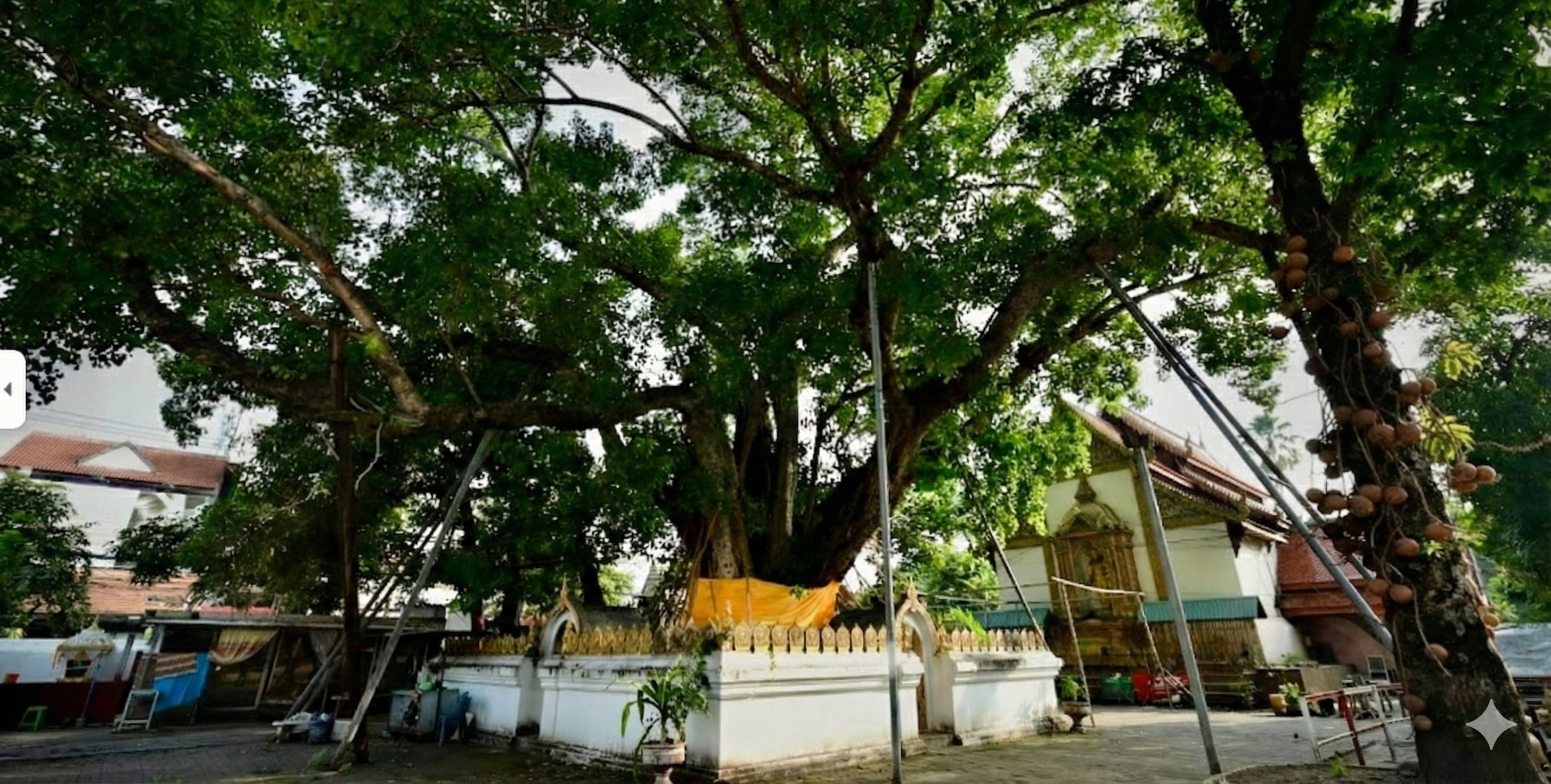
Wide-angle view of an ancient Bodhi tree providing shade over the white walls and golden architecture of Wat Si Koet in Chiang Mai Old City.

The Supported Giant at Wat Si Koet Within the courtyard of Wat Si Koet, the heavy branches of this sacred Bodhi tree are upheld by metal supports. These structures protect the ageing giant while symbolising the spiritual act of sustaining Buddhism itself.

Photo by
A. Di Paolo

3. The Roots: An Architectural Conflict


Reading deeper, we find in the tree's root system a narrative of conflict, not just between organic growth and static architecture, but between two competing worldviews coexisting within the temple walls.


3.1. Unyielding Growth, Unstable Ground

The sacred status of the Bodhi tree creates a paradox: a venerated object with destructive potential. This physical conflict is the surface manifestation of a deeper philosophical tension. In the doctrinal,  nibbānic  Buddhist view, a tree is merely  rūpa —physical form, composed of elements and possessing no inherent sacredness.
Yet in the animist folk belief that informs popular practice, the tree is an active agent, home to a powerful spirit. The architectural conflict is thus a clash between the tree as inert matter and the tree as a living entity. Its powerful root systems destroying pavement, threatening foundations, and damaging the ornate facades of temple buildings are physical evidence of this ideological struggle.

The famous image of a Buddha head entirely engulfed by the roots of a Bodhi tree is the ultimate visual metaphor for this tension, where the animist power of sacred nature reclaims and consumes a doctrinal artifact.


3.2. The Saint on the Structure

This conflict reaches its apex when Bodhi trees begin to grow in what is considered the "wrong place." According to one monk, even a sacred Bodhi tree must be in the "right place" to be truly auspicious, ideally on the main cosmological axis of the temple. When a sapling sprouts atop a crematorium or outgrows a building, it is not just an inconvenience; it is a cosmological anomaly. A symbol of enlightenment and life emerges unsolicited in a place associated with death and transition, disrupting the sacred geography of the temple.

This phenomenon, a dramatic clash of Bodhi Tree architecture and nature, creates difficult decisions for authorities, who must weigh spiritual significance against practical necessity when sacred trees are removed for new construction or parking spaces.
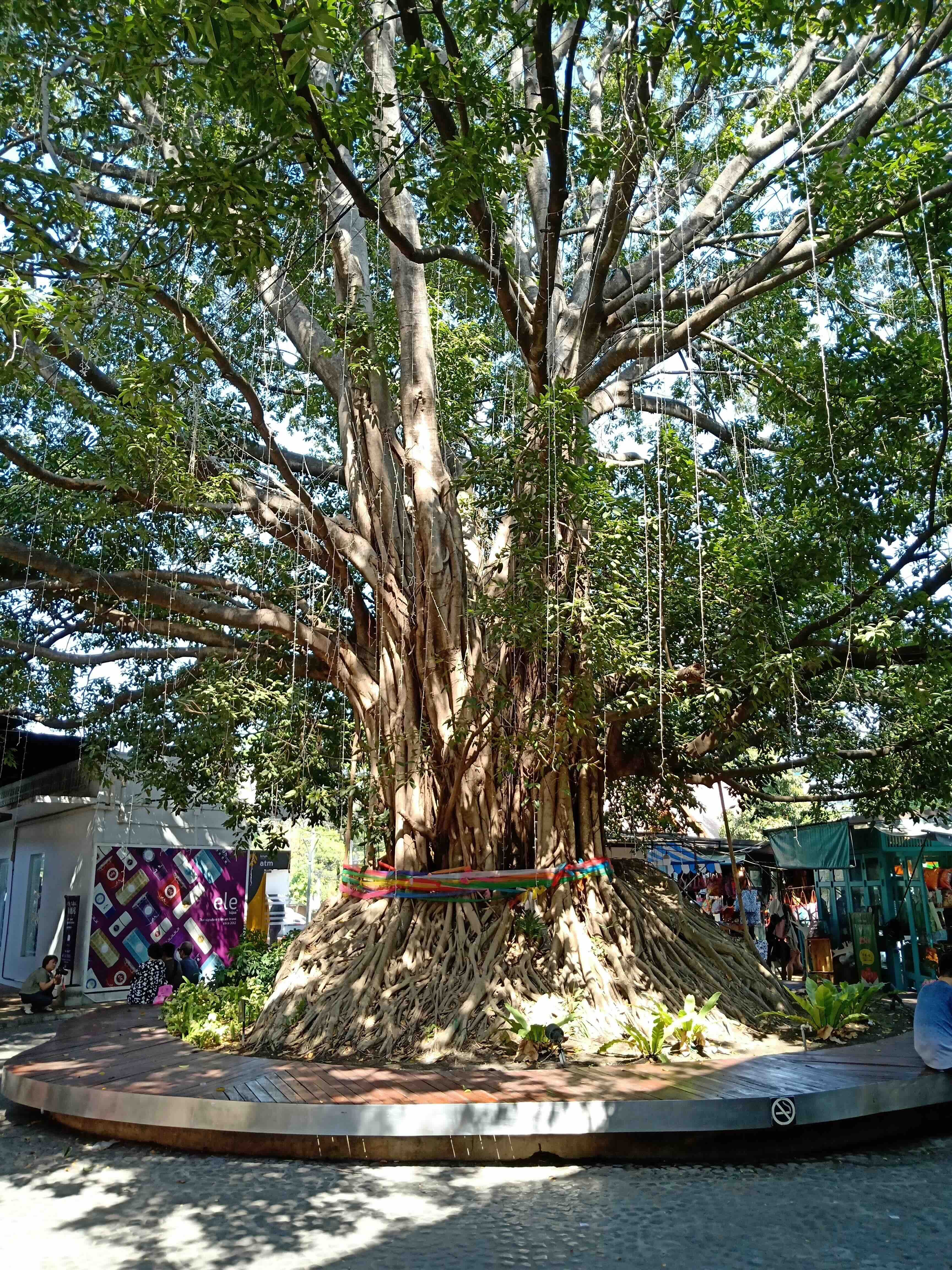
Expansive sacred Bodhi tree with heavy branches supported by metal poles within the courtyard of Wat Si Koet temple in Chiang Mai, Thailand.
Sacred Roots and Spirits Cascading aerial roots form a natural tapestry on this majestic Ficus in Chiang Mai. Adorned with colourful sacred ribbons, the tree is revered as a residence for guardian spirits, protecting it from urban encroachment.
Photo by
A. Di Paolo

4. A Modern Paradox: Conservation and Contradiction


The final chapter of this text is still being written, as contemporary Thai society grapples with the role of sacred trees, producing evolving and sometimes contradictory approaches to their preservation.


4.1. The Ordained Forest

In a modern reinterpretation of Buddhist principles, a group of "Environmental monks" ( Phra nak anurak ) has developed the ritual of "ordaining a tree." By wrapping a tree in the saffron robes of a monk, they declare it sacred, extending a monk's protected status to the natural world. This innovative practice is a conservation strategy designed to protect local forests from logging. It leverages the cultural authority of the monkhood to address modern ecological threats, demonstrating a form of engaged Buddhism that directly confronts environmental issues.


4.2. The Monk's Dilemma: A Vow of Non-Interference

A significant paradox is rooted in the  Vinaya , the monastic code of conduct. The rules explicitly prohibit monks from cutting or damaging living plants. This precept is not simply an abstract reverence for life; it is a direct institutionalization of the same animist folk beliefs that motivate lay rituals.


The rule was established after laity expressed dismay at monks cutting trees, which they believed to be living things inhabited by tree spirits ( Rukkha Thewada ).


This creates a powerful feedback loop between lay belief and monastic law, but it poses a modern dilemma. In urban temples, this rule can prevent monks from performing necessary horticultural maintenance like pruning. Consequently, many heritage trees suffer from poor health and become safety risks, victims of a precept intended to protect them.


4.3. From Sacred Grove to Virtual Space

Modernization and digital technology are reshaping how the laity interacts with Buddhism. The rise of "Virtual Buddhism," where Dhamma teachings are shared through online platforms, has made the religion more accessible than ever.


This shift, however, raises questions about the future of physical religious spaces. When followers can connect with the faith without being physically present, what becomes the role of the traditional temple garden and its ancient, sacred trees?
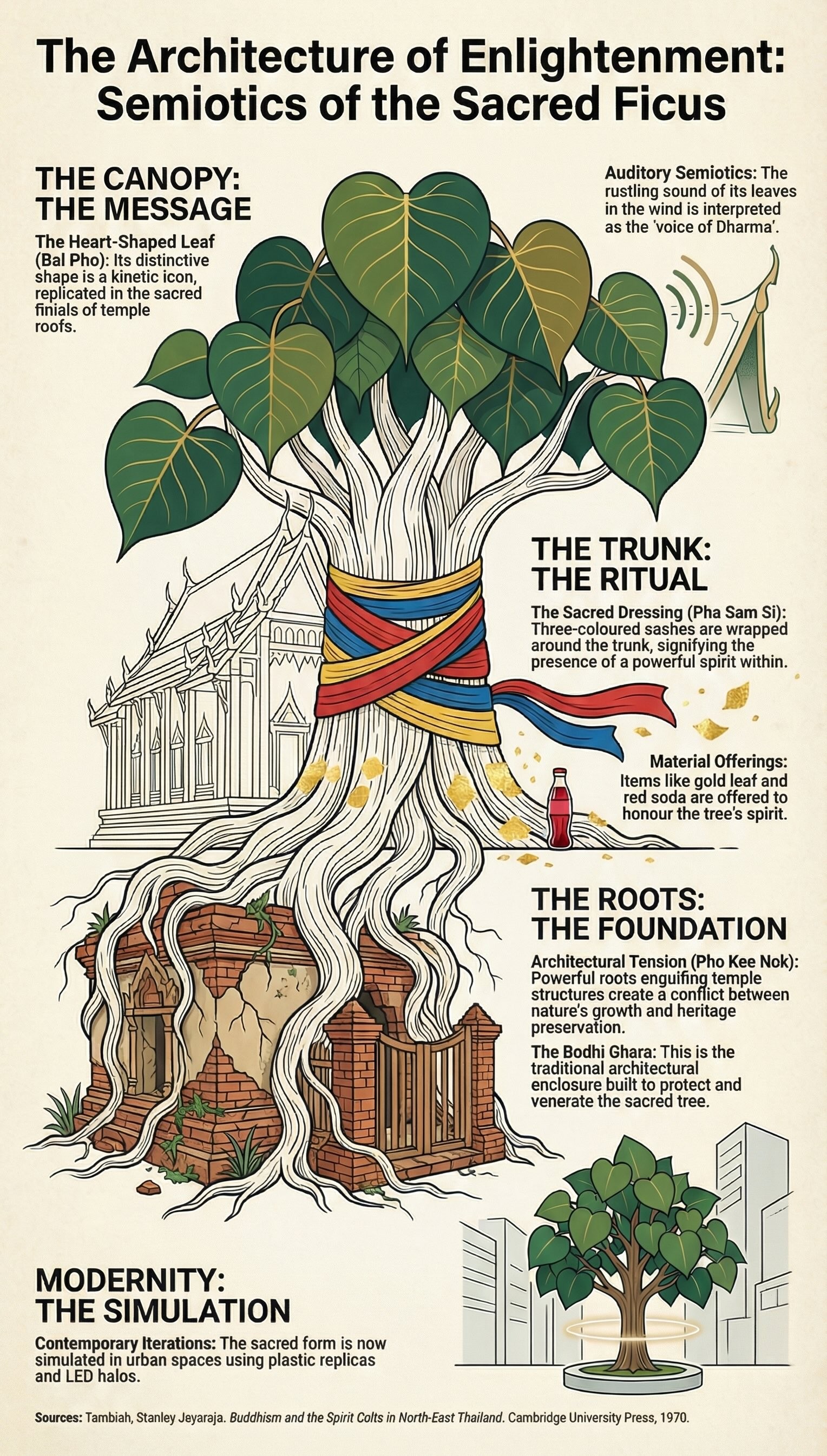


Infographic titled 'The Architecture of Enlightenment' explaining the semiotics of the Sacred Ficus, including the symbolism of heart-shaped leaves, trunk rituals like Pha Sam Si wrappings, and the interaction of roots with temple architecture.

5. Conclusion: The Living Monument


The Bodhi tree in Thailand is not a static symbol but a dynamic, living monument. Unlike a stone temple, which passively endures, the tree actively participates in the culture it inhabits. It grows, adapts, and creates architectural conflict. It inspires ancient rituals of adornment and modern rituals of conservation. It is a powerful testament to a faith that is not simply preserved in stone but is constantly being negotiated between humanity, the built environment, and the persistent, sacred power of the natural world.


References / Further Reading
----
  • Darlington, Susan M.  The Ordination of a Tree: The Thai Buddhist Environmental Movement . State University of New York Press, 2012.
  • Tambiah, Stanley Jeyaraja.  Buddhism and the Spirit Cults in North-East Thailand . Cambridge University Press, 1970.

POST
POST
POST

brand

© 2021 - 2025 | Asian Heritage Silva : All rights reserved. a Website Created by matinee.icu

Towering Bodhi tree at Wat Suan Dok supported by traditional Lanna-style wooden crutches known as Mai Kham Sali under a blue sky.

Bodhi Tree Thailand: Spiritual Meaning, History & The 'Vegetal Saint'.

January 1, 2026

In Thailand, the Bodhi tree, Ficus religiosa , is far more than a botanical specimen. It is a living palimpsest, a surface where ancient animist reverence, Buddhist doctrine, and modern environmentalism are written one over the other, with traces of each layer remaining visible. To the casual observer, it is a source of shade in a temple courtyard; to the semiotician, it is a dense visual text. This article proposes to "read" the sacred tree as a complex sign system, decoding the layers of meaning embedded in its various elements, from the enlightened canopy to its architecturally disruptive roots.

Explore the Blog Post

Visual Semiotics

A semiotic analysis of sacred trees in Thailand. We decode the Bodhi tree's role in Thai Buddhist iconography and explore the meaning of Ficus religiosa.

January 1, 2026

A. Di Paolo

by Alma Lawson

In Thailand, the Bodhi tree, Ficus religiosa , is far more than a botanical specimen. It is a living palimpsest, a surface where ancient animist reverence, Buddhist doctrine, and modern environmentalism are written one over the other, with traces of each layer remaining visible. To the casual observer, it is a source of shade in a temple courtyard; to the semiotician, it is a dense visual text. This article proposes to "read" the sacred tree as a complex sign system, decoding the layers of meaning embedded in its various elements, from the enlightened canopy to its architecturally disruptive roots.

1. The Canopy: The Locus of Enlightenment


The canopy constitutes the opening chapter of the Bodhi tree's sacred text, a narrative of pure enlightenment that exists above the fray of worldly interaction. Its leaves and the shelter it provides are not merely physical attributes but carriers of profound religious significance.


1.1. The Leaf as Sacred Imprint

The Bodhi tree is, first and foremost, a living memoir of the moment Siddhartha Gautama achieved enlightenment and became the Buddha. For Buddhists, the tree is a direct, physical reminder of the place where he sat, meditated under its canopy, and reached nirvana.

The tree itself becomes an important component in the story of enlightenment, a silent witness and facilitator. It stands as a tangible link to the foundational event of the faith, transforming every Bodhi tree in every temple into a symbol of that ultimate spiritual potential.


1.2. A Shelter for the Mind

The broad canopy of the Bodhi tree provides a physical space conducive to spiritual practice, echoing the Buddha's own meditative act. In Thai temples, monks utilize the shade and privacy offered by these large trees for both walking meditation ( Jong-klom ) and sitting meditation.

This practice turns the temple garden into a microcosm of the forest, directly connecting the urban temple to the ascetic traditions of wandering Forest Monks ( Phra Tudong ), who sought out the solitude of nature to advance their spiritual discipline. The tree's canopy thus creates a sacred micro-environment, a natural hall for contemplation within the temple grounds.

Large, spreading tree with a massive exposed root system wrapped in colorful sash cloths, located near the historic Chiang Mai Gate and city moat.
The Supported Giant at Wat Si Koet Within the courtyard of Wat Si Koet, the heavy branches of this sacred Bodhi tree are upheld by metal supports. These structures protect the ageing giant while symbolising the spiritual act of sustaining Buddhism itself.
Photo by
A. Di Paolo

2.1. The Axis Adorned


As the central, accessible column of the sacred tree, the trunk becomes a focal point for lay ritual. It is an axis where deep-rooted local beliefs in tree spirits ( Rukkha Thewada ) and other animist traditions merge with formal Buddhist practice. This ritual layering perfectly illustrates the syncretic genius of Thai popular religion, which rarely erases pre-Buddhist beliefs but instead subsumes them into a broader Buddhist cosmology.

This animist syncretism is a hallmark of Thai popular religion, where the adornment of the trunk becomes a visible manifestation of cultural blending.


2.2. Dressing the Sacred: Acts of Devotion

Laypeople engage in specific rituals centered on the tree's trunk, each a material expression of faith and a means of making merit. A semiotic reading of these acts reveals a profound impulse to transform the natural object into a social being.


  • Coloured Sashes:  Temple visitors frequently tie pieces of coloured fabric or scarves around the trunks of Bodhi trees. This is more than decoration; it is an act of "dressing" the tree, anthropomorphizing it into a figure worthy of clothing. This gesture elevates the tree from mere flora to a respected social and spiritual actor, visually marked for reverence.
  • Support Sticks (Mai Kham):  Another common practice involves placing long wooden sticks against a Bodhi tree. This act functions as a form of sympathetic magic. By physically "supporting" the sacred tree—a symbol of the Buddha's achievement—the devotee hopes to receive metaphysical support and prosperity in their own life. The physical gesture is a prayer for reciprocal spiritual reinforcement.
Wide-angle view of an ancient Bodhi tree providing shade over the white walls and golden architecture of Wat Si Koet in Chiang Mai Old City.

The Supported Giant at Wat Si Koet Within the courtyard of Wat Si Koet, the heavy branches of this sacred Bodhi tree are upheld by metal supports. These structures protect the ageing giant while symbolising the spiritual act of sustaining Buddhism itself.

Photo by
A. Di Paolo

3. The Roots: An Architectural Conflict


Reading deeper, we find in the tree's root system a narrative of conflict, not just between organic growth and static architecture, but between two competing worldviews coexisting within the temple walls.


3.1. Unyielding Growth, Unstable Ground

The sacred status of the Bodhi tree creates a paradox: a venerated object with destructive potential. This physical conflict is the surface manifestation of a deeper philosophical tension. In the doctrinal,  nibbānic  Buddhist view, a tree is merely  rūpa —physical form, composed of elements and possessing no inherent sacredness.
Yet in the animist folk belief that informs popular practice, the tree is an active agent, home to a powerful spirit. The architectural conflict is thus a clash between the tree as inert matter and the tree as a living entity. Its powerful root systems destroying pavement, threatening foundations, and damaging the ornate facades of temple buildings are physical evidence of this ideological struggle.

The famous image of a Buddha head entirely engulfed by the roots of a Bodhi tree is the ultimate visual metaphor for this tension, where the animist power of sacred nature reclaims and consumes a doctrinal artifact.


3.2. The Saint on the Structure

This conflict reaches its apex when Bodhi trees begin to grow in what is considered the "wrong place." According to one monk, even a sacred Bodhi tree must be in the "right place" to be truly auspicious, ideally on the main cosmological axis of the temple. When a sapling sprouts atop a crematorium or outgrows a building, it is not just an inconvenience; it is a cosmological anomaly. A symbol of enlightenment and life emerges unsolicited in a place associated with death and transition, disrupting the sacred geography of the temple.

This phenomenon, a dramatic clash of Bodhi Tree architecture and nature, creates difficult decisions for authorities, who must weigh spiritual significance against practical necessity when sacred trees are removed for new construction or parking spaces.

Expansive sacred Bodhi tree with heavy branches supported by metal poles within the courtyard of Wat Si Koet temple in Chiang Mai, Thailand.
Sacred Roots and Spirits Cascading aerial roots form a natural tapestry on this majestic Ficus in Chiang Mai. Adorned with colourful sacred ribbons, the tree is revered as a residence for guardian spirits, protecting it from urban encroachment.
Photo by
A. Di Paolo

4. A Modern Paradox: Conservation and Contradiction


The final chapter of this text is still being written, as contemporary Thai society grapples with the role of sacred trees, producing evolving and sometimes contradictory approaches to their preservation.


4.1. The Ordained Forest

In a modern reinterpretation of Buddhist principles, a group of "Environmental monks" ( Phra nak anurak ) has developed the ritual of "ordaining a tree." By wrapping a tree in the saffron robes of a monk, they declare it sacred, extending a monk's protected status to the natural world. This innovative practice is a conservation strategy designed to protect local forests from logging. It leverages the cultural authority of the monkhood to address modern ecological threats, demonstrating a form of engaged Buddhism that directly confronts environmental issues.


4.2. The Monk's Dilemma: A Vow of Non-Interference

A significant paradox is rooted in the  Vinaya , the monastic code of conduct. The rules explicitly prohibit monks from cutting or damaging living plants. This precept is not simply an abstract reverence for life; it is a direct institutionalization of the same animist folk beliefs that motivate lay rituals.


The rule was established after laity expressed dismay at monks cutting trees, which they believed to be living things inhabited by tree spirits ( Rukkha Thewada ).


This creates a powerful feedback loop between lay belief and monastic law, but it poses a modern dilemma. In urban temples, this rule can prevent monks from performing necessary horticultural maintenance like pruning. Consequently, many heritage trees suffer from poor health and become safety risks, victims of a precept intended to protect them.


4.3. From Sacred Grove to Virtual Space

Modernization and digital technology are reshaping how the laity interacts with Buddhism. The rise of "Virtual Buddhism," where Dhamma teachings are shared through online platforms, has made the religion more accessible than ever.


This shift, however, raises questions about the future of physical religious spaces. When followers can connect with the faith without being physically present, what becomes the role of the traditional temple garden and its ancient, sacred trees?


Infographic titled 'The Architecture of Enlightenment' explaining the semiotics of the Sacred Ficus, including the symbolism of heart-shaped leaves, trunk rituals like Pha Sam Si wrappings, and the interaction of roots with temple architecture.

5. Conclusion: The Living Monument


The Bodhi tree in Thailand is not a static symbol but a dynamic, living monument. Unlike a stone temple, which passively endures, the tree actively participates in the culture it inhabits. It grows, adapts, and creates architectural conflict. It inspires ancient rituals of adornment and modern rituals of conservation. It is a powerful testament to a faith that is not simply preserved in stone but is constantly being negotiated between humanity, the built environment, and the persistent, sacred power of the natural world.


References / Further Reading
----
  • Darlington, Susan M.  The Ordination of a Tree: The Thai Buddhist Environmental Movement . State University of New York Press, 2012.
  • Tambiah, Stanley Jeyaraja.  Buddhism and the Spirit Cults in North-East Thailand . Cambridge University Press, 1970.


POST

POST

POST

Donate Today

Support the costs of the project to keep it alive

DONATE

Explore More

About The Map Project

Learn Map Builder

Help Through GFW

Privacy Policy

About

Our Vision

Contact Us

CONNECT

Facebook Icn
bluesky icon
mastodon icon
brand

© 2021 - 2025 | Asian Heritage Silva : All rights reserved. a Website Created by matinee.icu

Towering Bodhi tree at Wat Suan Dok supported by traditional Lanna-style wooden crutches known as Mai Kham Sali under a blue sky.

Bodhi Tree Thailand: Spiritual Meaning, History & The 'Vegetal Saint'.

January 1, 2026

In Thailand, the Bodhi tree, Ficus religiosa , is far more than a botanical specimen. It is a living palimpsest, a surface where ancient animist reverence, Buddhist doctrine, and modern environmentalism are written one over the other, with traces of each layer remaining visible. To the casual observer, it is a source of shade in a temple courtyard; to the semiotician, it is a dense visual text. This article proposes to "read" the sacred tree as a complex sign system, decoding the layers of meaning embedded in its various elements, from the enlightened canopy to its architecturally disruptive roots.

Explore the Blog Post

Visual Semiotics

A semiotic analysis of sacred trees in Thailand. We decode the Bodhi tree's role in Thai Buddhist iconography and explore the meaning of Ficus religiosa.

A. Di Paolo

January 1, 2026

by Alma Lawson

In Thailand, the Bodhi tree, Ficus religiosa , is far more than a botanical specimen. It is a living palimpsest, a surface where ancient animist reverence, Buddhist doctrine, and modern environmentalism are written one over the other, with traces of each layer remaining visible. To the casual observer, it is a source of shade in a temple courtyard; to the semiotician, it is a dense visual text. This article proposes to "read" the sacred tree as a complex sign system, decoding the layers of meaning embedded in its various elements, from the enlightened canopy to its architecturally disruptive roots.

1. The Canopy: The Locus of Enlightenment


The canopy constitutes the opening chapter of the Bodhi tree's sacred text, a narrative of pure enlightenment that exists above the fray of worldly interaction. Its leaves and the shelter it provides are not merely physical attributes but carriers of profound religious significance.


1.1. The Leaf as Sacred Imprint

The Bodhi tree is, first and foremost, a living memoir of the moment Siddhartha Gautama achieved enlightenment and became the Buddha. For Buddhists, the tree is a direct, physical reminder of the place where he sat, meditated under its canopy, and reached nirvana.

The tree itself becomes an important component in the story of enlightenment, a silent witness and facilitator. It stands as a tangible link to the foundational event of the faith, transforming every Bodhi tree in every temple into a symbol of that ultimate spiritual potential.


1.2. A Shelter for the Mind

The broad canopy of the Bodhi tree provides a physical space conducive to spiritual practice, echoing the Buddha's own meditative act. In Thai temples, monks utilize the shade and privacy offered by these large trees for both walking meditation ( Jong-klom ) and sitting meditation.

This practice turns the temple garden into a microcosm of the forest, directly connecting the urban temple to the ascetic traditions of wandering Forest Monks ( Phra Tudong ), who sought out the solitude of nature to advance their spiritual discipline. The tree's canopy thus creates a sacred micro-environment, a natural hall for contemplation within the temple grounds.

Large, spreading tree with a massive exposed root system wrapped in colorful sash cloths, located near the historic Chiang Mai Gate and city moat.
The Supported Giant at Wat Si Koet Within the courtyard of Wat Si Koet, the heavy branches of this sacred Bodhi tree are upheld by metal supports. These structures protect the ageing giant while symbolising the spiritual act of sustaining Buddhism itself.
Photo by
A. Di Paolo

2.1. The Axis Adorned


As the central, accessible column of the sacred tree, the trunk becomes a focal point for lay ritual. It is an axis where deep-rooted local beliefs in tree spirits ( Rukkha Thewada ) and other animist traditions merge with formal Buddhist practice. This ritual layering perfectly illustrates the syncretic genius of Thai popular religion, which rarely erases pre-Buddhist beliefs but instead subsumes them into a broader Buddhist cosmology.

This animist syncretism is a hallmark of Thai popular religion, where the adornment of the trunk becomes a visible manifestation of cultural blending.


2.2. Dressing the Sacred: Acts of Devotion

Laypeople engage in specific rituals centered on the tree's trunk, each a material expression of faith and a means of making merit. A semiotic reading of these acts reveals a profound impulse to transform the natural object into a social being.


  • Coloured Sashes:  Temple visitors frequently tie pieces of coloured fabric or scarves around the trunks of Bodhi trees. This is more than decoration; it is an act of "dressing" the tree, anthropomorphizing it into a figure worthy of clothing. This gesture elevates the tree from mere flora to a respected social and spiritual actor, visually marked for reverence.
  • Support Sticks (Mai Kham):  Another common practice involves placing long wooden sticks against a Bodhi tree. This act functions as a form of sympathetic magic. By physically "supporting" the sacred tree—a symbol of the Buddha's achievement—the devotee hopes to receive metaphysical support and prosperity in their own life. The physical gesture is a prayer for reciprocal spiritual reinforcement.
Wide-angle view of an ancient Bodhi tree providing shade over the white walls and golden architecture of Wat Si Koet in Chiang Mai Old City.
The Supported Giant at Wat Si Koet Within the courtyard of Wat Si Koet, the heavy branches of this sacred Bodhi tree are upheld by metal supports. These structures protect the ageing giant while symbolising the spiritual act of sustaining Buddhism itself.
Photo by
A. Di Paolo

3. The Roots: An Architectural Conflict


Reading deeper, we find in the tree's root system a narrative of conflict, not just between organic growth and static architecture, but between two competing worldviews coexisting within the temple walls.


3.1. Unyielding Growth, Unstable Ground

The sacred status of the Bodhi tree creates a paradox: a venerated object with destructive potential. This physical conflict is the surface manifestation of a deeper philosophical tension. In the doctrinal,  nibbānic  Buddhist view, a tree is merely  rūpa —physical form, composed of elements and possessing no inherent sacredness.
Yet in the animist folk belief that informs popular practice, the tree is an active agent, home to a powerful spirit. The architectural conflict is thus a clash between the tree as inert matter and the tree as a living entity. Its powerful root systems destroying pavement, threatening foundations, and damaging the ornate facades of temple buildings are physical evidence of this ideological struggle.

The famous image of a Buddha head entirely engulfed by the roots of a Bodhi tree is the ultimate visual metaphor for this tension, where the animist power of sacred nature reclaims and consumes a doctrinal artifact.


3.2. The Saint on the Structure

This conflict reaches its apex when Bodhi trees begin to grow in what is considered the "wrong place." According to one monk, even a sacred Bodhi tree must be in the "right place" to be truly auspicious, ideally on the main cosmological axis of the temple. When a sapling sprouts atop a crematorium or outgrows a building, it is not just an inconvenience; it is a cosmological anomaly. A symbol of enlightenment and life emerges unsolicited in a place associated with death and transition, disrupting the sacred geography of the temple.

This phenomenon, a dramatic clash of Bodhi Tree architecture and nature, creates difficult decisions for authorities, who must weigh spiritual significance against practical necessity when sacred trees are removed for new construction or parking spaces.

Expansive sacred Bodhi tree with heavy branches supported by metal poles within the courtyard of Wat Si Koet temple in Chiang Mai, Thailand.
Sacred Roots and Spirits Cascading aerial roots form a natural tapestry on this majestic Ficus in Chiang Mai. Adorned with colourful sacred ribbons, the tree is revered as a residence for guardian spirits, protecting it from urban encroachment.
Photo by
A. Di Paolo

4. A Modern Paradox: Conservation and Contradiction


The final chapter of this text is still being written, as contemporary Thai society grapples with the role of sacred trees, producing evolving and sometimes contradictory approaches to their preservation.


4.1. The Ordained Forest

In a modern reinterpretation of Buddhist principles, a group of "Environmental monks" ( Phra nak anurak ) has developed the ritual of "ordaining a tree." By wrapping a tree in the saffron robes of a monk, they declare it sacred, extending a monk's protected status to the natural world. This innovative practice is a conservation strategy designed to protect local forests from logging. It leverages the cultural authority of the monkhood to address modern ecological threats, demonstrating a form of engaged Buddhism that directly confronts environmental issues.


4.2. The Monk's Dilemma: A Vow of Non-Interference

A significant paradox is rooted in the  Vinaya , the monastic code of conduct. The rules explicitly prohibit monks from cutting or damaging living plants. This precept is not simply an abstract reverence for life; it is a direct institutionalization of the same animist folk beliefs that motivate lay rituals.


The rule was established after laity expressed dismay at monks cutting trees, which they believed to be living things inhabited by tree spirits ( Rukkha Thewada ).


This creates a powerful feedback loop between lay belief and monastic law, but it poses a modern dilemma. In urban temples, this rule can prevent monks from performing necessary horticultural maintenance like pruning. Consequently, many heritage trees suffer from poor health and become safety risks, victims of a precept intended to protect them.


4.3. From Sacred Grove to Virtual Space

Modernization and digital technology are reshaping how the laity interacts with Buddhism. The rise of "Virtual Buddhism," where Dhamma teachings are shared through online platforms, has made the religion more accessible than ever.


This shift, however, raises questions about the future of physical religious spaces. When followers can connect with the faith without being physically present, what becomes the role of the traditional temple garden and its ancient, sacred trees?


Infographic titled 'The Architecture of Enlightenment' explaining the semiotics of the Sacred Ficus, including the symbolism of heart-shaped leaves, trunk rituals like Pha Sam Si wrappings, and the interaction of roots with temple architecture.

5. Conclusion: The Living Monument


The Bodhi tree in Thailand is not a static symbol but a dynamic, living monument. Unlike a stone temple, which passively endures, the tree actively participates in the culture it inhabits. It grows, adapts, and creates architectural conflict. It inspires ancient rituals of adornment and modern rituals of conservation. It is a powerful testament to a faith that is not simply preserved in stone but is constantly being negotiated between humanity, the built environment, and the persistent, sacred power of the natural world.


References / Further Reading
----
  • Darlington, Susan M.  The Ordination of a Tree: The Thai Buddhist Environmental Movement . State University of New York Press, 2012.
  • Tambiah, Stanley Jeyaraja.  Buddhism and the Spirit Cults in North-East Thailand . Cambridge University Press, 1970.


POST

POST

POST

brand

© 2021 - 2025 | Asian Heritage Silva : All rights reserved. | A Website Created by matinee.icu