To read the news about our planet is to live with a persistent, low-grade anxiety. The scale of the crisis feels immense, and the proposed solutions often seem profoundly disconnected from our daily lives. On one hand, we hear of vast, top-down government policies and international accords that feel abstract and distant. On the other, we are encouraged to take small, individual actions that, while important, can feel painfully inadequate. We are caught between systems too big to influence and actions too small to feel like they matter. But what if some of the most powerful and surprising environmental wisdom doesn't come from modern science labs or international conferences? What if it lies dormant in ancient traditions, spiritual practices, and the lived experience of communities who have maintained a deep, functional, and sacred relationship with their land for centuries? These are not sentimental relics of a bygone era, but sophisticated, resilient strategies for living within the limits of a finite world. This article explores five counter-intuitive truths drawn from the fields, forests, and spiritual centers of Southeast Asia. They challenge our core assumptions about what it means to protect the natural world, offering lessons that are at once ancient and urgently contemporary.
Sacred Rituals
The Living Spiritual Sanctuary of Southeast Asian Landscapes

Editorial Team
December 15, 2025
1. Sometimes, 'Killing the Land' is How You Save the Community.
In the forests of West Kalimantan, Indonesia, the Kantu’ people practice a dual agricultural system, cultivating swidden (slash-and-burn) rice for subsistence while tapping rubber trees for the global market. The most startling part of this system is their terminology. Land planted with rubber is called tanah mati —"dead land." To an outsider, this sounds like a condemnation. For the Kantu’, however, it reveals a profoundly different worldview.
To understand why rubber land is "dead," one must first understand what makes their swidden land "alive." For the Kantu’, the life of the land is defined by its participation in a dense web of social and spiritual exchange. The bounty of the rice fields is part of a moral economy that includes reciprocal obligations between households, who share labor, and between the community and the spirits of the forest, who grant fertility in exchange for respect and offerings. Rubber cultivation operates entirely outside this system. It is a purely transactional, individualistic pursuit, its profits tied to a distant market with no reciprocal duties to the community or the cosmos. It is conceptually "dead" because it does not participate in the cycles of exchange that give the land, and the community, its life.
Yet this tanah mati is precisely what allows their "alive" land to thrive. The cash from rubber provides a vital economic buffer against market shocks or crop failures, insulating their food security from global volatility. This type of resilient, small-scale system has a proven history of economic significance in the broader region.
"...smallholder rubber production played a significant role in Malaysia’s entrance into the twentieth-century global economy."
The Kantu’ model reveals a logic that transcends our binary thinking of "good" subsistence versus "bad" cash-cropping. It shows that for some, the vitality of a landscape is measured not in yields alone, but in the richness of its relationships.
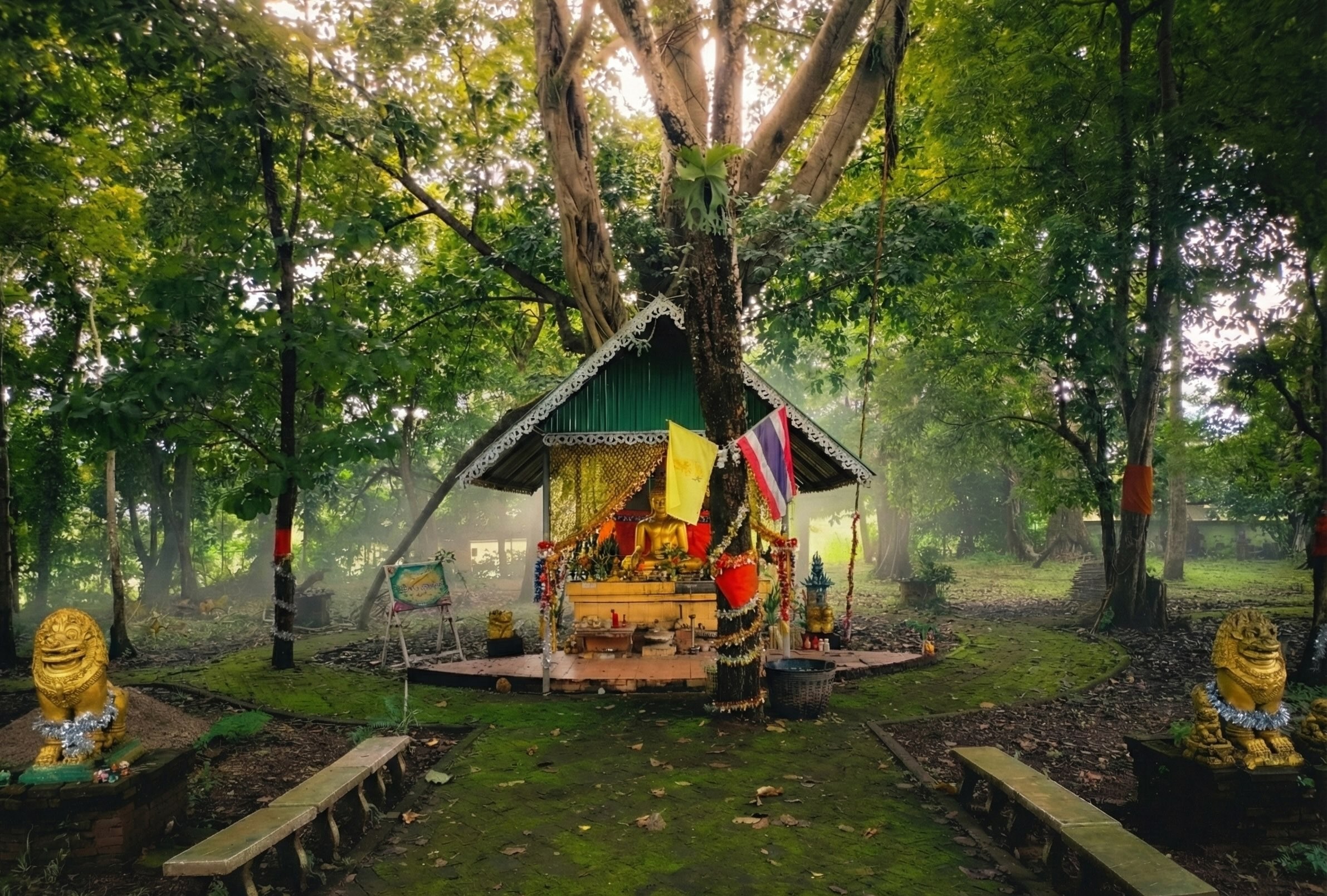
Guardians of the Green A small forest shrine features a golden Buddha guarded by mythical Singha lions. This synergy of Buddhist iconography and local animist spirit worship creates a powerful moral boundary that protects the surrounding forest from exploitation.
Photo by
Editorial Team
2. To Protect a Forest, You Must Ordain It
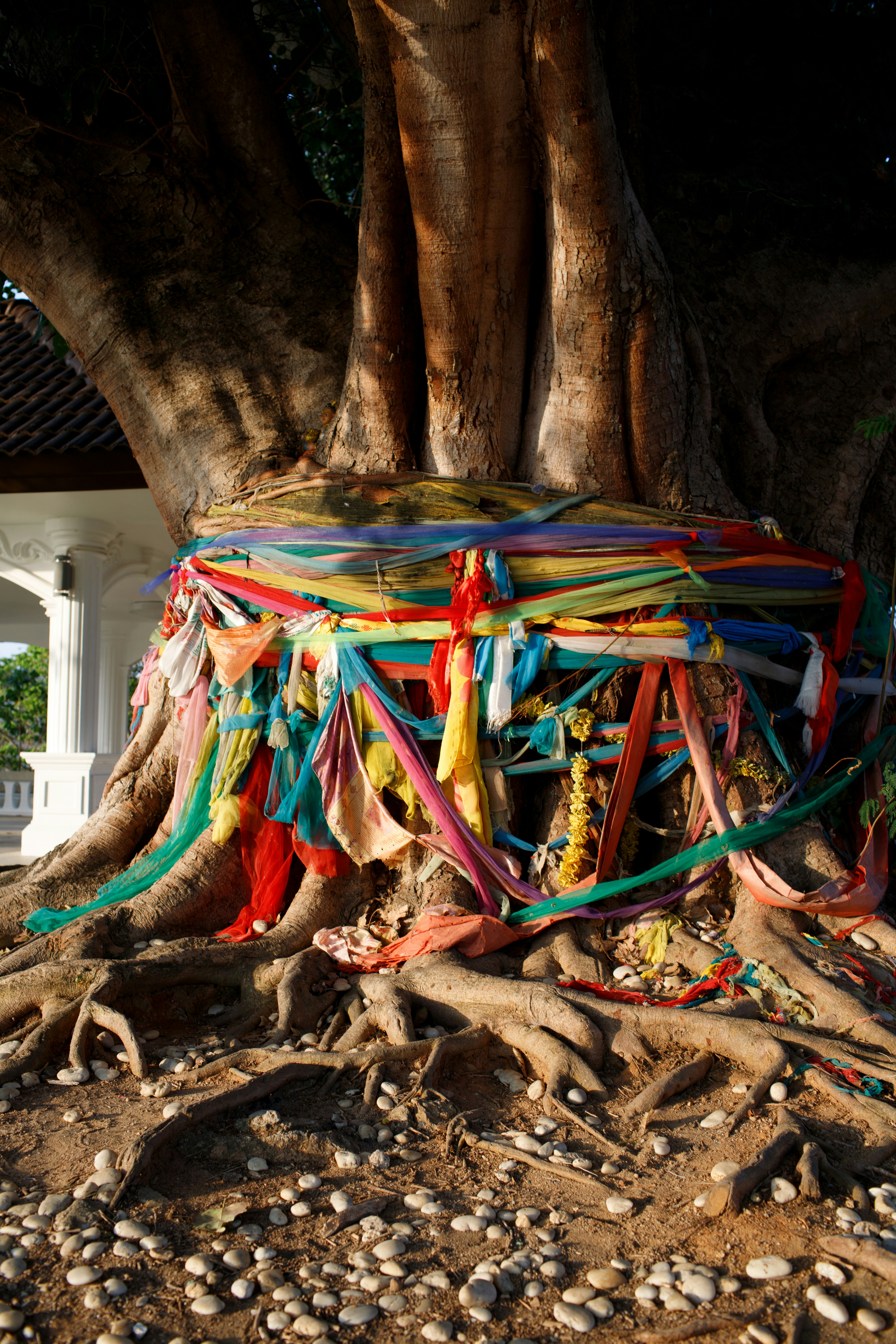
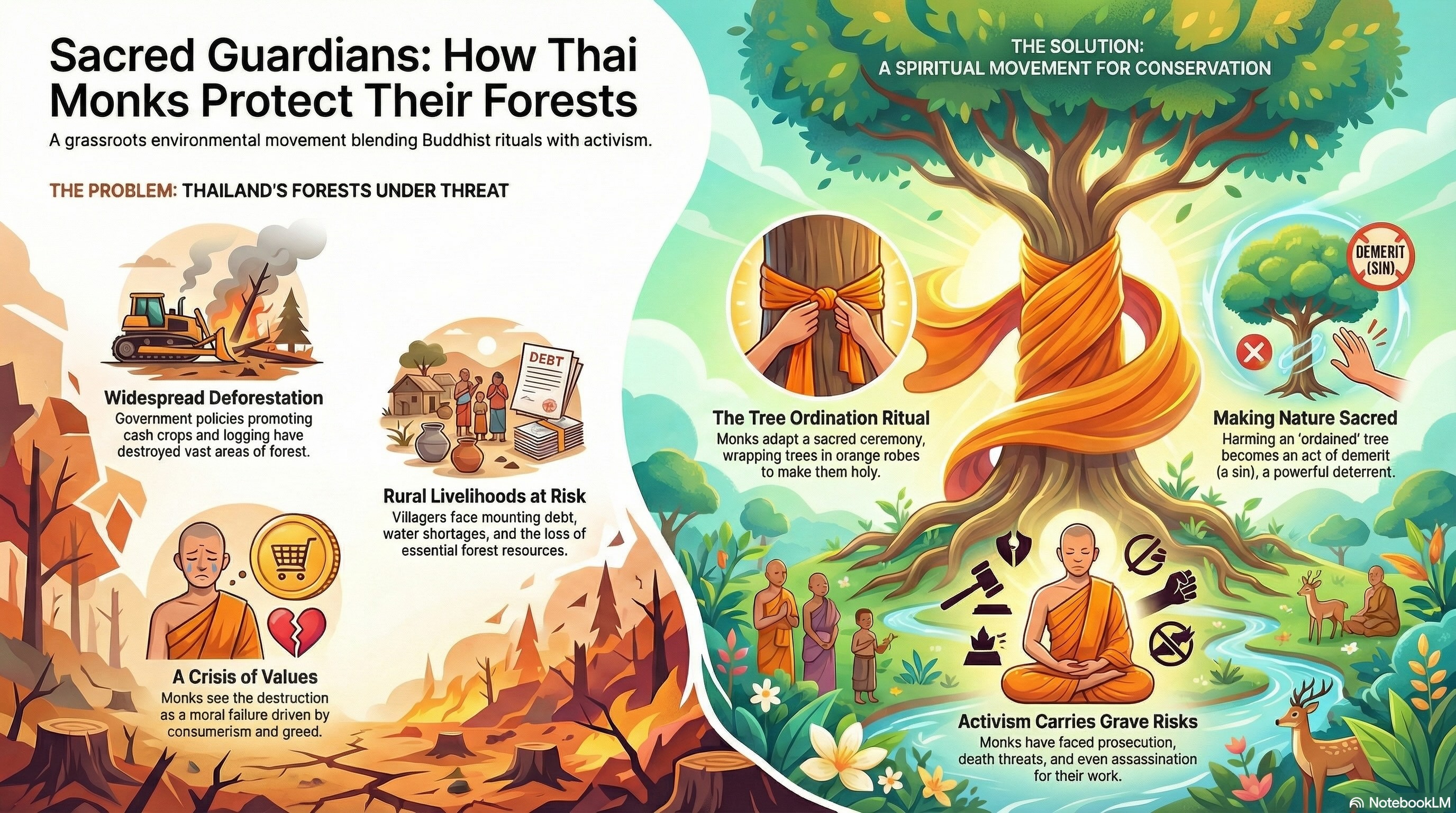
In Thailand, a powerful environmental movement spearheaded by Buddhist monks has found a stunningly effective way to protect forests: they ordain them. In a ceremony rich with spiritual significance, a tree's trunk is wrapped in the saffron robes of a Buddhist monk. This is not a literal belief that the tree has become a monk, but a profound ritual metaphor. The act recategorizes the forest in the eyes of the community, transforming it from a mere collection of resources into a sacred space. To cut down an ordained tree becomes as morally unthinkable as harming a monk.
This approach is more than just a sacred rite; it is a brilliant piece of socio-political theater. Learning from past conflicts where activists were arrested, monks like Phrakhru Pitak began inviting government and military officials to preside over the ceremonies. Their participation provides a public display of support, co-opting potential state opposition and making them partners in the forest’s protection. The strategy is rooted in a simple philosophy: to solve contemporary problems, you must use ideas and rituals that villagers already accept and are familiar with. A plaque nailed to an ordained tree often carries a slogan with powerful, overlapping meanings:
“tham lai pa khue tham lai chat”
(To destroy the forest is to destroy the nation/life/rebirth.)
The key word, chat, means not only "nation" but also "life" or "rebirth." The message thus weaves together the fate of the nation's political body, the ecosystem's living body, and the individual's spiritual body into a single, sacred whole. It transforms conservation from a cold, legalistic process into a vibrant, community-driven act of devotion.
Guardians of the Green A small forest shrine features a golden Buddha guarded by mythical Singha lions. This synergy of Buddhist iconography and local animist spirit worship creates a powerful moral boundary that protects the surrounding forest from exploitation.
Photo by
Editorial Team
3. The Best Park Rangers are a Buddha and a Fierce Spirit
The genius of the Thai environmental monks lies not only in adapting Buddhist rituals but in their savvy integration of pre-existing local animist beliefs. Rather than trying to erase older traditions in favor of a "pure" Buddhism, they braided them together to create a more potent form of protection.
When consecrating a new community forest, monks would often place a Buddha image under a great tree, declaring it the "chief" of the forest. But right beside it, they would help villagers erect a shrine for the local guardian spirit. This fusion created a powerful psychological deterrent against illegal logging, one explained by a beautifully direct strategic assessment:
"This led to the saying that “the good Buddha and the fierce spirits help each other take care of the forest.” This means that the Buddha earns the villagers’ respect. But they fear the spirits. if you have both, respect and fear, the villagers won’t dare cut the trees."
This approach is a masterclass in cultural synergy. It creates a uniquely powerful moral and psychological deterrent by leveraging both the aspirational pull of respect and the prohibitory power of fear—a combination that legal regulations alone cannot replicate. It’s a profound lesson that successful conservation often comes not from imposing a single ideology, but from respectfully weaving together the different belief systems that give meaning to a community's world.
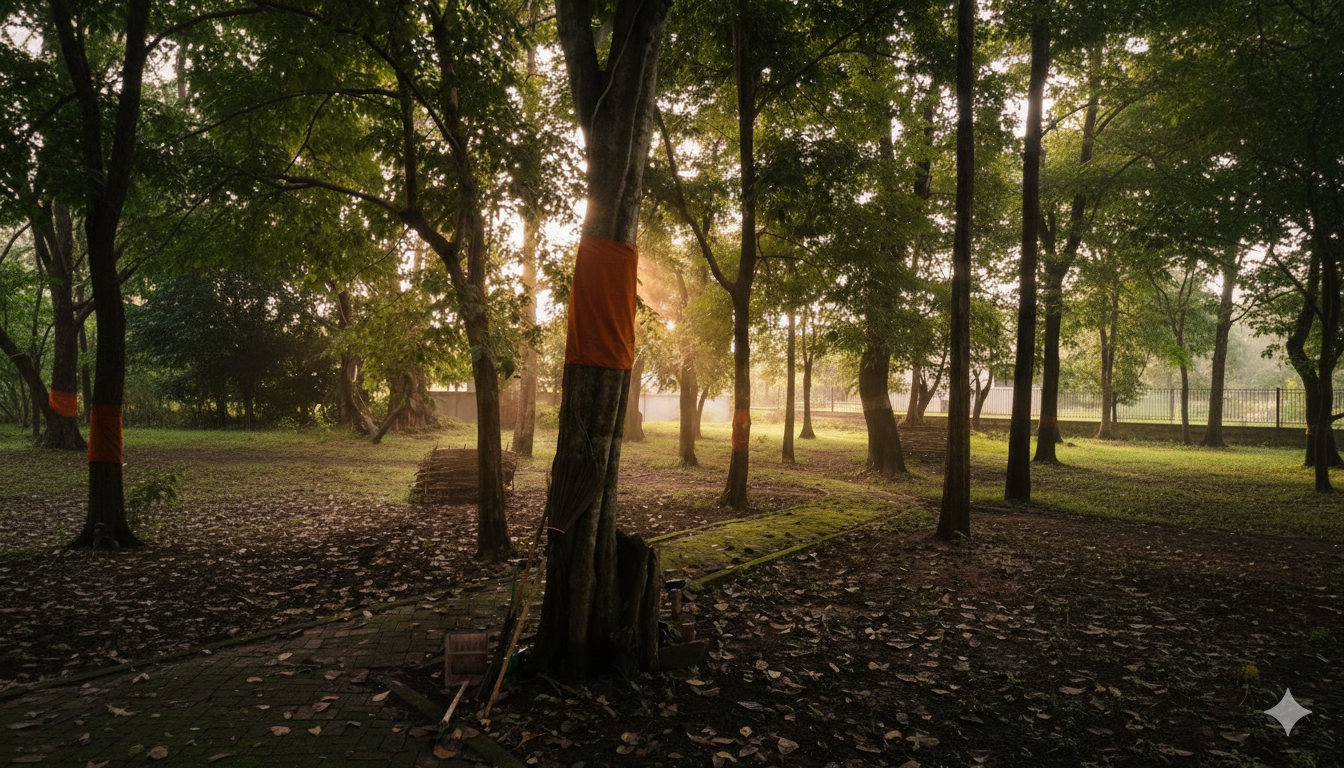
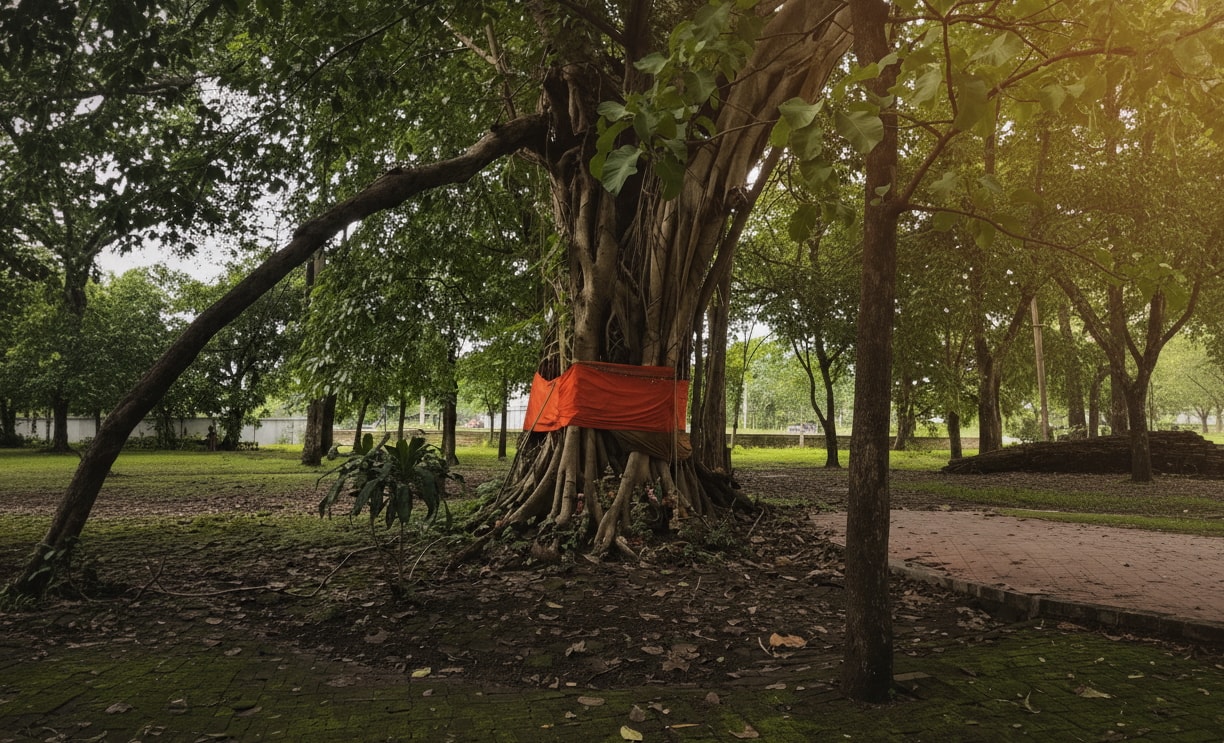
The Ordained Sentinel in Pai Bathed in the soft light of a misty sunrise in Pai, a tree wrapped in saffron robes stands as a silent guardian. This ordination ritual transforms the forest into sacred ground, making deforestation a spiritual taboo.
Photo by
Editorial Team
4. Tradition is a Weapon, Not a Museum Piece
In Indonesia, adat, or customary law, is often invoked as an ancient, unbroken line of indigenous wisdom for managing natural resources. But the history of the term reveals something far more politically charged. Adat is not a static artifact; it is a dynamic weapon that has been wielded by all sides in environmental conflicts.
In the 1920s, the colonial Dutch government actively revived and reshaped traditional adat as a tool to suppress the rural population and maintain control. A lifetime later, the concept was mobilized for a radically different purpose. In the 1990s, non-governmental organizations (NGOs) began reviving adat as a powerful discourse to empower local communities, helping them legitimize their land claims against the state and corporations.
But the conflict is not just external. "Tradition" is also a contested space within communities. During its revival, adat leaders sometimes used the discourse to enhance their own waning influence, demonstrating that different local actors can deploy tradition to serve their own, sometimes competing, interests. It teaches us that tradition is not a static inheritance to be preserved, but a living language of power, constantly re-spoken to define the present.
5. Our 'Progress' is a Joke Our Ancestors Would Laugh At
The renowned Thai Buddhist monk Buddhadāsa Bhikkhu offered a razor-sharp critique of modern development, arguing that it is a profound spiritual regression. He observed that as "forest people developed...selfishness increased in line with material development."
What we celebrate as progress, he saw as a deepening sickness.
He proposed a powerful thought experiment: what if our forest-dwelling ancestors could see us now? They would witness a world plagued by pollution, addictive drugs, soaring rates of mental illness, and ever-expanding prisons and militaries. They wouldn't be impressed by our technology. According to Buddhadāsa, they would be "laughing at the ridiculous condition in which we find ourselves."
For Buddhadāsa, this condition is a direct symptom of taṇhā. This is not just any desire, but a specifically foolish and ignorant craving for more. This insatiable, delusional wanting is the root cause of both our personal suffering (dukkha) and the planetary suffering manifest in environmental destruction. His spiritual diagnosis reframes the environmental crisis entirely. It is not merely a problem of carbon or policy, but a profound symptom of a spiritual sickness rooted in materialism and a fundamental misunderstanding of what brings true well-being.
Conclusion: Listening for a Deeper Wisdom
These five truths, drawn from the living traditions of Southeast Asia, share a common thread. They reveal that the most enduring environmental solutions are often deeply local, culturally specific, and spiritually grounded.
They emerge from a worldview where nature is not an external resource to be managed, but a sacred relative, an ancestral heritage, and a source of profound spiritual truth. These strategies are not easily scaled or turned into universal policy templates, and that is precisely their strength. They work because they are woven into the very fabric of a community's identity and beliefs.
These examples challenge us to look beyond the dominant narratives of progress and scientific management that have so often failed us. They invite us to become anthropologists of our own predicament, to question our assumptions and listen for a different kind of wisdom. As we face an uncertain future, what essential wisdom about living on this planet have we already forgotten, and how can we begin to listen for it again?
POST
POST
POST

