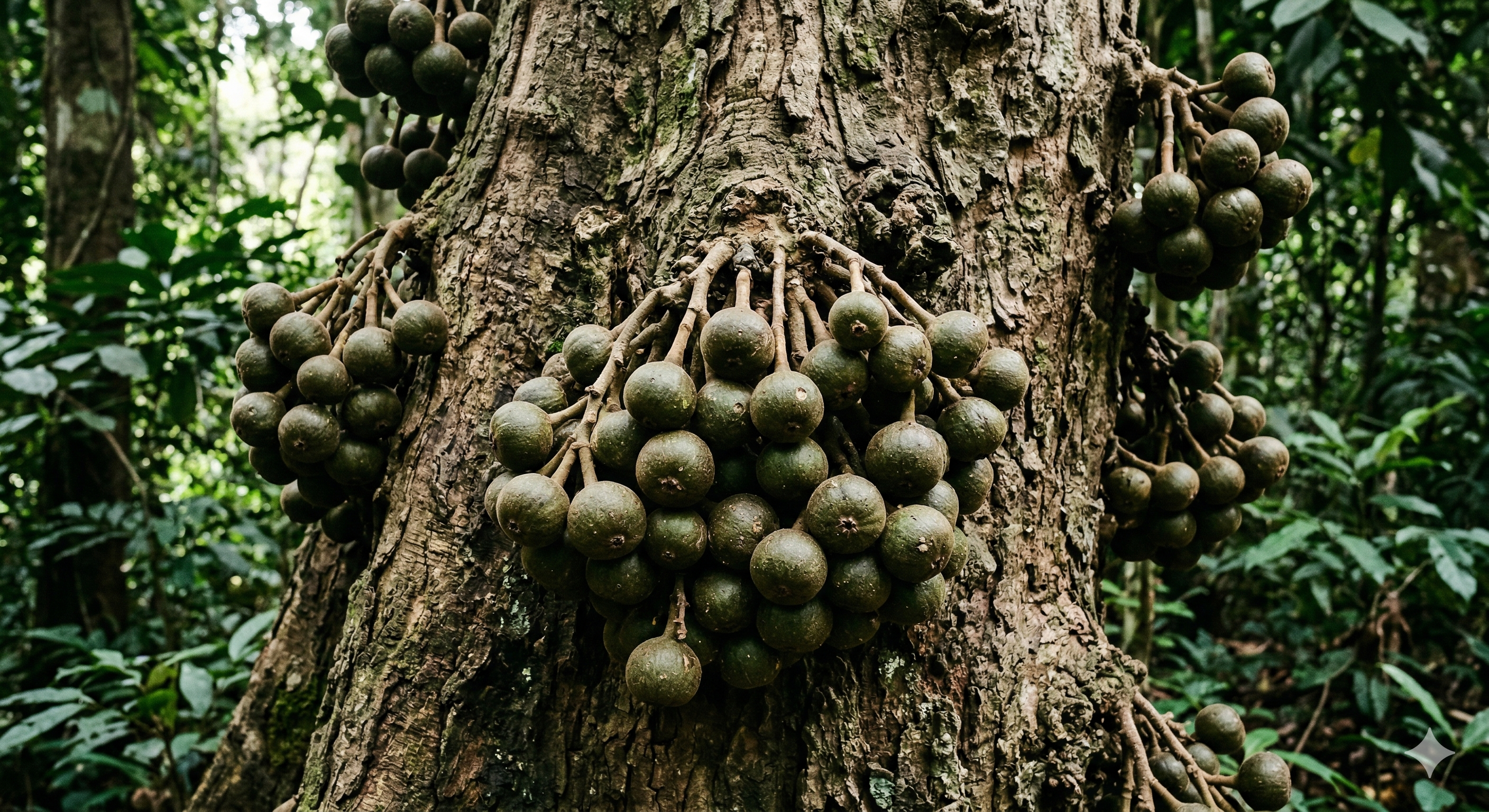
A close-up photograph of the massive, rough, textured bark of a large Ficus racemosa, or cluster fig tree, trunk within a lush, green rainforest environment. Numerous dense, pendant clusters of small, round, green, grape-like fruits (figs/syconia) hang directly from the thick, gnarled main trunk, a classic example of cauliflory. The forest background is blurred, emphasizing the natural patterns of the bark and the abundant fruit clusters.

The Mythical Udumbara: Unveiling the Ficus racemosa in Southeast Asian Buddhist Cosmology

March 27, 2026

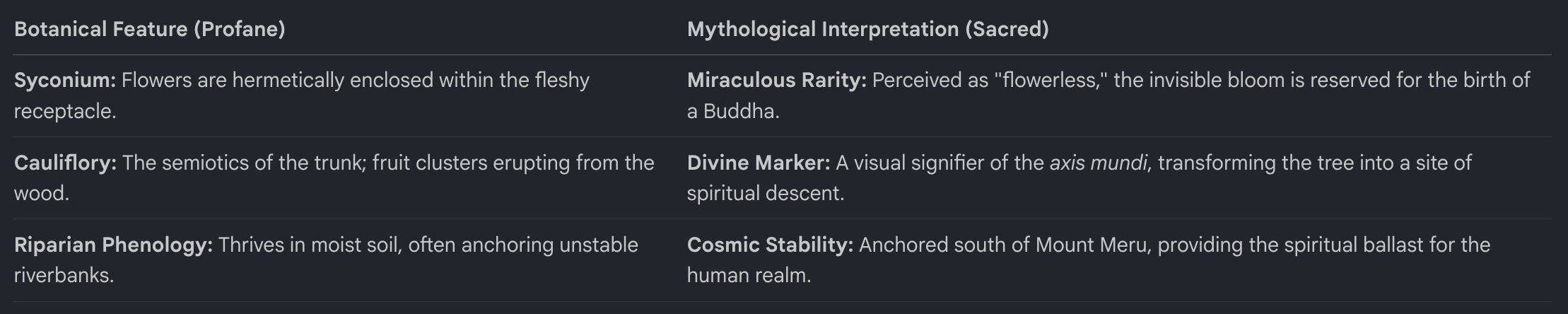
To the ethnobotanist, the Ficus racemosa presents an intriguing case of ontological divergence—a space where botanical phenology and high Buddhist myth intertwine. In the riparian landscapes of Southeast Asia, this tree is known for its "cauliflory," producing clusters of large, stalked fruit directly from its trunk. Yet, in the religious imagination, it is the Udumbara, a celestial harbinger said to bloom only once every 3,000 years to signal the arrival of a Cakravartin (Universal Sovereign) or a new Buddha. The perceived "miracle" of its flowerless state is rooted in the biological reality of the Ficus genus: its inflorescences are entirely enclosed within the syconium, a fleshy receptacle that the profane eye mistakes for fruit. This natural concealment transforms a biological quirk into an enduring symbol of the "hidden" Dhamma, where rarity is not a matter of occurrence, but of spiritual perception.

Explore the Blog Post

Sacred Rituals

The Mystery of the Invisible Flower

vector

Editorial Team

March 27, 2026

To the ethnobotanist, the Ficus racemosa presents an intriguing case of ontological divergence—a space where botanical phenology and high Buddhist myth intertwine. In the riparian landscapes of Southeast Asia, this tree is known for its "cauliflory," producing clusters of large, stalked fruit directly from its trunk. Yet, in the religious imagination, it is the Udumbara, a celestial harbinger said to bloom only once every 3,000 years to signal the arrival of a Cakravartin (Universal Sovereign) or a new Buddha. The perceived "miracle" of its flowerless state is rooted in the biological reality of the Ficus genus: its inflorescences are entirely enclosed within the syconium, a fleshy receptacle that the profane eye mistakes for fruit. This natural concealment transforms a biological quirk into an enduring symbol of the "hidden" Dhamma, where rarity is not a matter of occurrence, but of spiritual perception.

Section 1: Botany Meets Myth – The Axis of the World


The Ficus racemosa (identified as Dua in Thai and Revi in Khmer) is more than a riverine species; it is a structural pillar in the "Mythical Geography" of the Indianized world. Cosmologically, the Udumbara is situated to the south of Mount Meru, the axis mundi that anchors the Buddhist universe. Its physical presence, characterized by the peculiar growth of fruit along the trunk, serves as a bridge where natural peculiarities are elevated into sacred markers.
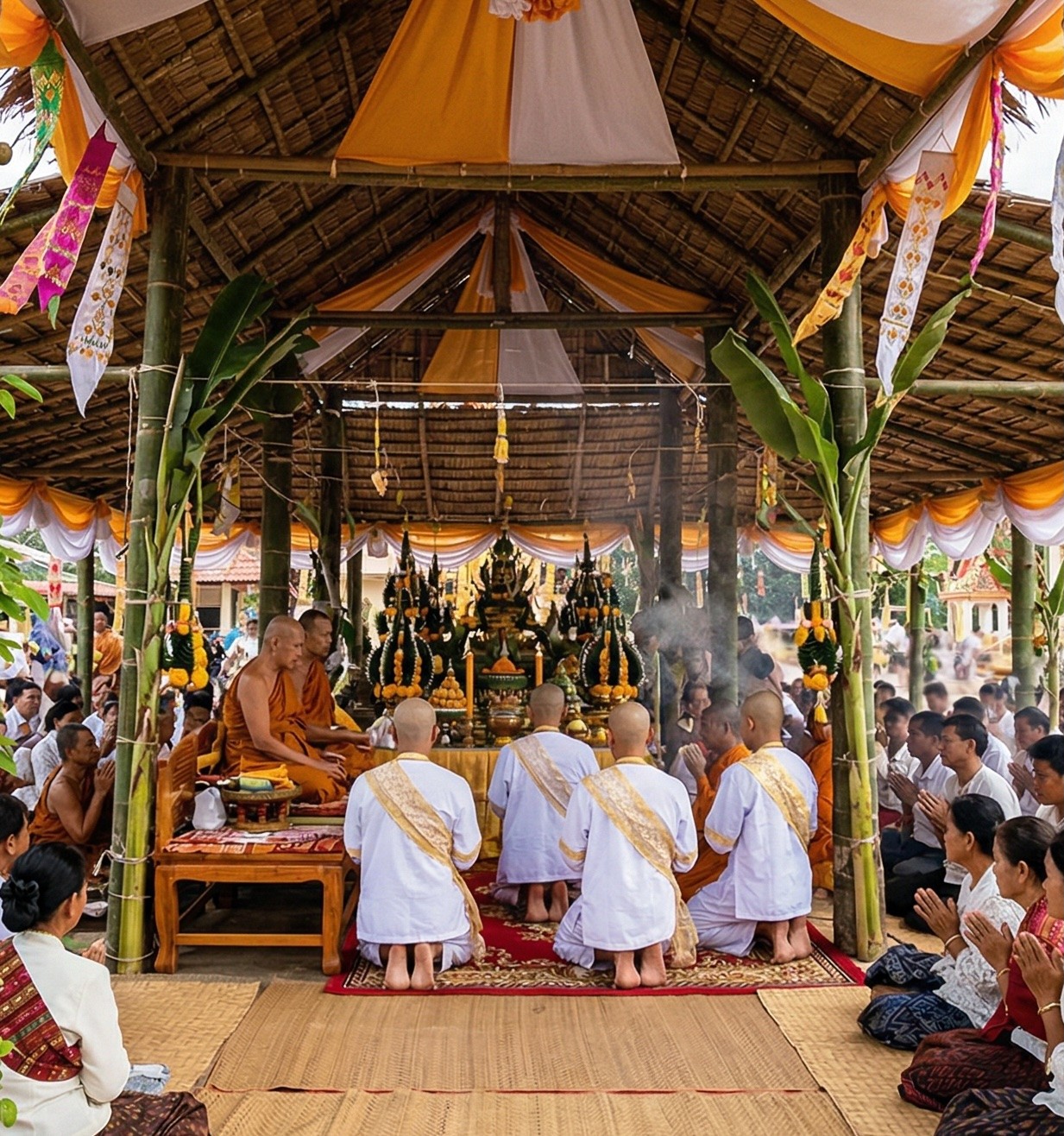


A wide-angle photograph taken inside a traditional, temporary bamboo and fabric ceremonial pavilion in Southeast Asia. Dozens of people are present. On a raised wooden platform under an ornate canopy, senior Buddhist monks in orange saffron robes sit, leading a ceremony. In front of them, initiates in white robes and gold sashes kneel on a patterned rug, looking towards a central altar with multi-tiered offerings. Around them, laypeople in traditional dress sit cross-legged on woven mats, with hands pressed together in prayer. The structure is decorated with colorful flags and textiles.
Stone testaments to devotion: a complex sandstone bas-relief from Sanchi Stupa. An intricate network of carved figures, gathered in a tiered composition, gazes towards a central sacred tree. The multitude of devotees, depicted in classical Indian style, offers an eternal scene of adoration and Buddhist narrative art.
Photo by
Editorial Team

Section 2: The Tree of Past Buddhas – From Sanchi to Sri Lanka.

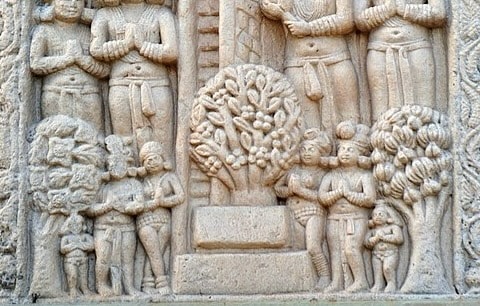
In the annals of visual anthropology, the Udumbara occupies a privileged place within ancient Buddhist iconography. Archaeological evidence from the bas-reliefs of Sanchi and Bharhut, meticulously documented by Major Cunningham, identifies the tree as the Bodhirukka (Tree of Enlightenment) for the past Buddha Kanakamuni. Because the leaves of the Ficus racemosa are often non-distinct in stone, ancient artists relied on a specific iconographic marker to identify the species: the depiction of "large stalked fruits"—large stalked fruits clustered along the trunk. This choice highlights how biological "cauliflory" dictates the semiotics of sacred art.


  • The Tree of Victory: Known as the jayabahu, the Udumbara’s association with enlightenment and royal triumph facilitated its historical spread from the Indian subcontinent to the royal gardens of Sri Lanka.


  • Archaeological Epigraphy: Cunningham and Viennot cite inscriptions alongside these "thick" visual descriptions to confirm the tree's role in the lineage of the Seven Buddhas of the Past.
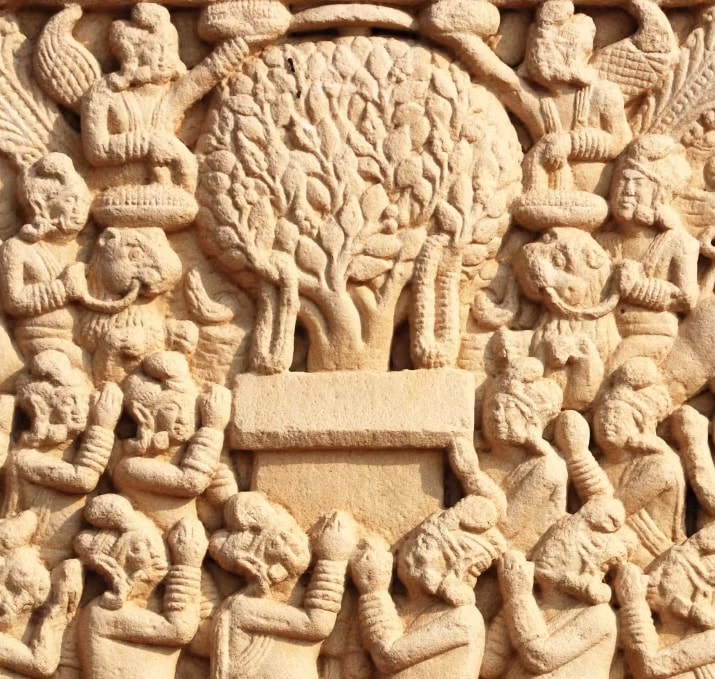

A close-up photograph of a detailed and complex ancient stone bas-relief carving from the Sanchi Stupa in India. The panel depicts a scene of worship centered around a finely carved tree, possibly a Bodhi or other sacred fig. Below and around the tree, a tiered and dense multitude of standing and seated human-like figures is carved, their hands pressed together in prayer (anjali mudra). The composition is intricate, showing many layers of carved figures, with detailed depictions of classical Indian clothing and headwear. The stone is aged and weathered.

Stone testaments to devotion: a complex sandstone bas-relief from Sanchi Stupa. An intricate network of carved figures, gathered in a tiered composition, gazes towards a central sacred tree. The multitude of devotees, depicted in classical Indian style, offers an eternal scene of adoration and Buddhist narrative art.

Photo by
Editorial Team

Section III: The Esoteric Body of Dhamma – The Five-Branched Fig.


In Khmer and Lao traditions, the Udumbara undergoes an esoteric mapping, where the tree is viewed as the "Embryo of Dhamma" (Le Figuier à cinq branches). François Bizot documented how the tree’s anatomy corresponds to the "ideal body of doctrine," serving as a vessel for initiation. In high-level ordinations in Northern Thailand and Laos, the Ficus racemosa even replaces the Ficus religiosa as the "tree of tradition" within the Ho diô (Palace of the Son/Ordinatary Pavilion), providing the structural pillars for the initiate's symbolic rebirth.


The Five Branches: The Extremities and the Body of Doctrine

The primary branches of the tree represent the five extremities of the human form and the structural integrity of the Buddhist canon.


The Leaves: The Ten Perfections (parami)

Each leaf symbolizes one of the parami necessary for the path to Buddhahood, transforming the foliage into a visual litany of virtues.


The Fruits: The Canonical Corpus

The clustered fruits represent the full body of the Dhamma, the concentrated "essence" hidden within the wood.


The Flower: The Four Noble Truths

As seen in the meditation tradition of Princess Cittakumārī, the search for the "four gems" within the Udumbara flower is an allegory for the human consciousness realizing the Four Noble Truths hidden within the physical body.


A detailed close-up photograph of an ancient stone bas-relief carving from the Sanchi Stupa complex in India. The panel, carved in a classical Indian style, depicts a narrative scene. In the center, two prominent female figures stand in elegant poses, likely deities or yakshis. They are surrounded by tiered groups of smaller standing figures, both male and female, in postures of worship or attendance. A carved tree is visible on the lower right. The stone shows signs of age and weathering, with fine details of clothing and ornamentation preserved.
Sanchi's silent chronicles: a weathered sandstone bas-relief from the ancient stupa complex. This intricate carving, rich in historical detail, depicts a narrative scene with celestial beings and devotees gathered in a tiered, classical Indian composition, a testament to early Buddhist art and storytelling.
Photo by
Editorial Team

Section IV: The Materiality of Power – The Royal Throne.

The Ficus racemosa is the "matter of authority" in Southeast Asian kingship, a role analyzed by H.G. Quaritch Wales in the context of Siamese state ceremonies. The wood of the Royal Fig is mandatory for the construction of thrones used in the Abhiseka (Aspersion) rituals, where the monarch is ritualistically transformed into a Cakravartin. This use of the Udumbara links the sovereign to the Rajasuya vedico, the ancient Vedic roots of royal consecration, where sitting upon the fig-wood stabilizes the cosmic axis and prevents cosmic chaos.


  1. The Octagonal Throne (Brah-d'u-nan Athadisa): Constructed of Ficus racemosa wood, the King sits here to receive ceremonial water from the eight cardinal directions. Upon this throne, he issues his "first command," assuming responsibility for the protection of the realm and the defense of the faith.


  1. The Bhadrapitha Throne: Here, the wood serves as the base upon which the monarch receives the royal regalia. The Udumbara wood acts as a conduit to the heavens of Indra, ensuring the King possesses the spiritual stability necessary for the Dhamma to flourish.


Section V: Ethno-ecology and Daily Life – From Gold Leaf to Medicine.


The "Royal" status of the tree does not distance it from the profane; rather, its sacredness is woven into the ethno-ecology of daily life. From the protection of "Spirit Trees" to the application of gold leaf, the Ficus racemosa remains a vital ethnobotanical primer.


tab


Conclusion: The Synthesis of Botany and Belief.


The Ficus racemosa encapsulates the unique Southeast Asian integration of botany, animism, and Buddhist philosophy. It is deemed "Royal" because it provides the material and spiritual stability of the axis mundi. By masking its flowers within its fruit, the tree creates a site where biological reality meets the miraculous. Whether serving as the structural pillars of the Ho diô or the wood for a King’s throne, the Udumbara remains the essential "matter of authority," the physical anchor through which the Dhamma is stabilized in the human realm.


References:
  • Århem, N. (2010). Spirit-ecology and Highland Animism. Research dataset.
  • Bizot, F. (1976). Le Figuier à cinq branches: Recherche sur le bouddhisme khmer. École française d'Extrême-Orient.
  • Cunningham, A. (1879). The Stupa of Bharhut: A Buddhist Monument. W.H. Allen & Co.
  • Viennot, O. (1954). Le culte de l'arbre dans l'Inde ancienne. Presses Universitaires de France.
  • Wales, H. G. Q. (1931). Siamese State Ceremonies: Their History and Function. Bernard Quaritch, Ltd.
  • Asian Heritage Silva. Internal Research Dataset on Southeast Asian Ethnobotany.

POST

POST

POST

brand

© 2021 - 2026 | Asian Heritage Silva : All rights reserved. a Website Created by matinee.icu

A close-up photograph of the massive, rough, textured bark of a large Ficus racemosa, or cluster fig tree, trunk within a lush, green rainforest environment. Numerous dense, pendant clusters of small, round, green, grape-like fruits (figs/syconia) hang directly from the thick, gnarled main trunk, a classic example of cauliflory. The forest background is blurred, emphasizing the natural patterns of the bark and the abundant fruit clusters.

The Mythical Udumbara: Unveiling the Ficus racemosa in Southeast Asian Buddhist Cosmology

March 27, 2026

To the ethnobotanist, the Ficus racemosa presents an intriguing case of ontological divergence—a space where botanical phenology and high Buddhist myth intertwine. In the riparian landscapes of Southeast Asia, this tree is known for its "cauliflory," producing clusters of large, stalked fruit directly from its trunk. Yet, in the religious imagination, it is the Udumbara, a celestial harbinger said to bloom only once every 3,000 years to signal the arrival of a Cakravartin (Universal Sovereign) or a new Buddha. The perceived "miracle" of its flowerless state is rooted in the biological reality of the Ficus genus: its inflorescences are entirely enclosed within the syconium, a fleshy receptacle that the profane eye mistakes for fruit. This natural concealment transforms a biological quirk into an enduring symbol of the "hidden" Dhamma, where rarity is not a matter of occurrence, but of spiritual perception.

Explore the Blog Post

Sacred Rituals

The Mystery of the Invisible Flower

vector

March 27, 2026

Editorial Team

To the ethnobotanist, the Ficus racemosa presents an intriguing case of ontological divergence—a space where botanical phenology and high Buddhist myth intertwine. In the riparian landscapes of Southeast Asia, this tree is known for its "cauliflory," producing clusters of large, stalked fruit directly from its trunk. Yet, in the religious imagination, it is the Udumbara, a celestial harbinger said to bloom only once every 3,000 years to signal the arrival of a Cakravartin (Universal Sovereign) or a new Buddha. The perceived "miracle" of its flowerless state is rooted in the biological reality of the Ficus genus: its inflorescences are entirely enclosed within the syconium, a fleshy receptacle that the profane eye mistakes for fruit. This natural concealment transforms a biological quirk into an enduring symbol of the "hidden" Dhamma, where rarity is not a matter of occurrence, but of spiritual perception.

Section 1: Botany Meets Myth – The Axis of the World


The Ficus racemosa (identified as Dua in Thai and Revi in Khmer) is more than a riverine species; it is a structural pillar in the "Mythical Geography" of the Indianized world. Cosmologically, the Udumbara is situated to the south of Mount Meru, the axis mundi that anchors the Buddhist universe. Its physical presence, characterized by the peculiar growth of fruit along the trunk, serves as a bridge where natural peculiarities are elevated into sacred markers.


A wide-angle photograph taken inside a traditional, temporary bamboo and fabric ceremonial pavilion in Southeast Asia. Dozens of people are present. On a raised wooden platform under an ornate canopy, senior Buddhist monks in orange saffron robes sit, leading a ceremony. In front of them, initiates in white robes and gold sashes kneel on a patterned rug, looking towards a central altar with multi-tiered offerings. Around them, laypeople in traditional dress sit cross-legged on woven mats, with hands pressed together in prayer. The structure is decorated with colorful flags and textiles.
Stone testaments to devotion: a complex sandstone bas-relief from Sanchi Stupa. An intricate network of carved figures, gathered in a tiered composition, gazes towards a central sacred tree. The multitude of devotees, depicted in classical Indian style, offers an eternal scene of adoration and Buddhist narrative art.
Photo by
Editorial Team

Section 2: The Tree of Past Buddhas – From Sanchi to Sri Lanka.

In the annals of visual anthropology, the Udumbara occupies a privileged place within ancient Buddhist iconography. Archaeological evidence from the bas-reliefs of Sanchi and Bharhut, meticulously documented by Major Cunningham, identifies the tree as the Bodhirukka (Tree of Enlightenment) for the past Buddha Kanakamuni. Because the leaves of the Ficus racemosa are often non-distinct in stone, ancient artists relied on a specific iconographic marker to identify the species: the depiction of "large stalked fruits"—large stalked fruits clustered along the trunk. This choice highlights how biological "cauliflory" dictates the semiotics of sacred art.


  • The Tree of Victory: Known as the jayabahu, the Udumbara’s association with enlightenment and royal triumph facilitated its historical spread from the Indian subcontinent to the royal gardens of Sri Lanka.


  • Archaeological Epigraphy: Cunningham and Viennot cite inscriptions alongside these "thick" visual descriptions to confirm the tree's role in the lineage of the Seven Buddhas of the Past.


A close-up photograph of a detailed and complex ancient stone bas-relief carving from the Sanchi Stupa in India. The panel depicts a scene of worship centered around a finely carved tree, possibly a Bodhi or other sacred fig. Below and around the tree, a tiered and dense multitude of standing and seated human-like figures is carved, their hands pressed together in prayer (anjali mudra). The composition is intricate, showing many layers of carved figures, with detailed depictions of classical Indian clothing and headwear. The stone is aged and weathered.

Stone testaments to devotion: a complex sandstone bas-relief from Sanchi Stupa. An intricate network of carved figures, gathered in a tiered composition, gazes towards a central sacred tree. The multitude of devotees, depicted in classical Indian style, offers an eternal scene of adoration and Buddhist narrative art.

Photo by
Editorial Team

Section III: The Esoteric Body of Dhamma – The Five-Branched Fig.


In Khmer and Lao traditions, the Udumbara undergoes an esoteric mapping, where the tree is viewed as the "Embryo of Dhamma" (Le Figuier à cinq branches). François Bizot documented how the tree’s anatomy corresponds to the "ideal body of doctrine," serving as a vessel for initiation. In high-level ordinations in Northern Thailand and Laos, the Ficus racemosa even replaces the Ficus religiosa as the "tree of tradition" within the Ho diô (Palace of the Son/Ordinatary Pavilion), providing the structural pillars for the initiate's symbolic rebirth.


The Five Branches: The Extremities and the Body of Doctrine

The primary branches of the tree represent the five extremities of the human form and the structural integrity of the Buddhist canon.


The Leaves: The Ten Perfections (parami)

Each leaf symbolizes one of the parami necessary for the path to Buddhahood, transforming the foliage into a visual litany of virtues.


The Fruits: The Canonical Corpus

The clustered fruits represent the full body of the Dhamma, the concentrated "essence" hidden within the wood.


The Flower: The Four Noble Truths

As seen in the meditation tradition of Princess Cittakumārī, the search for the "four gems" within the Udumbara flower is an allegory for the human consciousness realizing the Four Noble Truths hidden within the physical body.


A detailed close-up photograph of an ancient stone bas-relief carving from the Sanchi Stupa complex in India. The panel, carved in a classical Indian style, depicts a narrative scene. In the center, two prominent female figures stand in elegant poses, likely deities or yakshis. They are surrounded by tiered groups of smaller standing figures, both male and female, in postures of worship or attendance. A carved tree is visible on the lower right. The stone shows signs of age and weathering, with fine details of clothing and ornamentation preserved.
Sanchi's silent chronicles: a weathered sandstone bas-relief from the ancient stupa complex. This intricate carving, rich in historical detail, depicts a narrative scene with celestial beings and devotees gathered in a tiered, classical Indian composition, a testament to early Buddhist art and storytelling.
Photo by
Editorial Team

Section IV: The Materiality of Power – The Royal Throne.

The Ficus racemosa is the "matter of authority" in Southeast Asian kingship, a role analyzed by H.G. Quaritch Wales in the context of Siamese state ceremonies. The wood of the Royal Fig is mandatory for the construction of thrones used in the Abhiseka (Aspersion) rituals, where the monarch is ritualistically transformed into a Cakravartin. This use of the Udumbara links the sovereign to the Rajasuya vedico, the ancient Vedic roots of royal consecration, where sitting upon the fig-wood stabilizes the cosmic axis and prevents cosmic chaos.


  1. The Octagonal Throne (Brah-d'u-nan Athadisa): Constructed of Ficus racemosa wood, the King sits here to receive ceremonial water from the eight cardinal directions. Upon this throne, he issues his "first command," assuming responsibility for the protection of the realm and the defense of the faith.


  1. The Bhadrapitha Throne: Here, the wood serves as the base upon which the monarch receives the royal regalia. The Udumbara wood acts as a conduit to the heavens of Indra, ensuring the King possesses the spiritual stability necessary for the Dhamma to flourish.


Section V: Ethno-ecology and Daily Life – From Gold Leaf to Medicine.


The "Royal" status of the tree does not distance it from the profane; rather, its sacredness is woven into the ethno-ecology of daily life. From the protection of "Spirit Trees" to the application of gold leaf, the Ficus racemosa remains a vital ethnobotanical primer.


tab


Conclusion: The Synthesis of Botany and Belief.


The Ficus racemosa encapsulates the unique Southeast Asian integration of botany, animism, and Buddhist philosophy. It is deemed "Royal" because it provides the material and spiritual stability of the axis mundi. By masking its flowers within its fruit, the tree creates a site where biological reality meets the miraculous. Whether serving as the structural pillars of the Ho diô or the wood for a King’s throne, the Udumbara remains the essential "matter of authority," the physical anchor through which the Dhamma is stabilized in the human realm.


References:
  • Århem, N. (2010). Spirit-ecology and Highland Animism. Research dataset.
  • Bizot, F. (1976). Le Figuier à cinq branches: Recherche sur le bouddhisme khmer. École française d'Extrême-Orient.
  • Cunningham, A. (1879). The Stupa of Bharhut: A Buddhist Monument. W.H. Allen & Co.
  • Viennot, O. (1954). Le culte de l'arbre dans l'Inde ancienne. Presses Universitaires de France.
  • Wales, H. G. Q. (1931). Siamese State Ceremonies: Their History and Function. Bernard Quaritch, Ltd.
  • Asian Heritage Silva. Internal Research Dataset on Southeast Asian Ethnobotany.
vector
vector
vector
vector
vector
vector
vector
vector
vector
vector
vector
vector
vector
vector
vector
vector
vector
vector
vector
vector
vector
vector
vector
vector
vector
vector
vector
vector
vector
vector
vector
vector
vector
vector
vector
vector
vector
vector
vector
vector
vector
vector
vector
vector
vector
vector
vector
vector
vector
vector
vector
vector
vector
vector
vector
vector
vector
vector
vector
vector

Donate Today

Support the costs of the project to keep it alive

DONATE

Explore More

About The Map Project

Learn Map Builder

Help Through GFW

Privacy Policy

About

Our Vision

Contact Us

CONNECT

vector
vector
vector
vector
brand

© 2021 - 2026 | Asian Heritage Silva : All rights reserved. a Website Created by matinee.icu

A close-up photograph of the massive, rough, textured bark of a large Ficus racemosa, or cluster fig tree, trunk within a lush, green rainforest environment. Numerous dense, pendant clusters of small, round, green, grape-like fruits (figs/syconia) hang directly from the thick, gnarled main trunk, a classic example of cauliflory. The forest background is blurred, emphasizing the natural patterns of the bark and the abundant fruit clusters.

The Mythical Udumbara: Unveiling the Ficus racemosa in Southeast Asian Buddhist Cosmology

March 27, 2026

To the ethnobotanist, the Ficus racemosa presents an intriguing case of ontological divergence—a space where botanical phenology and high Buddhist myth intertwine. In the riparian landscapes of Southeast Asia, this tree is known for its "cauliflory," producing clusters of large, stalked fruit directly from its trunk. Yet, in the religious imagination, it is the Udumbara, a celestial harbinger said to bloom only once every 3,000 years to signal the arrival of a Cakravartin (Universal Sovereign) or a new Buddha. The perceived "miracle" of its flowerless state is rooted in the biological reality of the Ficus genus: its inflorescences are entirely enclosed within the syconium, a fleshy receptacle that the profane eye mistakes for fruit. This natural concealment transforms a biological quirk into an enduring symbol of the "hidden" Dhamma, where rarity is not a matter of occurrence, but of spiritual perception.

Explore the Blog Post

Sacred Rituals

The Mystery of the Invisible Flower

vector
Editorial Team

March 27, 2026

To the ethnobotanist, the Ficus racemosa presents an intriguing case of ontological divergence—a space where botanical phenology and high Buddhist myth intertwine. In the riparian landscapes of Southeast Asia, this tree is known for its "cauliflory," producing clusters of large, stalked fruit directly from its trunk. Yet, in the religious imagination, it is the Udumbara, a celestial harbinger said to bloom only once every 3,000 years to signal the arrival of a Cakravartin (Universal Sovereign) or a new Buddha. The perceived "miracle" of its flowerless state is rooted in the biological reality of the Ficus genus: its inflorescences are entirely enclosed within the syconium, a fleshy receptacle that the profane eye mistakes for fruit. This natural concealment transforms a biological quirk into an enduring symbol of the "hidden" Dhamma, where rarity is not a matter of occurrence, but of spiritual perception.

Section 1: Botany Meets Myth – The Axis of the World


The Ficus racemosa (identified as Dua in Thai and Revi in Khmer) is more than a riverine species; it is a structural pillar in the "Mythical Geography" of the Indianized world. Cosmologically, the Udumbara is situated to the south of Mount Meru, the axis mundi that anchors the Buddhist universe. Its physical presence, characterized by the peculiar growth of fruit along the trunk, serves as a bridge where natural peculiarities are elevated into sacred markers.


A wide-angle photograph taken inside a traditional, temporary bamboo and fabric ceremonial pavilion in Southeast Asia. Dozens of people are present. On a raised wooden platform under an ornate canopy, senior Buddhist monks in orange saffron robes sit, leading a ceremony. In front of them, initiates in white robes and gold sashes kneel on a patterned rug, looking towards a central altar with multi-tiered offerings. Around them, laypeople in traditional dress sit cross-legged on woven mats, with hands pressed together in prayer. The structure is decorated with colorful flags and textiles.
Stone testaments to devotion: a complex sandstone bas-relief from Sanchi Stupa. An intricate network of carved figures, gathered in a tiered composition, gazes towards a central sacred tree. The multitude of devotees, depicted in classical Indian style, offers an eternal scene of adoration and Buddhist narrative art.
Photo by
Editorial Team

Section 2: The Tree of Past Buddhas – From Sanchi to Sri Lanka.

In the annals of visual anthropology, the Udumbara occupies a privileged place within ancient Buddhist iconography. Archaeological evidence from the bas-reliefs of Sanchi and Bharhut, meticulously documented by Major Cunningham, identifies the tree as the Bodhirukka (Tree of Enlightenment) for the past Buddha Kanakamuni. Because the leaves of the Ficus racemosa are often non-distinct in stone, ancient artists relied on a specific iconographic marker to identify the species: the depiction of "large stalked fruits"—large stalked fruits clustered along the trunk. This choice highlights how biological "cauliflory" dictates the semiotics of sacred art.


  • The Tree of Victory: Known as the jayabahu, the Udumbara’s association with enlightenment and royal triumph facilitated its historical spread from the Indian subcontinent to the royal gardens of Sri Lanka.


  • Archaeological Epigraphy: Cunningham and Viennot cite inscriptions alongside these "thick" visual descriptions to confirm the tree's role in the lineage of the Seven Buddhas of the Past.


A close-up photograph of a detailed and complex ancient stone bas-relief carving from the Sanchi Stupa in India. The panel depicts a scene of worship centered around a finely carved tree, possibly a Bodhi or other sacred fig. Below and around the tree, a tiered and dense multitude of standing and seated human-like figures is carved, their hands pressed together in prayer (anjali mudra). The composition is intricate, showing many layers of carved figures, with detailed depictions of classical Indian clothing and headwear. The stone is aged and weathered.
Stone testaments to devotion: a complex sandstone bas-relief from Sanchi Stupa. An intricate network of carved figures, gathered in a tiered composition, gazes towards a central sacred tree. The multitude of devotees, depicted in classical Indian style, offers an eternal scene of adoration and Buddhist narrative art.
Photo by
Editorial Team

Section III: The Esoteric Body of Dhamma – The Five-Branched Fig.


In Khmer and Lao traditions, the Udumbara undergoes an esoteric mapping, where the tree is viewed as the "Embryo of Dhamma" (Le Figuier à cinq branches). François Bizot documented how the tree’s anatomy corresponds to the "ideal body of doctrine," serving as a vessel for initiation. In high-level ordinations in Northern Thailand and Laos, the Ficus racemosa even replaces the Ficus religiosa as the "tree of tradition" within the Ho diô (Palace of the Son/Ordinatary Pavilion), providing the structural pillars for the initiate's symbolic rebirth.


The Five Branches: The Extremities and the Body of Doctrine

The primary branches of the tree represent the five extremities of the human form and the structural integrity of the Buddhist canon.


The Leaves: The Ten Perfections (parami)

Each leaf symbolizes one of the parami necessary for the path to Buddhahood, transforming the foliage into a visual litany of virtues.


The Fruits: The Canonical Corpus

The clustered fruits represent the full body of the Dhamma, the concentrated "essence" hidden within the wood.


The Flower: The Four Noble Truths

As seen in the meditation tradition of Princess Cittakumārī, the search for the "four gems" within the Udumbara flower is an allegory for the human consciousness realizing the Four Noble Truths hidden within the physical body.


A detailed close-up photograph of an ancient stone bas-relief carving from the Sanchi Stupa complex in India. The panel, carved in a classical Indian style, depicts a narrative scene. In the center, two prominent female figures stand in elegant poses, likely deities or yakshis. They are surrounded by tiered groups of smaller standing figures, both male and female, in postures of worship or attendance. A carved tree is visible on the lower right. The stone shows signs of age and weathering, with fine details of clothing and ornamentation preserved.
Sanchi's silent chronicles: a weathered sandstone bas-relief from the ancient stupa complex. This intricate carving, rich in historical detail, depicts a narrative scene with celestial beings and devotees gathered in a tiered, classical Indian composition, a testament to early Buddhist art and storytelling.
Photo by
Editorial Team

Section IV: The Materiality of Power – The Royal Throne.

The Ficus racemosa is the "matter of authority" in Southeast Asian kingship, a role analyzed by H.G. Quaritch Wales in the context of Siamese state ceremonies. The wood of the Royal Fig is mandatory for the construction of thrones used in the Abhiseka (Aspersion) rituals, where the monarch is ritualistically transformed into a Cakravartin. This use of the Udumbara links the sovereign to the Rajasuya vedico, the ancient Vedic roots of royal consecration, where sitting upon the fig-wood stabilizes the cosmic axis and prevents cosmic chaos.


  1. The Octagonal Throne (Brah-d'u-nan Athadisa): Constructed of Ficus racemosa wood, the King sits here to receive ceremonial water from the eight cardinal directions. Upon this throne, he issues his "first command," assuming responsibility for the protection of the realm and the defense of the faith.


  1. The Bhadrapitha Throne: Here, the wood serves as the base upon which the monarch receives the royal regalia. The Udumbara wood acts as a conduit to the heavens of Indra, ensuring the King possesses the spiritual stability necessary for the Dhamma to flourish.


Section V: Ethno-ecology and Daily Life – From Gold Leaf to Medicine.


The "Royal" status of the tree does not distance it from the profane; rather, its sacredness is woven into the ethno-ecology of daily life. From the protection of "Spirit Trees" to the application of gold leaf, the Ficus racemosa remains a vital ethnobotanical primer.


tab


Conclusion: The Synthesis of Botany and Belief.


The Ficus racemosa encapsulates the unique Southeast Asian integration of botany, animism, and Buddhist philosophy. It is deemed "Royal" because it provides the material and spiritual stability of the axis mundi. By masking its flowers within its fruit, the tree creates a site where biological reality meets the miraculous. Whether serving as the structural pillars of the Ho diô or the wood for a King’s throne, the Udumbara remains the essential "matter of authority," the physical anchor through which the Dhamma is stabilized in the human realm.


References:
  • Århem, N. (2010). Spirit-ecology and Highland Animism. Research dataset.
  • Bizot, F. (1976). Le Figuier à cinq branches: Recherche sur le bouddhisme khmer. École française d'Extrême-Orient.
  • Cunningham, A. (1879). The Stupa of Bharhut: A Buddhist Monument. W.H. Allen & Co.
  • Viennot, O. (1954). Le culte de l'arbre dans l'Inde ancienne. Presses Universitaires de France.
  • Wales, H. G. Q. (1931). Siamese State Ceremonies: Their History and Function. Bernard Quaritch, Ltd.
  • Asian Heritage Silva. Internal Research Dataset on Southeast Asian Ethnobotany.
brand

© 2021 - 2026 | Asian Heritage Silva : All rights reserved. | A Website Created by matinee.icu