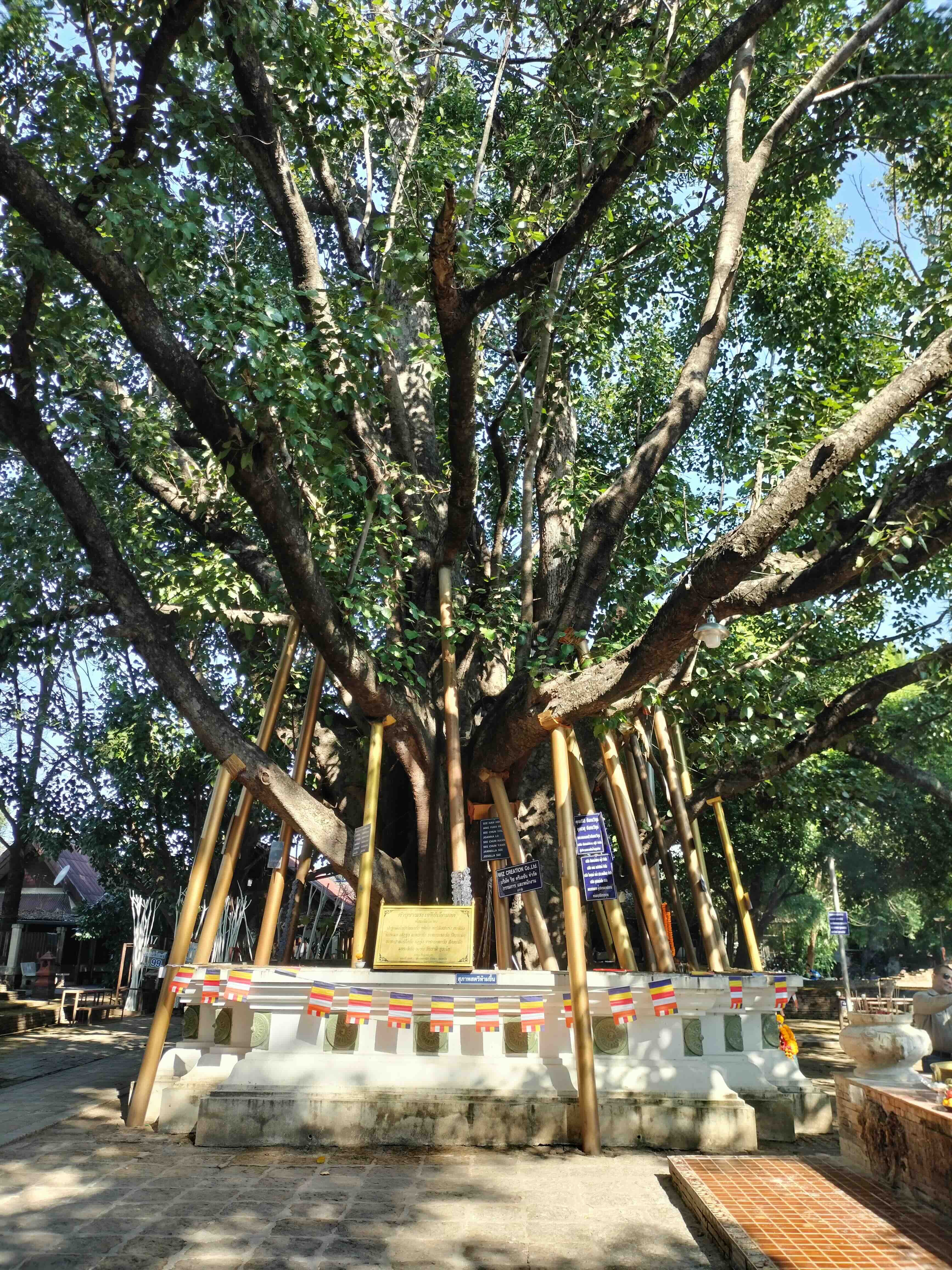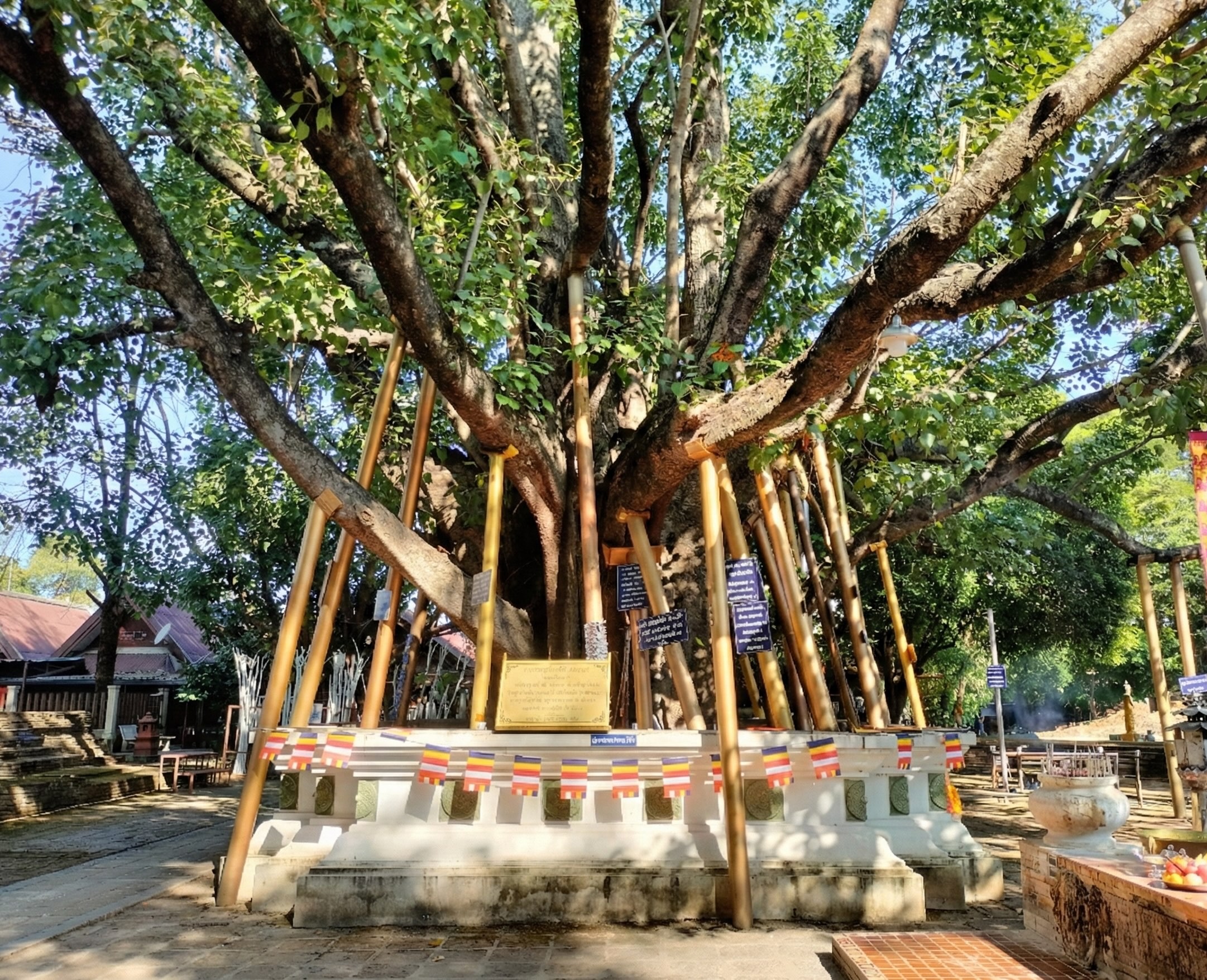
A wide-angle photograph showing the massive, sprawling sacred tree at Wat Chet Yot temple in Chiang Mai, Thailand, completely devoid of people. Numerous golden-painted posts act as supports for the tree's heavy, lower branches, creating a conical structure around the base. A white pedestal adorned with colorful Buddhist flags surrounds the thick, textured trunk. The ground is paved with bricks, and other temple buildings and lush vegetation are visible in the background under a bright sunlit sky.

Spatial Syntax of the Sacred Ficus

January 12, 2026

The Thai Bo Tree ( Ficus religiosa ) must be analyzed not as a mere botanical specimen, but as a complex ritual assemblage, a curated space where layers of belief are made manifest. This analysis posits that the tree’s sanctity is constructed and reinforced through a series of "paratextual" elements that operate in concert to define its meaning. These include its architectural enclosure, which demarcates sacred ground from the profane; an iconographic corps of guardians, such as the earth goddess Mae Thorani and the serpentine Naga, who protect the site by perpetually enacting key mythological events; and the syncretic co-location of animist spirit cults, which spatially integrates pre-Buddhist beliefs into a subordinate, protective role. Together, these architectural, iconographic, and topographical elements frame the Bo Tree as a living installation—a dynamic, curated exhibition of Thai religious history where narratives from the Pali Canon, local spirit lore, and Brahmanic mythology are simultaneously displayed, interpreted, and hierarchically arranged.

Read the Article

Thailand | Bodhi trees

An Analysis of Paratextual Elements at the Thai Bo Tree.

A. Di Paolo

January 12, 2026

by Alma Lawson

The Thai Bo Tree ( Ficus religiosa ) must be analyzed not as a mere botanical specimen, but as a complex ritual assemblage, a curated space where layers of belief are made manifest. This analysis posits that the tree’s sanctity is constructed and reinforced through a series of "paratextual" elements that operate in concert to define its meaning. These include its architectural enclosure, which demarcates sacred ground from the profane; an iconographic corps of guardians, such as the earth goddess Mae Thorani and the serpentine Naga, who protect the site by perpetually enacting key mythological events; and the syncretic co-location of animist spirit cults, which spatially integrates pre-Buddhist beliefs into a subordinate, protective role. Together, these architectural, iconographic, and topographical elements frame the Bo Tree as a living installation—a dynamic, curated exhibition of Thai religious history where narratives from the Pali Canon, local spirit lore, and Brahmanic mythology are simultaneously displayed, interpreted, and hierarchically arranged.

The Architecture of Containment: Delineating the Sacred through the 'Bodhi Ghara'.


The physical boundary surrounding a sacred Bo Tree in Thailand is not merely a protective fence but a potent semiotic device—an architectural form known as a  Bodhi Ghara —that performs a crucial theological function.

This enclosure is strategically vital, serving to formally separate the sacred space occupied by the tree from the profane, everyday world surrounding it.

Just as the Buddhist temple complex, or  wat , is architecturally "set apart from the village" to create a distinct ritual center (Tambiah, 1970, p. 141), this same principle of deliberate separation is applied in microcosm to the Bo Tree, the living symbol of the Buddha's enlightenment.


This sacred boundary functions to create a zone of perfect, consecrated order that stands in direct opposition to the temporal and often chaotic world outside. Low walls, ornate balustrades, or other demarcating structures act as a physical and symbolic threshold. In crossing this line, one moves from the profane space of agricultural cycles, social obligations, and the pervasive threat of malevolent spirits ( phi ) into a timeless, ritual space that directly references the historical moment of the Buddha's ultimate spiritual achievement.


The enclosure, therefore, serves not only to protect the tree but to frame it, creating a space of inviolable purity that elevates its biological existence into a profound theological statement. This architectural act of containment prepares the ground for the protective entities who guard the sanctity of the space within.


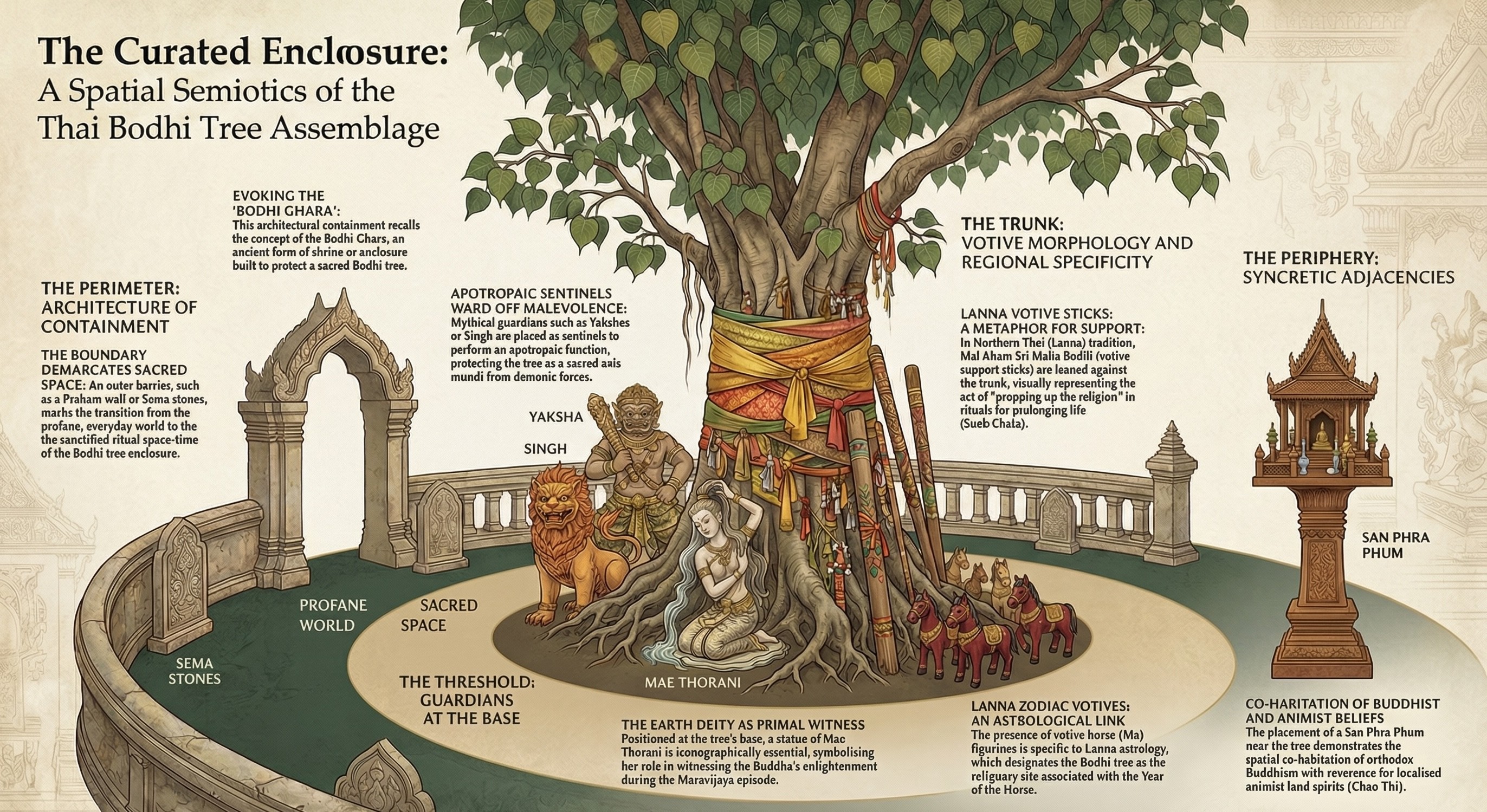
n educational infographic titled "The Curated Enclosure: Spatial Semiotics of the Thai Bodhi Tree," visualizing the sacred tree as a "Ritual Assemblage" within a temple complex. The graphic delineates four conceptual zones: Zone A (The Perimeter), Zone B (Guardians), Zone C (Syncretic Adjacencies/Spirit Houses), and Zone D (Votive Morphology). Detailed illustrations depict the "Centre of the Jambu Continent," Naga imagery relating to the Enlightenment, and the spatial relationship between the Bodhi tree and animist shrines.

Syncretic Adjacencies: The Coexistence of Buddhist and Animist Topographies


The religious landscape of Thailand is a complex tapestry woven from the threads of orthodox Buddhism and deeply rooted, pre-existing animist spirit cults. This syncretism is not merely a theological abstraction; it is mapped directly onto the physical environment. An analysis of the spatial co-location of Buddhist symbols and animist shrines reveals a carefully managed hierarchy of belief systems.


The placement of spirit houses adjacent to a sacred Bo Tree offers a clear illustration of this dynamic relationship.Within the grounds of a  wat , it is common to find shrines ( San Phra Phum ) dedicated to local guardian spirits, such as the guardian of the  wat  itself (Chao Phau) and the guardian of the village (Tapubaan) (Tambiah, 1970, p. 280). These shrines are often situated in close proximity to primary Buddhist icons like the stupa or the Bo Tree. This physical adjacency does not imply equality but rather a structured integration.


By placing the animist shrines within the  wat  grounds but adjacent to the Buddhist core, the arrangement makes the theological subordination of the spirits  physically tangible  and visually self-evident to any visitor.The relationship is one of theological tension managed through a clear hierarchy. According to local belief, these powerful territorial spirits are themselves framed as "pious Buddhists" (Tambiah, 1970, p. 294).


They are seen as protectors of the faith, enforcing religious taboos, such as the prohibition of certain work on the Buddhist Sabbath ( wan phraa ) (Tambiah, 1970, p. 268). This theological framing effectively co-opts the animist deities, transforming them from potential rivals into servants and guardians of the overarching Buddhist order. Their shrines, standing near the Bo Tree, thus signify their subordinate yet essential role in protecting the Buddhist community and its sacred sites.


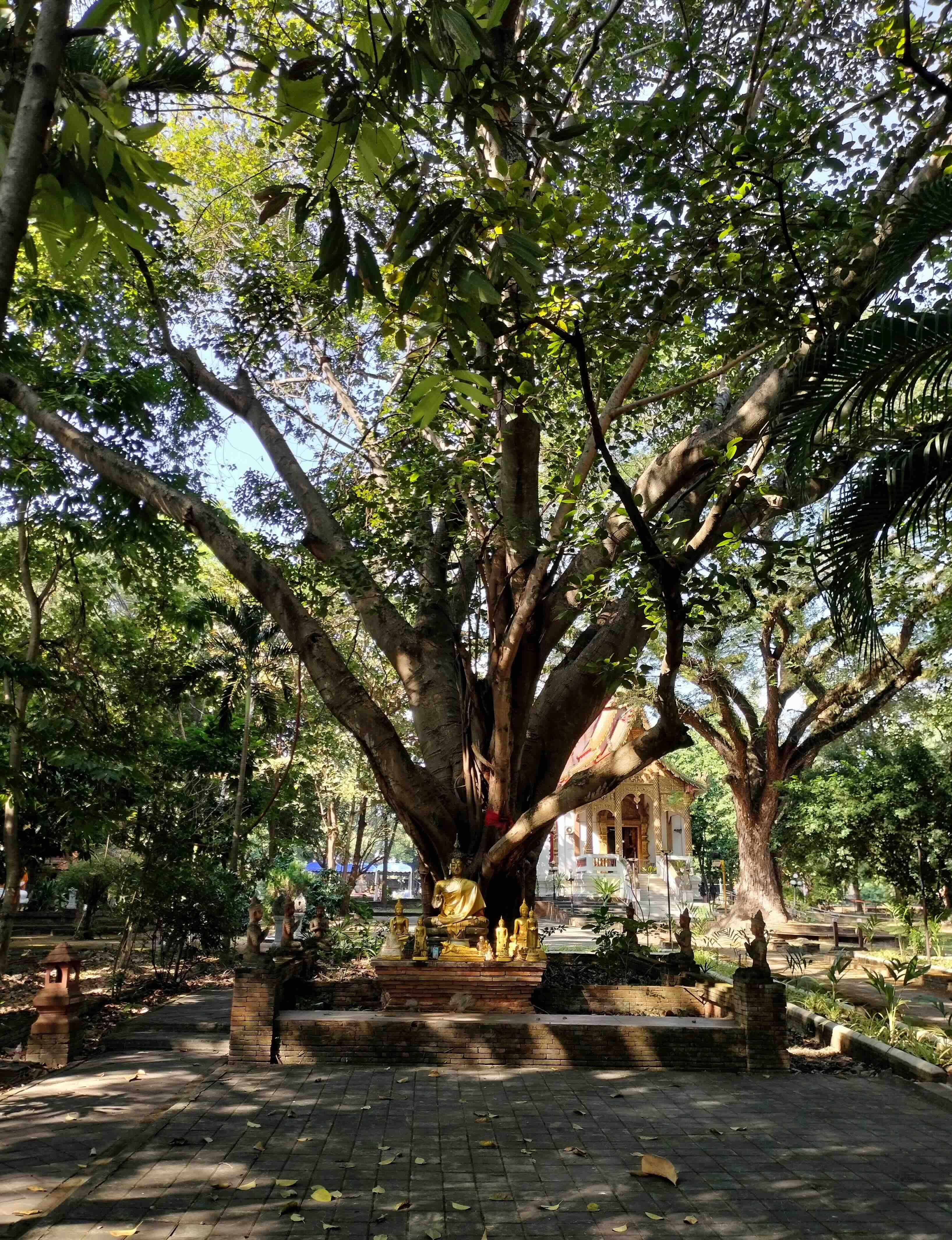
A colossal Ficus religiosa, known as the Bodhi tree, dominates this quiet corner of Wat Chet Yot in Chiang Mai. Its massive, textured trunk, bolstered by prominent buttress roots that provide essential structural stability against the elements, cradles a modest brick altar.

Syncretic Adjacencies: The Coexistence of Buddhist and Animist Topographies


The religious landscape of Thailand is a complex tapestry woven from the threads of orthodox Buddhism and deeply rooted, pre-existing animist spirit cults. This syncretism is not merely a theological abstraction; it is mapped directly onto the physical environment. An analysis of the spatial co-location of Buddhist symbols and animist shrines reveals a carefully managed hierarchy of belief systems.


The placement of spirit houses adjacent to a sacred Bo Tree offers a clear illustration of this dynamic relationship.Within the grounds of a  wat , it is common to find shrines ( San Phra Phum ) dedicated to local guardian spirits, such as the guardian of the  wat  itself (Chao Phau) and the guardian of the village (Tapubaan) (Tambiah, 1970, p. 280). These shrines are often situated in close proximity to primary Buddhist icons like the stupa or the Bo Tree. This physical adjacency does not imply equality but rather a structured integration.


By placing the animist shrines within the  wat  grounds but adjacent to the Buddhist core, the arrangement makes the theological subordination of the spirits  physically tangible  and visually self-evident to any visitor.The relationship is one of theological tension managed through a clear hierarchy. According to local belief, these powerful territorial spirits are themselves framed as "pious Buddhists" (Tambiah, 1970, p. 294).


They are seen as protectors of the faith, enforcing religious taboos, such as the prohibition of certain work on the Buddhist Sabbath ( wan phraa ) (Tambiah, 1970, p. 268). This theological framing effectively co-opts the animist deities, transforming them from potential rivals into servants and guardians of the overarching Buddhist order. Their shrines, standing near the Bo Tree, thus signify their subordinate yet essential role in protecting the Buddhist community and its sacred sites.


A wide-angle photograph showing the massive, sprawling sacred tree at Wat Chet Yot temple in Chiang Mai, Thailand, completely devoid of people. Numerous golden-painted posts act as supports for the tree's heavy, lower branches, creating a conical structure around the base. A white pedestal adorned with colorful Buddhist flags surrounds the thick, textured trunk. The ground is paved with bricks, and other temple buildings and lush vegetation are visible in the background under a bright sunlit sky.

A dense array of gilded posts serves as a complex system of artificial buttressing. These external supports function as an exoskeleton, redistributing the immense tensile and compressive loads from the heavy, cantilevered limbs down to the terrestrial foundation.

Votive Morphology: An Analysis of Specific Material Elements


A complete understanding of the Bo Tree's spatial syntax requires an examination of the smaller, often overlooked votive objects and material practices that accumulate around its base. These elements, far from being incidental, provide insight into regional variations of belief and animate the grand narratives of the site on a personal, material level.


The Serpentine Syntax: Naga Guardianship and Root Conflation


Among the most powerful iconographic elements is the  Naga , a serpentine deity of profound significance in Buddhist mythology. The Naga's role as a protector is rooted in the story of the cobra king  Mucalinda , who shielded the meditating Buddha from a raging storm for seven days by coiling his body around him and spreading his great hood like an umbrella (Tambiah, 1970, p. 173).


This act of devotion is architecturally and sculpturally encoded into the landscape of the sacred tree.This myth finds its expression in temple architecture, where it is common to see "balustrades in the form of long Nagas," effectively making the serpent's body the enclosure of the sacred space (Tambiah, 1970, p. 174). When placed around a Bo Tree, this design creates a powerful visual and symbolic conflation.


The sinuous, protective form of the Naga merges with the powerful, snake-like aerial roots of the  Ficus religiosa  itself. The Naga is thus not merely depicted  near  the tree; its form becomes fused with the architecture of containment and the biology of the tree, creating a multi-layered symbol of primal, protective power in service of the Buddha.


Lanna Zodiac Votives: The Year of the Horse


It must be stated clearly and concisely that the provided source texts do not contain specific information to conduct an analysis of Lanna zodiac votives. While Northern Thai (Lanna) tradition is known to associate pilgrimage to specific Bo Tree shrines with one's birth year in the animal zodiac, particularly the Year of the Horse, no references to votive horse figurines or related pilgrimage practices could be found in the supplied material. This section therefore stands as a necessary marker for future research, acknowledging a known cultural practice that cannot be substantiated by the present context.


The Practice of Support: The 'Mai Kham' Metaphor


Based on the synthesis of architectural semiotics and ethnographic data provided in the sources, the following is a scientific description of the Mai Kham (also referred to as Mai Kham Sali or Mai Kham Bodhi):


  • Material and Formal Attributes: The Mai Kham consists of forked wooden sticks, ranging in size from small twigs to large pillars measuring up to ten feet in length. These implements are often piously decorated by painting the wood white and adorning them with turmeric powder, cowrie shells, and colorful paper or ribbons, particularly yellow scarves that mirror the color of monastic robes.

  • Ritual and Temporal Context: The use of these supports is central to the Northern Thai (Lan Na) New Year festival (Songkran), involving a formal visual procession where the sticks are carried through the community before being deposited at the temple. This practice is classified as a merit-making ritual intended to ensure long life and prosperity for the donor, often prescribed by fortune tellers to counteract bad luck.

  • Operationalizing "Support" (Kham): Anthropologically, the ritual functions through a literal and metaphorical translation of the Thai verb kham (to support). Physically, the sticks are placed under the heavy, spreading branches of the Ficus religiosa (Bodhi tree), which is characterized by a soft structure and lacks a hardy wood core. Metaphorically, this act is interpreted as "supporting" the Buddhist religion (Sasana), physicalizing the devotee’s commitment to maintaining the spiritual order.

  • Cosmological and Spatial Hierarchy: The placement of the Mai Kham around the Bodhi tree anchors the botanical entity within the Sisa Phaendin (Head Land) visual schema, which identifies the tree as the central cosmological throne of the universe. The variation in the dimensions of the sticks serves as a visual marker of social hierarchy; while ordinary villagers provide smaller supports, the massive, column-sized Mai Kham are dedicated specifically to the King and the Royal Family.

  • Semiotic Convergence: The Mai Kham acts as a semiotic bridge between the biological needs of the tree and the symbolic requirements of the temple's sacred geography. By propping up the "Tree of Awakening," the ritual reinforces the concept of Bodhi (awakening/wisdom), transforming a simple botanical maintenance act into a sophisticated pedagogical tool for communicating Buddhist interdependency to the laity.


Conclusion: The Bo Tree as a Living Museum


Ultimately, the Thai Bo Tree functions as far more than a simple object of veneration. The deliberate layering of paratextual elements—the architectural containment, the iconographic corps of guardians, and the syncretic adjacency of animist shrines—transforms the tree from a natural object into a dynamic, "living museum." This is not a passive repository but an active work of curation. The spatial syntax does not merely display narratives from the Pali Canon, local animist histories, and Brahmanic mythology side-by-side; it actively  ranks  and  interprets  them.


It places the Buddhist narrative at the inviolable center, re-casts animist deities as subordinate protectors of that center, and integrates powerful Brahmanic figures like the Naga as devoted servants to the Buddha. The site thus becomes a curated space where a dominant theological hierarchy is made manifest through material culture and spatial arrangement, a continuously performed exhibition of Thai religious identity where history is not merely remembered but perpetually enacted and reinforced.


References

--------


  • Anonymous. (n.d.). Rigorous academic annotated bibliography: Visual semiotics of the Thai Bo Tree Unpublished manuscript.

  • Darlington, S. M. (2012).  The ordination of a tree: The Thai Buddhist environmental . State University of New York Press.

  • Phra Nakhon Khiri National Museum. (n.d.).  Buddha Statue in Subduing Mara Posture  Museum monograph.

  • Tambiah, S. J. (1970).  Buddhism and the spirit cults in North-east Thailand . Cambridge University Press.


brand

© 2021 - 2025 | Asian Heritage Silva : All rights reserved. a Website Created by matinee.icu

A wide-angle photograph showing the massive, sprawling sacred tree at Wat Chet Yot temple in Chiang Mai, Thailand, completely devoid of people. Numerous golden-painted posts act as supports for the tree's heavy, lower branches, creating a conical structure around the base. A white pedestal adorned with colorful Buddhist flags surrounds the thick, textured trunk. The ground is paved with bricks, and other temple buildings and lush vegetation are visible in the background under a bright sunlit sky.

Spatial Syntax of the Sacred Ficus

January 12, 2026

The Thai Bo Tree ( Ficus religiosa ) must be analyzed not as a mere botanical specimen, but as a complex ritual assemblage, a curated space where layers of belief are made manifest. This analysis posits that the tree’s sanctity is constructed and reinforced through a series of "paratextual" elements that operate in concert to define its meaning. These include its architectural enclosure, which demarcates sacred ground from the profane; an iconographic corps of guardians, such as the earth goddess Mae Thorani and the serpentine Naga, who protect the site by perpetually enacting key mythological events; and the syncretic co-location of animist spirit cults, which spatially integrates pre-Buddhist beliefs into a subordinate, protective role. Together, these architectural, iconographic, and topographical elements frame the Bo Tree as a living installation—a dynamic, curated exhibition of Thai religious history where narratives from the Pali Canon, local spirit lore, and Brahmanic mythology are simultaneously displayed, interpreted, and hierarchically arranged.

Read the Article

Thailand | Bodhi trees

An Analysis of Paratextual Elements at the Thai Bo Tree.

January 12, 2026

A. Di Paolo

by Alma Lawson

The Thai Bo Tree ( Ficus religiosa ) must be analyzed not as a mere botanical specimen, but as a complex ritual assemblage, a curated space where layers of belief are made manifest. This analysis posits that the tree’s sanctity is constructed and reinforced through a series of "paratextual" elements that operate in concert to define its meaning. These include its architectural enclosure, which demarcates sacred ground from the profane; an iconographic corps of guardians, such as the earth goddess Mae Thorani and the serpentine Naga, who protect the site by perpetually enacting key mythological events; and the syncretic co-location of animist spirit cults, which spatially integrates pre-Buddhist beliefs into a subordinate, protective role. Together, these architectural, iconographic, and topographical elements frame the Bo Tree as a living installation—a dynamic, curated exhibition of Thai religious history where narratives from the Pali Canon, local spirit lore, and Brahmanic mythology are simultaneously displayed, interpreted, and hierarchically arranged.

The Architecture of Containment: Delineating the Sacred through the 'Bodhi Ghara'.


The physical boundary surrounding a sacred Bo Tree in Thailand is not merely a protective fence but a potent semiotic device—an architectural form known as a  Bodhi Ghara —that performs a crucial theological function.

This enclosure is strategically vital, serving to formally separate the sacred space occupied by the tree from the profane, everyday world surrounding it.

Just as the Buddhist temple complex, or  wat , is architecturally "set apart from the village" to create a distinct ritual center (Tambiah, 1970, p. 141), this same principle of deliberate separation is applied in microcosm to the Bo Tree, the living symbol of the Buddha's enlightenment.


This sacred boundary functions to create a zone of perfect, consecrated order that stands in direct opposition to the temporal and often chaotic world outside. Low walls, ornate balustrades, or other demarcating structures act as a physical and symbolic threshold. In crossing this line, one moves from the profane space of agricultural cycles, social obligations, and the pervasive threat of malevolent spirits ( phi ) into a timeless, ritual space that directly references the historical moment of the Buddha's ultimate spiritual achievement.


The enclosure, therefore, serves not only to protect the tree but to frame it, creating a space of inviolable purity that elevates its biological existence into a profound theological statement. This architectural act of containment prepares the ground for the protective entities who guard the sanctity of the space within.


n educational infographic titled "The Curated Enclosure: Spatial Semiotics of the Thai Bodhi Tree," visualizing the sacred tree as a "Ritual Assemblage" within a temple complex. The graphic delineates four conceptual zones: Zone A (The Perimeter), Zone B (Guardians), Zone C (Syncretic Adjacencies/Spirit Houses), and Zone D (Votive Morphology). Detailed illustrations depict the "Centre of the Jambu Continent," Naga imagery relating to the Enlightenment, and the spatial relationship between the Bodhi tree and animist shrines.

Syncretic Adjacencies: The Coexistence of Buddhist and Animist Topographies


The religious landscape of Thailand is a complex tapestry woven from the threads of orthodox Buddhism and deeply rooted, pre-existing animist spirit cults. This syncretism is not merely a theological abstraction; it is mapped directly onto the physical environment. An analysis of the spatial co-location of Buddhist symbols and animist shrines reveals a carefully managed hierarchy of belief systems.


The placement of spirit houses adjacent to a sacred Bo Tree offers a clear illustration of this dynamic relationship.Within the grounds of a  wat , it is common to find shrines ( San Phra Phum ) dedicated to local guardian spirits, such as the guardian of the  wat  itself (Chao Phau) and the guardian of the village (Tapubaan) (Tambiah, 1970, p. 280). These shrines are often situated in close proximity to primary Buddhist icons like the stupa or the Bo Tree. This physical adjacency does not imply equality but rather a structured integration.


By placing the animist shrines within the  wat  grounds but adjacent to the Buddhist core, the arrangement makes the theological subordination of the spirits  physically tangible  and visually self-evident to any visitor.The relationship is one of theological tension managed through a clear hierarchy. According to local belief, these powerful territorial spirits are themselves framed as "pious Buddhists" (Tambiah, 1970, p. 294).


They are seen as protectors of the faith, enforcing religious taboos, such as the prohibition of certain work on the Buddhist Sabbath ( wan phraa ) (Tambiah, 1970, p. 268). This theological framing effectively co-opts the animist deities, transforming them from potential rivals into servants and guardians of the overarching Buddhist order. Their shrines, standing near the Bo Tree, thus signify their subordinate yet essential role in protecting the Buddhist community and its sacred sites.


A colossal Ficus religiosa, known as the Bodhi tree, dominates this quiet corner of Wat Chet Yot in Chiang Mai. Its massive, textured trunk, bolstered by prominent buttress roots that provide essential structural stability against the elements, cradles a modest brick altar.

Syncretic Adjacencies: The Coexistence of Buddhist and Animist Topographies


The religious landscape of Thailand is a complex tapestry woven from the threads of orthodox Buddhism and deeply rooted, pre-existing animist spirit cults. This syncretism is not merely a theological abstraction; it is mapped directly onto the physical environment. An analysis of the spatial co-location of Buddhist symbols and animist shrines reveals a carefully managed hierarchy of belief systems.


The placement of spirit houses adjacent to a sacred Bo Tree offers a clear illustration of this dynamic relationship.Within the grounds of a  wat , it is common to find shrines ( San Phra Phum ) dedicated to local guardian spirits, such as the guardian of the  wat  itself (Chao Phau) and the guardian of the village (Tapubaan) (Tambiah, 1970, p. 280). These shrines are often situated in close proximity to primary Buddhist icons like the stupa or the Bo Tree. This physical adjacency does not imply equality but rather a structured integration.


By placing the animist shrines within the  wat  grounds but adjacent to the Buddhist core, the arrangement makes the theological subordination of the spirits  physically tangible  and visually self-evident to any visitor.The relationship is one of theological tension managed through a clear hierarchy. According to local belief, these powerful territorial spirits are themselves framed as "pious Buddhists" (Tambiah, 1970, p. 294).


They are seen as protectors of the faith, enforcing religious taboos, such as the prohibition of certain work on the Buddhist Sabbath ( wan phraa ) (Tambiah, 1970, p. 268). This theological framing effectively co-opts the animist deities, transforming them from potential rivals into servants and guardians of the overarching Buddhist order. Their shrines, standing near the Bo Tree, thus signify their subordinate yet essential role in protecting the Buddhist community and its sacred sites.


A wide-angle photograph showing the massive, sprawling sacred tree at Wat Chet Yot temple in Chiang Mai, Thailand, completely devoid of people. Numerous golden-painted posts act as supports for the tree's heavy, lower branches, creating a conical structure around the base. A white pedestal adorned with colorful Buddhist flags surrounds the thick, textured trunk. The ground is paved with bricks, and other temple buildings and lush vegetation are visible in the background under a bright sunlit sky.

A dense array of gilded posts serves as a complex system of artificial buttressing. These external supports function as an exoskeleton, redistributing the immense tensile and compressive loads from the heavy, cantilevered limbs down to the terrestrial foundation.

Votive Morphology: An Analysis of Specific Material Elements


A complete understanding of the Bo Tree's spatial syntax requires an examination of the smaller, often overlooked votive objects and material practices that accumulate around its base. These elements, far from being incidental, provide insight into regional variations of belief and animate the grand narratives of the site on a personal, material level.


The Serpentine Syntax: Naga Guardianship and Root Conflation


Among the most powerful iconographic elements is the  Naga , a serpentine deity of profound significance in Buddhist mythology. The Naga's role as a protector is rooted in the story of the cobra king  Mucalinda , who shielded the meditating Buddha from a raging storm for seven days by coiling his body around him and spreading his great hood like an umbrella (Tambiah, 1970, p. 173).


This act of devotion is architecturally and sculpturally encoded into the landscape of the sacred tree.This myth finds its expression in temple architecture, where it is common to see "balustrades in the form of long Nagas," effectively making the serpent's body the enclosure of the sacred space (Tambiah, 1970, p. 174). When placed around a Bo Tree, this design creates a powerful visual and symbolic conflation.


The sinuous, protective form of the Naga merges with the powerful, snake-like aerial roots of the  Ficus religiosa  itself. The Naga is thus not merely depicted  near  the tree; its form becomes fused with the architecture of containment and the biology of the tree, creating a multi-layered symbol of primal, protective power in service of the Buddha.


Lanna Zodiac Votives: The Year of the Horse


It must be stated clearly and concisely that the provided source texts do not contain specific information to conduct an analysis of Lanna zodiac votives. While Northern Thai (Lanna) tradition is known to associate pilgrimage to specific Bo Tree shrines with one's birth year in the animal zodiac, particularly the Year of the Horse, no references to votive horse figurines or related pilgrimage practices could be found in the supplied material. This section therefore stands as a necessary marker for future research, acknowledging a known cultural practice that cannot be substantiated by the present context.


The Practice of Support: The 'Mai Kham' Metaphor


Based on the synthesis of architectural semiotics and ethnographic data provided in the sources, the following is a scientific description of the Mai Kham (also referred to as Mai Kham Sali or Mai Kham Bodhi):


  • Material and Formal Attributes: The Mai Kham consists of forked wooden sticks, ranging in size from small twigs to large pillars measuring up to ten feet in length. These implements are often piously decorated by painting the wood white and adorning them with turmeric powder, cowrie shells, and colorful paper or ribbons, particularly yellow scarves that mirror the color of monastic robes.

  • Ritual and Temporal Context: The use of these supports is central to the Northern Thai (Lan Na) New Year festival (Songkran), involving a formal visual procession where the sticks are carried through the community before being deposited at the temple. This practice is classified as a merit-making ritual intended to ensure long life and prosperity for the donor, often prescribed by fortune tellers to counteract bad luck.

  • Operationalizing "Support" (Kham): Anthropologically, the ritual functions through a literal and metaphorical translation of the Thai verb kham (to support). Physically, the sticks are placed under the heavy, spreading branches of the Ficus religiosa (Bodhi tree), which is characterized by a soft structure and lacks a hardy wood core. Metaphorically, this act is interpreted as "supporting" the Buddhist religion (Sasana), physicalizing the devotee’s commitment to maintaining the spiritual order.

  • Cosmological and Spatial Hierarchy: The placement of the Mai Kham around the Bodhi tree anchors the botanical entity within the Sisa Phaendin (Head Land) visual schema, which identifies the tree as the central cosmological throne of the universe. The variation in the dimensions of the sticks serves as a visual marker of social hierarchy; while ordinary villagers provide smaller supports, the massive, column-sized Mai Kham are dedicated specifically to the King and the Royal Family.

  • Semiotic Convergence: The Mai Kham acts as a semiotic bridge between the biological needs of the tree and the symbolic requirements of the temple's sacred geography. By propping up the "Tree of Awakening," the ritual reinforces the concept of Bodhi (awakening/wisdom), transforming a simple botanical maintenance act into a sophisticated pedagogical tool for communicating Buddhist interdependency to the laity.


Conclusion: The Bo Tree as a Living Museum


Ultimately, the Thai Bo Tree functions as far more than a simple object of veneration. The deliberate layering of paratextual elements—the architectural containment, the iconographic corps of guardians, and the syncretic adjacency of animist shrines—transforms the tree from a natural object into a dynamic, "living museum." This is not a passive repository but an active work of curation. The spatial syntax does not merely display narratives from the Pali Canon, local animist histories, and Brahmanic mythology side-by-side; it actively  ranks  and  interprets  them.


It places the Buddhist narrative at the inviolable center, re-casts animist deities as subordinate protectors of that center, and integrates powerful Brahmanic figures like the Naga as devoted servants to the Buddha. The site thus becomes a curated space where a dominant theological hierarchy is made manifest through material culture and spatial arrangement, a continuously performed exhibition of Thai religious identity where history is not merely remembered but perpetually enacted and reinforced.


References

--------


  • Anonymous. (n.d.). Rigorous academic annotated bibliography: Visual semiotics of the Thai Bo Tree Unpublished manuscript.

  • Darlington, S. M. (2012).  The ordination of a tree: The Thai Buddhist environmental . State University of New York Press.

  • Phra Nakhon Khiri National Museum. (n.d.).  Buddha Statue in Subduing Mara Posture  Museum monograph.

  • Tambiah, S. J. (1970).  Buddhism and the spirit cults in North-east Thailand . Cambridge University Press.


PAPER

Spatial Syntax of the Sacred Ficus

A. Di Paolo

January 12, 2026

PAPER

The Sentient Landscape: An Examination of Asia's Cosmological Vision of the Forest

A. Di Paolo

January 16, 2026

PAPER

An Eco-Dhammic Response: The Realignment of Soteriology and Conservation in Contemporary Thai Buddhism

A. Di Paolo

January 23, 2026

Donate Today

Support the costs of the project to keep it alive

DONATE

Explore More

About The Map Project

Learn Map Builder

Help Through GFW

Privacy Policy

About

Our Vision

Contact Us

CONNECT

Facebook Icn
bluesky icon
mastodon icon
brand

© 2021 - 2025 | Asian Heritage Silva : All rights reserved. a Website Created by matinee.icu

A wide-angle photograph showing the massive, sprawling sacred tree at Wat Chet Yot temple in Chiang Mai, Thailand, completely devoid of people. Numerous golden-painted posts act as supports for the tree's heavy, lower branches, creating a conical structure around the base. A white pedestal adorned with colorful Buddhist flags surrounds the thick, textured trunk. The ground is paved with bricks, and other temple buildings and lush vegetation are visible in the background under a bright sunlit sky.

Spatial Syntax of the Sacred Ficus

January 12, 2026

The Thai Bo Tree ( Ficus religiosa ) must be analyzed not as a mere botanical specimen, but as a complex ritual assemblage, a curated space where layers of belief are made manifest. This analysis posits that the tree’s sanctity is constructed and reinforced through a series of "paratextual" elements that operate in concert to define its meaning. These include its architectural enclosure, which demarcates sacred ground from the profane; an iconographic corps of guardians, such as the earth goddess Mae Thorani and the serpentine Naga, who protect the site by perpetually enacting key mythological events; and the syncretic co-location of animist spirit cults, which spatially integrates pre-Buddhist beliefs into a subordinate, protective role. Together, these architectural, iconographic, and topographical elements frame the Bo Tree as a living installation—a dynamic, curated exhibition of Thai religious history where narratives from the Pali Canon, local spirit lore, and Brahmanic mythology are simultaneously displayed, interpreted, and hierarchically arranged.

Thailand | Bodhi trees

An Analysis of Paratextual Elements at the Thai Bo Tree.

A. Di Paolo

January 12, 2026

by Alma Lawson

The Thai Bo Tree ( Ficus religiosa ) must be analyzed not as a mere botanical specimen, but as a complex ritual assemblage, a curated space where layers of belief are made manifest. This analysis posits that the tree’s sanctity is constructed and reinforced through a series of "paratextual" elements that operate in concert to define its meaning. These include its architectural enclosure, which demarcates sacred ground from the profane; an iconographic corps of guardians, such as the earth goddess Mae Thorani and the serpentine Naga, who protect the site by perpetually enacting key mythological events; and the syncretic co-location of animist spirit cults, which spatially integrates pre-Buddhist beliefs into a subordinate, protective role. Together, these architectural, iconographic, and topographical elements frame the Bo Tree as a living installation—a dynamic, curated exhibition of Thai religious history where narratives from the Pali Canon, local spirit lore, and Brahmanic mythology are simultaneously displayed, interpreted, and hierarchically arranged.

The Architecture of Containment: Delineating the Sacred through the 'Bodhi Ghara'.


The physical boundary surrounding a sacred Bo Tree in Thailand is not merely a protective fence but a potent semiotic device—an architectural form known as a  Bodhi Ghara —that performs a crucial theological function.

This enclosure is strategically vital, serving to formally separate the sacred space occupied by the tree from the profane, everyday world surrounding it.

Just as the Buddhist temple complex, or  wat , is architecturally "set apart from the village" to create a distinct ritual center (Tambiah, 1970, p. 141), this same principle of deliberate separation is applied in microcosm to the Bo Tree, the living symbol of the Buddha's enlightenment.


This sacred boundary functions to create a zone of perfect, consecrated order that stands in direct opposition to the temporal and often chaotic world outside. Low walls, ornate balustrades, or other demarcating structures act as a physical and symbolic threshold. In crossing this line, one moves from the profane space of agricultural cycles, social obligations, and the pervasive threat of malevolent spirits ( phi ) into a timeless, ritual space that directly references the historical moment of the Buddha's ultimate spiritual achievement.


The enclosure, therefore, serves not only to protect the tree but to frame it, creating a space of inviolable purity that elevates its biological existence into a profound theological statement. This architectural act of containment prepares the ground for the protective entities who guard the sanctity of the space within.

n educational infographic titled "The Curated Enclosure: Spatial Semiotics of the Thai Bodhi Tree," visualizing the sacred tree as a "Ritual Assemblage" within a temple complex. The graphic delineates four conceptual zones: Zone A (The Perimeter), Zone B (Guardians), Zone C (Syncretic Adjacencies/Spirit Houses), and Zone D (Votive Morphology). Detailed illustrations depict the "Centre of the Jambu Continent," Naga imagery relating to the Enlightenment, and the spatial relationship between the Bodhi tree and animist shrines.

The Guardian Corps: Iconographic Protectors of the Enlightenment Space


The space delineated by the sacred enclosure is rarely left empty. It is populated by a cohort of iconographic figures whose strategic placement transforms them from decorative statuary into a necessary "Guardian Corps." These protectors are tasked with actively defending the sanctity of the enlightenment site against metaphysical threats, embodying narratives of protection drawn directly from Buddhist scripture and regional mythology.


Mae Thorani: The Earth as Witness


The figure of the earth goddess, Mae Thorani (also Nang Thoranee), is a cornerstone of this protective assembly. Her placement is almost invariably at the base of the Bo Tree or the Buddha image seated beneath it, a position that directly references the climactic  Maravijaya  episode—the Buddha’s triumph over the demon Mara.

As Mara challenged the Buddha's right to the very throne of enlightenment, the Buddha, having no other witness, called upon "the earth itself" to testify to his accumulated merits (Tambiah, 1970, p. 52). Mae Thorani is the personification of this response. Her statue is not a passive reminder of this cosmic event; it is an icon that perpetually  performs  the act of witnessing. Her image actively enacts the vanquishing of Mara, making her a continuous, living agent whose mythic testimony secures the space against the forces of spiritual obstruction.


Non-Human Sentinels: Apotropaic Defense


Complementing the earth goddess are other, often fiercer, non-human sentinels. While the provided texts do not detail specific figures like  Yakshas  or lions in this context, Thai religious cosmology is replete with "malevolent spirits" ( phi ) and "demons" that pose a constant threat to sacred spaces (Tambiah, 1970, p. 50).


These spirits are a pervasive force in the lived reality of the village, capable of causing illness, misfortune, and even death (Tambiah, 1970, pp. 271, 314).

The strategic placement of formidable guardian figures is therefore a standard apotropaic strategy, a necessary spiritual perimeter defense designed to ward off such entities. These sentinels confront and repel negative influences before they can encroach upon the sacred center occupied by the tree, ensuring that the space of enlightenment remains pure and undisturbed. This layering of protection extends beyond the Buddhist pantheon, integrating adjacent spiritual topographies into its system.


A colossal Ficus religiosa, known as the Bodhi tree, dominates this quiet corner of Wat Chet Yot in Chiang Mai. Its massive, textured trunk, bolstered by prominent buttress roots that provide essential structural stability against the elements, cradles a modest brick altar.

Syncretic Adjacencies: The Coexistence of Buddhist and Animist Topographies


The religious landscape of Thailand is a complex tapestry woven from the threads of orthodox Buddhism and deeply rooted, pre-existing animist spirit cults. This syncretism is not merely a theological abstraction; it is mapped directly onto the physical environment. An analysis of the spatial co-location of Buddhist symbols and animist shrines reveals a carefully managed hierarchy of belief systems.


The placement of spirit houses adjacent to a sacred Bo Tree offers a clear illustration of this dynamic relationship.Within the grounds of a  wat , it is common to find shrines ( San Phra Phum ) dedicated to local guardian spirits, such as the guardian of the  wat  itself (Chao Phau) and the guardian of the village (Tapubaan) (Tambiah, 1970, p. 280). These shrines are often situated in close proximity to primary Buddhist icons like the stupa or the Bo Tree. This physical adjacency does not imply equality but rather a structured integration.


By placing the animist shrines within the  wat  grounds but adjacent to the Buddhist core, the arrangement makes the theological subordination of the spirits  physically tangible  and visually self-evident to any visitor.The relationship is one of theological tension managed through a clear hierarchy. According to local belief, these powerful territorial spirits are themselves framed as "pious Buddhists" (Tambiah, 1970, p. 294).


They are seen as protectors of the faith, enforcing religious taboos, such as the prohibition of certain work on the Buddhist Sabbath ( wan phraa ) (Tambiah, 1970, p. 268). This theological framing effectively co-opts the animist deities, transforming them from potential rivals into servants and guardians of the overarching Buddhist order. Their shrines, standing near the Bo Tree, thus signify their subordinate yet essential role in protecting the Buddhist community and its sacred sites.

A wide-angle photograph showing the massive, sprawling sacred tree at Wat Chet Yot temple in Chiang Mai, Thailand, completely devoid of people. Numerous golden-painted posts act as supports for the tree's heavy, lower branches, creating a conical structure around the base. A white pedestal adorned with colorful Buddhist flags surrounds the thick, textured trunk. The ground is paved with bricks, and other temple buildings and lush vegetation are visible in the background under a bright sunlit sky.
A dense array of gilded posts serves as a complex system of artificial buttressing. These external supports function as an exoskeleton, redistributing the immense tensile and compressive loads from the heavy, cantilevered limbs down to the terrestrial foundation.

Votive Morphology: An Analysis of Specific Material Elements


A complete understanding of the Bo Tree's spatial syntax requires an examination of the smaller, often overlooked votive objects and material practices that accumulate around its base. These elements, far from being incidental, provide insight into regional variations of belief and animate the grand narratives of the site on a personal, material level.


The Serpentine Syntax: Naga Guardianship and Root Conflation


Among the most powerful iconographic elements is the  Naga , a serpentine deity of profound significance in Buddhist mythology. The Naga's role as a protector is rooted in the story of the cobra king  Mucalinda , who shielded the meditating Buddha from a raging storm for seven days by coiling his body around him and spreading his great hood like an umbrella (Tambiah, 1970, p. 173).


This act of devotion is architecturally and sculpturally encoded into the landscape of the sacred tree.This myth finds its expression in temple architecture, where it is common to see "balustrades in the form of long Nagas," effectively making the serpent's body the enclosure of the sacred space (Tambiah, 1970, p. 174). When placed around a Bo Tree, this design creates a powerful visual and symbolic conflation.


The sinuous, protective form of the Naga merges with the powerful, snake-like aerial roots of the  Ficus religiosa  itself. The Naga is thus not merely depicted  near  the tree; its form becomes fused with the architecture of containment and the biology of the tree, creating a multi-layered symbol of primal, protective power in service of the Buddha.


Lanna Zodiac Votives: The Year of the Horse


It must be stated clearly and concisely that the provided source texts do not contain specific information to conduct an analysis of Lanna zodiac votives. While Northern Thai (Lanna) tradition is known to associate pilgrimage to specific Bo Tree shrines with one's birth year in the animal zodiac, particularly the Year of the Horse, no references to votive horse figurines or related pilgrimage practices could be found in the supplied material. This section therefore stands as a necessary marker for future research, acknowledging a known cultural practice that cannot be substantiated by the present context.


The Practice of Support: The 'Mai Kham' Metaphor


Based on the synthesis of architectural semiotics and ethnographic data provided in the sources, the following is a scientific description of the Mai Kham (also referred to as Mai Kham Sali or Mai Kham Bodhi):


  • Material and Formal Attributes: The Mai Kham consists of forked wooden sticks, ranging in size from small twigs to large pillars measuring up to ten feet in length. These implements are often piously decorated by painting the wood white and adorning them with turmeric powder, cowrie shells, and colorful paper or ribbons, particularly yellow scarves that mirror the color of monastic robes.

  • Ritual and Temporal Context: The use of these supports is central to the Northern Thai (Lan Na) New Year festival (Songkran), involving a formal visual procession where the sticks are carried through the community before being deposited at the temple. This practice is classified as a merit-making ritual intended to ensure long life and prosperity for the donor, often prescribed by fortune tellers to counteract bad luck.

  • Operationalizing "Support" (Kham): Anthropologically, the ritual functions through a literal and metaphorical translation of the Thai verb kham (to support). Physically, the sticks are placed under the heavy, spreading branches of the Ficus religiosa (Bodhi tree), which is characterized by a soft structure and lacks a hardy wood core. Metaphorically, this act is interpreted as "supporting" the Buddhist religion (Sasana), physicalizing the devotee’s commitment to maintaining the spiritual order.

  • Cosmological and Spatial Hierarchy: The placement of the Mai Kham around the Bodhi tree anchors the botanical entity within the Sisa Phaendin (Head Land) visual schema, which identifies the tree as the central cosmological throne of the universe. The variation in the dimensions of the sticks serves as a visual marker of social hierarchy; while ordinary villagers provide smaller supports, the massive, column-sized Mai Kham are dedicated specifically to the King and the Royal Family.

  • Semiotic Convergence: The Mai Kham acts as a semiotic bridge between the biological needs of the tree and the symbolic requirements of the temple's sacred geography. By propping up the "Tree of Awakening," the ritual reinforces the concept of Bodhi (awakening/wisdom), transforming a simple botanical maintenance act into a sophisticated pedagogical tool for communicating Buddhist interdependency to the laity.


Conclusion: The Bo Tree as a Living Museum


Ultimately, the Thai Bo Tree functions as far more than a simple object of veneration. The deliberate layering of paratextual elements—the architectural containment, the iconographic corps of guardians, and the syncretic adjacency of animist shrines—transforms the tree from a natural object into a dynamic, "living museum." This is not a passive repository but an active work of curation. The spatial syntax does not merely display narratives from the Pali Canon, local animist histories, and Brahmanic mythology side-by-side; it actively  ranks  and  interprets  them.


It places the Buddhist narrative at the inviolable center, re-casts animist deities as subordinate protectors of that center, and integrates powerful Brahmanic figures like the Naga as devoted servants to the Buddha. The site thus becomes a curated space where a dominant theological hierarchy is made manifest through material culture and spatial arrangement, a continuously performed exhibition of Thai religious identity where history is not merely remembered but perpetually enacted and reinforced.


References

--------


  • Anonymous. (n.d.). Rigorous academic annotated bibliography: Visual semiotics of the Thai Bo Tree Unpublished manuscript.

  • Darlington, S. M. (2012).  The ordination of a tree: The Thai Buddhist environmental . State University of New York Press.

  • Phra Nakhon Khiri National Museum. (n.d.).  Buddha Statue in Subduing Mara Posture  Museum monograph.

  • Tambiah, S. J. (1970).  Buddhism and the spirit cults in North-east Thailand . Cambridge University Press.


PAPER

Spatial Syntax of the Sacred Ficus

A. Di Paolo

January 12, 2026

PAPER

The Sentient Landscape: An Examination of Asia's Cosmological Vision of the Forest

A. Di Paolo

January 16, 2026

PAPER

An Eco-Dhammic Response: The Realignment of Soteriology and Conservation in Contemporary Thai Buddhism

A. Di Paolo

January 23, 2026

brand

© 2021 - 2025 | Asian Heritage Silva : All rights reserved. | A Website Created by matinee.icu