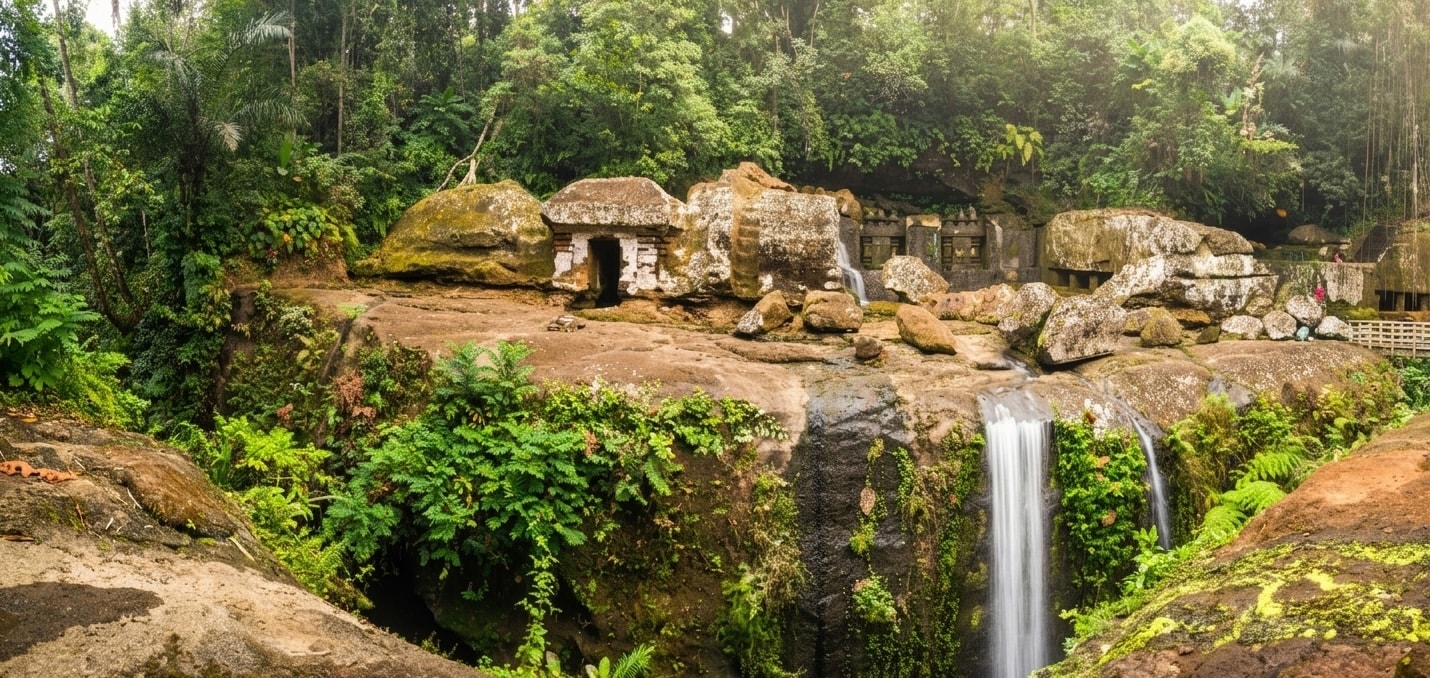
A panoramic view of the ancient Gunung Kawi temple complex in Tampaksiring, Bali, Indonesia, set within a lush tropical rainforest. The image captures a series of large, rock-cut shrines, or candi, carved directly into a massive cliff face on the left. A smaller, built temple structure sits on a ledge nearby. To the right, a dramatic waterfall cascades down the rock face into a river gorge. Visitors can be seen walking on a wooden bridge and stairs, which lead through the verdant landscape and connect different areas of the sacred site.

The Strangling Guardian: Unveiling the Shadows of Bali’s Sacred Beringin

May 8, 2026

This post offers an anthropological and ecological re-evaluation of the island's most sacred tree, the Beringin (Ficus benjamina). Challenging the romanticized vision of Bali, the study analyzes the tree as a formidable, sentient entity and a physical manifestation of tenget—a sacred power that is both protective and dangerous.1 The analysis establishes a foundational link between the strangler fig ecology and Balinese Hindu cosmology. The tree's life cycle of "arboreal strangulation" is interpreted as a metaphor for the necessary destruction embodied by the deity Kala. Lexicologically, the paper decodes the visual syntax of the "dressed" tree, focusing on the Kain Poleng (checkered cloth) as a sophisticated semiotic marker for Rwa Bhineda, the fundamental principle of complementary dualities.1 The study explores the Secular-Ritual Paradox, detailing how the tree's sacred status and governing taboos—meant to placate resident spirits (bhuta kala)—create a "Material Dilemma" in high-density urban areas like Denpasar. This friction between rapid urbanisation and ancient taboos forces modern infrastructure to yield to the niskala (invisible, spiritual world). Ultimately, the Beringin represents Bali's central ecological paradox: acknowledging the spiritual and financial gravity required for authentic cultural heritage preservation.

Explore the Blog Post

Sacred Trees

Arboreal Strangulation, Sacred Space, and the Ecological Paradox of Modern Bali.

vector

Editorial Team

May 8, 2026

This post offers an anthropological and ecological re-evaluation of the island's most sacred tree, the Beringin (Ficus benjamina). Challenging the romanticized vision of Bali, the study analyzes the tree as a formidable, sentient entity and a physical manifestation of tenget—a sacred power that is both protective and dangerous.1 The analysis establishes a foundational link between the strangler fig ecology and Balinese Hindu cosmology. The tree's life cycle of "arboreal strangulation" is interpreted as a metaphor for the necessary destruction embodied by the deity Kala. Lexicologically, the paper decodes the visual syntax of the "dressed" tree, focusing on the Kain Poleng (checkered cloth) as a sophisticated semiotic marker for Rwa Bhineda, the fundamental principle of complementary dualities.1 The study explores the Secular-Ritual Paradox, detailing how the tree's sacred status and governing taboos—meant to placate resident spirits (bhuta kala)—create a "Material Dilemma" in high-density urban areas like Denpasar. This friction between rapid urbanisation and ancient taboos forces modern infrastructure to yield to the niskala (invisible, spiritual world). Ultimately, the Beringin represents Bali's central ecological paradox: acknowledging the spiritual and financial gravity required for authentic cultural heritage preservation.

The Twilight Sentinel: Beyond the Edenic Myth

As twilight descends upon a Balinese village, the Beringin tree (Ficus benjamina) undergoes a disturbing transformation. The sprawling aerial roots, which dangled like harmless threads in the midday sun, now resemble a menacing, light-swallowing curtain. The dense canopy creates a pocket of absolute stillness—a density that seems to exert a physical pressure on the air itself. This is the uncanny reality of the sacred banyan: a mixture of profound awe and primal dread that commands the attention of every passer-by. To stand beneath its boughs is to leave the sekala (the visible, material realm) and brush against the niskala (the invisible, spiritual world).


For decades, the "construction of Bali’s mystique" by colonial-era artists—such as the Singaporean pioneers Liu Kang and Chen Wen Hsi during their landmark 1952 trip—portrayed the island as an untouched, romanticised Eden. Their sketches often captured the "incredible natural scenery" and the "sumptuous" allure of the landscape. However, the Beringin shatters this sanitised vision. It is no mere botanical specimen or peaceful spiritual haven; it is a formidable, sentient entity. In Balinese culture, these trees are the physical manifestation of tenget—a sacred power that is as dangerous as it is protective. It is a liminal space where the divine and the demonic coexist, requiring a cautious respect that borders on animist fears.
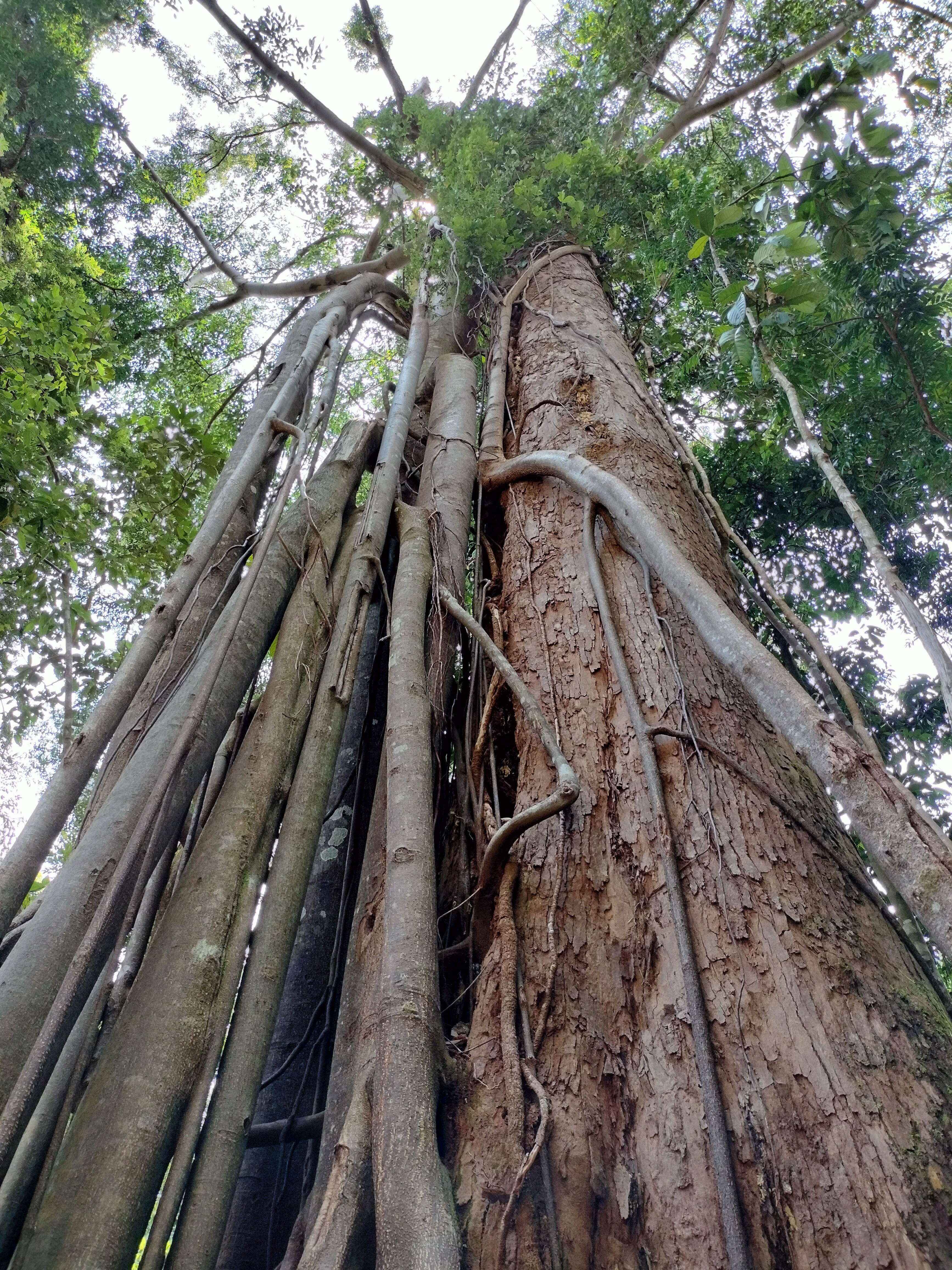
A low-angle photograph looking up a massive rainforest tree. Its large, rough, reddish-brown host trunk is almost entirely encased by the massive network of thick, grey, smooth aerial roots of a mature Strangler Fig (Ficus spp.). These roots fuse and twist, forming a dense lattice that extends upwards towards a dense, green forest canopy and a bright sky. The vertical perspective emphasizes the fig's suffocating hold and the height of both plants in a dense forest environment.
Photo by
Editorial Team

The Violence of Ecology: Botanical Roots of a Strangler

The biological life cycle of the Ficus is a study in arboreal violence, a process best described as "arboreal strangulation." As a hemi-epiphyte, the tree begins its life precariously, germinating high within the canopy of a host tree. It sends long, delicate roots downwards, eventually reaching the forest floor and anchoring itself into the soil. Once established, these roots thicken and fuse, slowly encircling the host.

Hemi-epiphyte: A botanical classification for plants that spend a portion of their life cycle as epiphytes (living on other plants) before establishing a root system that reaches the ground, often eventually outcompeting or killing the host.


This ecological process serves as a potent metaphor within Balinese Hindu cosmology. The violent cycle of death and rebirth inherent in the strangler fig’s growth mirrors the roles of the deities Shiva and Kala. In this context, the tree represents Kala (Time/Destruction)—the ultimate consumer that must destroy the old to facilitate the new. The host's demise is not a tragedy but a manifestation of Kala’s inevitable march. This biological "violence" is spiritually necessary; the Beringin is a natural emblem in ceremonies linked to pitra yadnya (rites for the dead), where the tree acts as a vehicle for purification. The ancestral spirit ascends through the tree's towering body, seeking unity with the gods by leaving the strangled "host" of the material body behind.
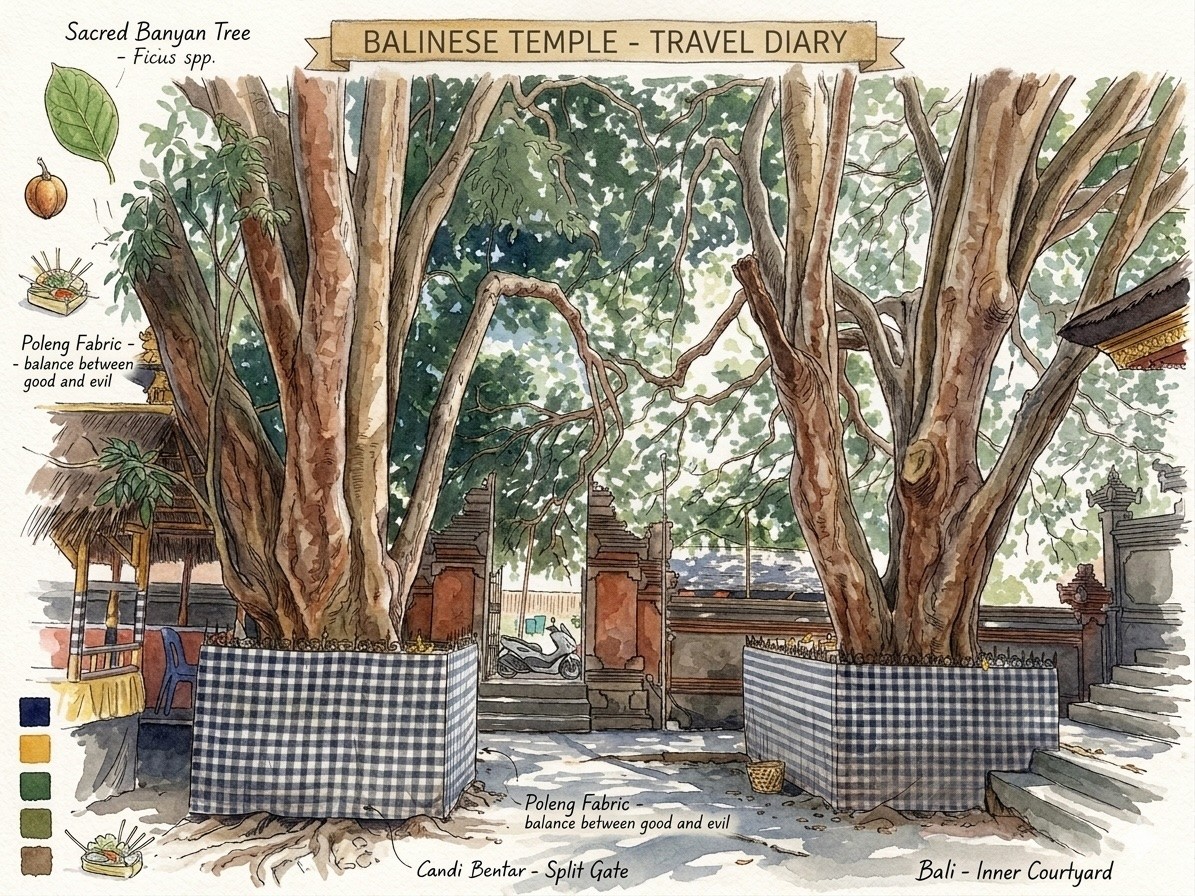
balinese waringin travel watercolor.

Photo by
Editorial Team

The Semiotics of the Dressed Tree: Shadow Spirituality and Taboos

The Beringin functions as a multi-layered visual-sign system where botanical form and ritual dress joints encode ideas of protection and liminality. It is rarely uninhabited; its complex network of aerial roots serves as a dwelling for bhuta kala (unseen spirits) and ancestors seeking purification. Because of these residents, the Beringin is a primary "signifier" of sacred space, feared as much as it is worshipped.


The Visual Syntax of Rwa Bhineda

The most striking visual element of the Beringin is the "dressed" trunk, frequently wrapped in Kain Poleng—a black and white checkered cloth. This fabric is a sophisticated semiotic marker of Rwa Bhineda, the fundamental Balinese principle of complementary dualities. The stark contrast of the checks symbolises the balance between light and dark, good and evil, and the protective yet dangerous nature of the tree’s power. This cloth functions as an apotropaic marker, a warning that the tree is a seat of ambivalent forces that must be ritually balanced to maintain Tri Hita Karana (the three causes of prosperity: harmony between humans, nature, and the divine).


Animist Fears and Prohibitions

To maintain this equilibrium, strict taboos govern human interaction with the Beringin. These are not mere suggestions but essential protocols to avoid spiritual retribution:


  • Forbidden Acts: One must never cut the wood, urinate near the base, or engage in disrespectful speech or behaviour within the tree's perimeter.
  • The Material Consequence: Violating these rules is believed to invite immediate illness or personal calamity, as the resident bhuta kala are easily offended by those who ignore the tree's tenget status.
  • Dark Folklore: Stories persist of those who attempted to prune a Beringin without permission, only to suffer mysterious accidents or find their tools shattered by an unseen force.
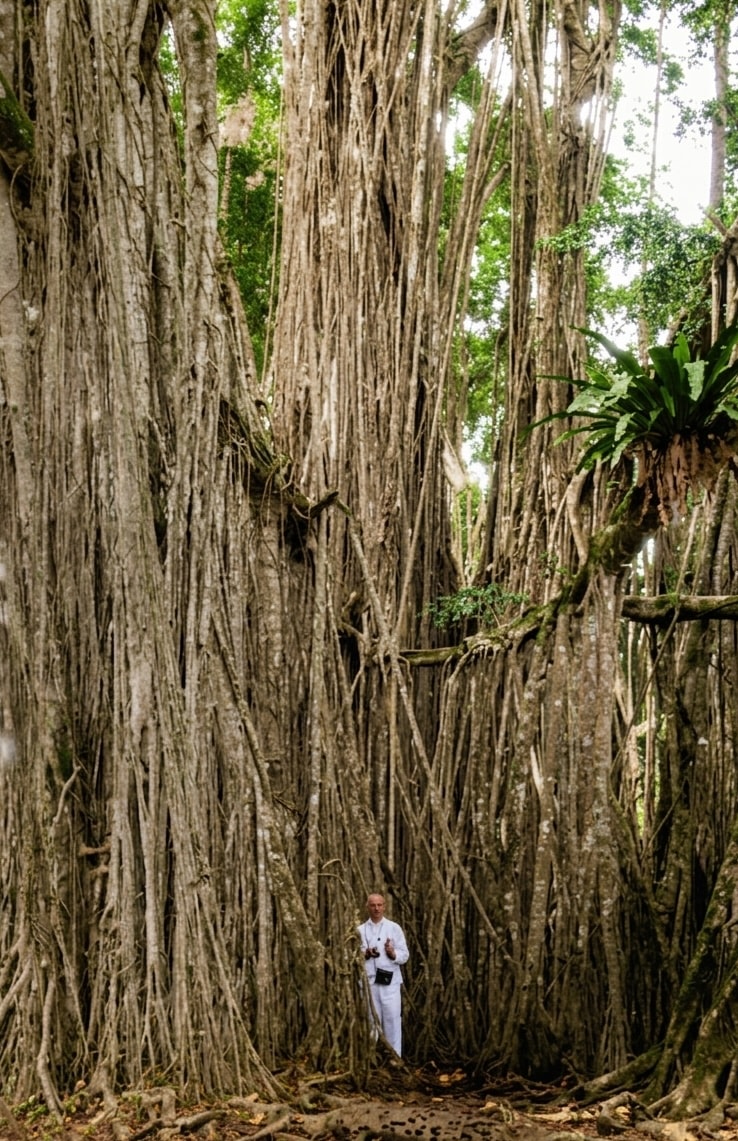


TROPENMUSEUM COLLECTION Giant Waringin tree on Bali
Photo by
Editorial Team
Material Culture: The Secular-Ritual Paradox

Despite its fearsome reputation, the Beringin facilitates a unique "Secular-Ritual" paradox. Beneath the vast shade of its pengayoman (guardianship), thriving micro-economies huddle. In a typical village or city centre, one finds warungs (food stalls), scooter parking, and bustling markets clustered under the canopy. Large baskets of produce are stacked against the roots, and the cool shade provides a communal shelter for the mundane activities of daily life.


The Material Dilemma

However, this proximity creates a significant logistical and financial burden. When a Beringin grows in a high-density urban area like Denpasar, it cannot be managed like a common street tree. If a branch falls or if maintenance becomes a safety necessity, the community faces a "Material Dilemma." Pruning a sacred branch requires more than just a saw; it necessitates a complex array of apotropaic rituals.


The community must coordinate with priests, prepare elaborate offerings (banten), and perform ceremonies to seek permission from the resident spirits. The cost of these offerings and the labour involved in the ritual can be staggering, placing a tangible economic weight on local wards. In the modern context, the sacred status of the tree becomes a physical and financial gravity, where the cost of maintaining spiritual balance rivals the cost of urban infrastructure.

Conclusion: The Modern Friction

Today, the Beringin stands at the centre of a growing tension between rapid urbanisation and ancient taboos. In cities where space is at a premium, modern roads are often forced to curve awkwardly around "immovable" sacred trees. These trees create a physical friction in the urban landscape, serving as anchors of the niskala in an ever-accelerating present.


The visual of a high-traffic tarmac road bending to accommodate a tree wrapped in Kain Poleng is the ultimate expression of Bali’s "Ecological Paradox." Maintaining these liminal spaces causes significant anxiety, yet to remove them would be to sever the connection to the ancestors and the protective guardianship of the pengayoman.


True heritage preservation in Bali is not about sanitising nature or removing the "darker" elements of folklore. Instead, it requires an embrace of Rwa Bhineda—acknowledging the necessary friction between the light of progress and the shadows of the sacred.


The Beringin remains the strangling guardian, a living reminder that the forest—and the spirits within it—never truly leaves the city.

POST
POST
POST

brand

© 2021 - 2026 | Asian Heritage Silva : All rights reserved. a Website Created by matinee.icu

A panoramic view of the ancient Gunung Kawi temple complex in Tampaksiring, Bali, Indonesia, set within a lush tropical rainforest. The image captures a series of large, rock-cut shrines, or candi, carved directly into a massive cliff face on the left. A smaller, built temple structure sits on a ledge nearby. To the right, a dramatic waterfall cascades down the rock face into a river gorge. Visitors can be seen walking on a wooden bridge and stairs, which lead through the verdant landscape and connect different areas of the sacred site.

The Strangling Guardian: Unveiling the Shadows of Bali’s Sacred Beringin

May 8, 2026

This post offers an anthropological and ecological re-evaluation of the island's most sacred tree, the Beringin (Ficus benjamina). Challenging the romanticized vision of Bali, the study analyzes the tree as a formidable, sentient entity and a physical manifestation of tenget—a sacred power that is both protective and dangerous.1 The analysis establishes a foundational link between the strangler fig ecology and Balinese Hindu cosmology. The tree's life cycle of "arboreal strangulation" is interpreted as a metaphor for the necessary destruction embodied by the deity Kala. Lexicologically, the paper decodes the visual syntax of the "dressed" tree, focusing on the Kain Poleng (checkered cloth) as a sophisticated semiotic marker for Rwa Bhineda, the fundamental principle of complementary dualities.1 The study explores the Secular-Ritual Paradox, detailing how the tree's sacred status and governing taboos—meant to placate resident spirits (bhuta kala)—create a "Material Dilemma" in high-density urban areas like Denpasar. This friction between rapid urbanisation and ancient taboos forces modern infrastructure to yield to the niskala (invisible, spiritual world). Ultimately, the Beringin represents Bali's central ecological paradox: acknowledging the spiritual and financial gravity required for authentic cultural heritage preservation.

Explore the Blog Post

Sacred Trees

Arboreal Strangulation, Sacred Space, and the Ecological Paradox of Modern Bali.

vector

May 8, 2026

Editorial Team

This post offers an anthropological and ecological re-evaluation of the island's most sacred tree, the Beringin (Ficus benjamina). Challenging the romanticized vision of Bali, the study analyzes the tree as a formidable, sentient entity and a physical manifestation of tenget—a sacred power that is both protective and dangerous.1 The analysis establishes a foundational link between the strangler fig ecology and Balinese Hindu cosmology. The tree's life cycle of "arboreal strangulation" is interpreted as a metaphor for the necessary destruction embodied by the deity Kala. Lexicologically, the paper decodes the visual syntax of the "dressed" tree, focusing on the Kain Poleng (checkered cloth) as a sophisticated semiotic marker for Rwa Bhineda, the fundamental principle of complementary dualities.1 The study explores the Secular-Ritual Paradox, detailing how the tree's sacred status and governing taboos—meant to placate resident spirits (bhuta kala)—create a "Material Dilemma" in high-density urban areas like Denpasar. This friction between rapid urbanisation and ancient taboos forces modern infrastructure to yield to the niskala (invisible, spiritual world). Ultimately, the Beringin represents Bali's central ecological paradox: acknowledging the spiritual and financial gravity required for authentic cultural heritage preservation.

The Twilight Sentinel: Beyond the Edenic Myth

As twilight descends upon a Balinese village, the Beringin tree (Ficus benjamina) undergoes a disturbing transformation. The sprawling aerial roots, which dangled like harmless threads in the midday sun, now resemble a menacing, light-swallowing curtain. The dense canopy creates a pocket of absolute stillness—a density that seems to exert a physical pressure on the air itself. This is the uncanny reality of the sacred banyan: a mixture of profound awe and primal dread that commands the attention of every passer-by. To stand beneath its boughs is to leave the sekala (the visible, material realm) and brush against the niskala (the invisible, spiritual world).


For decades, the "construction of Bali’s mystique" by colonial-era artists—such as the Singaporean pioneers Liu Kang and Chen Wen Hsi during their landmark 1952 trip—portrayed the island as an untouched, romanticised Eden. Their sketches often captured the "incredible natural scenery" and the "sumptuous" allure of the landscape. However, the Beringin shatters this sanitised vision. It is no mere botanical specimen or peaceful spiritual haven; it is a formidable, sentient entity. In Balinese culture, these trees are the physical manifestation of tenget—a sacred power that is as dangerous as it is protective. It is a liminal space where the divine and the demonic coexist, requiring a cautious respect that borders on animist fears.

A low-angle photograph looking up a massive rainforest tree. Its large, rough, reddish-brown host trunk is almost entirely encased by the massive network of thick, grey, smooth aerial roots of a mature Strangler Fig (Ficus spp.). These roots fuse and twist, forming a dense lattice that extends upwards towards a dense, green forest canopy and a bright sky. The vertical perspective emphasizes the fig's suffocating hold and the height of both plants in a dense forest environment.
Photo by
Editorial Team

The Violence of Ecology: Botanical Roots of a Strangler

The biological life cycle of the Ficus is a study in arboreal violence, a process best described as "arboreal strangulation." As a hemi-epiphyte, the tree begins its life precariously, germinating high within the canopy of a host tree. It sends long, delicate roots downwards, eventually reaching the forest floor and anchoring itself into the soil. Once established, these roots thicken and fuse, slowly encircling the host.

Hemi-epiphyte: A botanical classification for plants that spend a portion of their life cycle as epiphytes (living on other plants) before establishing a root system that reaches the ground, often eventually outcompeting or killing the host.


This ecological process serves as a potent metaphor within Balinese Hindu cosmology. The violent cycle of death and rebirth inherent in the strangler fig’s growth mirrors the roles of the deities Shiva and Kala. In this context, the tree represents Kala (Time/Destruction)—the ultimate consumer that must destroy the old to facilitate the new. The host's demise is not a tragedy but a manifestation of Kala’s inevitable march. This biological "violence" is spiritually necessary; the Beringin is a natural emblem in ceremonies linked to pitra yadnya (rites for the dead), where the tree acts as a vehicle for purification. The ancestral spirit ascends through the tree's towering body, seeking unity with the gods by leaving the strangled "host" of the material body behind.

balinese waringin travel watercolor.

Photo by
Editorial Team

The Semiotics of the Dressed Tree: Shadow Spirituality and Taboos

The Beringin functions as a multi-layered visual-sign system where botanical form and ritual dress joints encode ideas of protection and liminality. It is rarely uninhabited; its complex network of aerial roots serves as a dwelling for bhuta kala (unseen spirits) and ancestors seeking purification. Because of these residents, the Beringin is a primary "signifier" of sacred space, feared as much as it is worshipped.


The Visual Syntax of Rwa Bhineda

The most striking visual element of the Beringin is the "dressed" trunk, frequently wrapped in Kain Poleng—a black and white checkered cloth. This fabric is a sophisticated semiotic marker of Rwa Bhineda, the fundamental Balinese principle of complementary dualities. The stark contrast of the checks symbolises the balance between light and dark, good and evil, and the protective yet dangerous nature of the tree’s power. This cloth functions as an apotropaic marker, a warning that the tree is a seat of ambivalent forces that must be ritually balanced to maintain Tri Hita Karana (the three causes of prosperity: harmony between humans, nature, and the divine).


Animist Fears and Prohibitions

To maintain this equilibrium, strict taboos govern human interaction with the Beringin. These are not mere suggestions but essential protocols to avoid spiritual retribution:


  • Forbidden Acts: One must never cut the wood, urinate near the base, or engage in disrespectful speech or behaviour within the tree's perimeter.
  • The Material Consequence: Violating these rules is believed to invite immediate illness or personal calamity, as the resident bhuta kala are easily offended by those who ignore the tree's tenget status.
  • Dark Folklore: Stories persist of those who attempted to prune a Beringin without permission, only to suffer mysterious accidents or find their tools shattered by an unseen force.


TROPENMUSEUM COLLECTION Giant Waringin tree on Bali
Photo by
Editorial Team
Material Culture: The Secular-Ritual Paradox

Despite its fearsome reputation, the Beringin facilitates a unique "Secular-Ritual" paradox. Beneath the vast shade of its pengayoman (guardianship), thriving micro-economies huddle. In a typical village or city centre, one finds warungs (food stalls), scooter parking, and bustling markets clustered under the canopy. Large baskets of produce are stacked against the roots, and the cool shade provides a communal shelter for the mundane activities of daily life.


The Material Dilemma

However, this proximity creates a significant logistical and financial burden. When a Beringin grows in a high-density urban area like Denpasar, it cannot be managed like a common street tree. If a branch falls or if maintenance becomes a safety necessity, the community faces a "Material Dilemma." Pruning a sacred branch requires more than just a saw; it necessitates a complex array of apotropaic rituals.


The community must coordinate with priests, prepare elaborate offerings (banten), and perform ceremonies to seek permission from the resident spirits. The cost of these offerings and the labour involved in the ritual can be staggering, placing a tangible economic weight on local wards. In the modern context, the sacred status of the tree becomes a physical and financial gravity, where the cost of maintaining spiritual balance rivals the cost of urban infrastructure.

Conclusion: The Modern Friction

Today, the Beringin stands at the centre of a growing tension between rapid urbanisation and ancient taboos. In cities where space is at a premium, modern roads are often forced to curve awkwardly around "immovable" sacred trees. These trees create a physical friction in the urban landscape, serving as anchors of the niskala in an ever-accelerating present.


The visual of a high-traffic tarmac road bending to accommodate a tree wrapped in Kain Poleng is the ultimate expression of Bali’s "Ecological Paradox." Maintaining these liminal spaces causes significant anxiety, yet to remove them would be to sever the connection to the ancestors and the protective guardianship of the pengayoman.


True heritage preservation in Bali is not about sanitising nature or removing the "darker" elements of folklore. Instead, it requires an embrace of Rwa Bhineda—acknowledging the necessary friction between the light of progress and the shadows of the sacred.


The Beringin remains the strangling guardian, a living reminder that the forest—and the spirits within it—never truly leaves the city.

vector
vector
vector
vector
vector
vector
vector
vector
vector
vector
vector
vector
vector
vector
vector
vector
vector
vector
vector
vector
vector
vector
vector
vector
vector
vector
vector
vector
vector
vector
vector
vector
vector
vector
vector
vector
vector
vector
vector
vector
vector
vector
vector
vector
vector
vector
vector
vector
vector
vector
vector
vector
vector
vector
vector
vector
vector
vector
vector
vector

Donate Today

Support the costs of the project to keep it alive

DONATE

Explore More

About The Map Project

Learn Map Builder

Help Through GFW

Privacy Policy

About

Our Vision

Contact Us

CONNECT

vector
vector
vector
vector
brand

© 2021 - 2026 | Asian Heritage Silva : All rights reserved. a Website Created by matinee.icu

A panoramic view of the ancient Gunung Kawi temple complex in Tampaksiring, Bali, Indonesia, set within a lush tropical rainforest. The image captures a series of large, rock-cut shrines, or candi, carved directly into a massive cliff face on the left. A smaller, built temple structure sits on a ledge nearby. To the right, a dramatic waterfall cascades down the rock face into a river gorge. Visitors can be seen walking on a wooden bridge and stairs, which lead through the verdant landscape and connect different areas of the sacred site.

The Strangling Guardian: Unveiling the Shadows of Bali’s Sacred Beringin

May 8, 2026

This post offers an anthropological and ecological re-evaluation of the island's most sacred tree, the Beringin (Ficus benjamina). Challenging the romanticized vision of Bali, the study analyzes the tree as a formidable, sentient entity and a physical manifestation of tenget—a sacred power that is both protective and dangerous.1 The analysis establishes a foundational link between the strangler fig ecology and Balinese Hindu cosmology. The tree's life cycle of "arboreal strangulation" is interpreted as a metaphor for the necessary destruction embodied by the deity Kala. Lexicologically, the paper decodes the visual syntax of the "dressed" tree, focusing on the Kain Poleng (checkered cloth) as a sophisticated semiotic marker for Rwa Bhineda, the fundamental principle of complementary dualities.1 The study explores the Secular-Ritual Paradox, detailing how the tree's sacred status and governing taboos—meant to placate resident spirits (bhuta kala)—create a "Material Dilemma" in high-density urban areas like Denpasar. This friction between rapid urbanisation and ancient taboos forces modern infrastructure to yield to the niskala (invisible, spiritual world). Ultimately, the Beringin represents Bali's central ecological paradox: acknowledging the spiritual and financial gravity required for authentic cultural heritage preservation.

Explore the Blog Post

Sacred Trees

Arboreal Strangulation, Sacred Space, and the Ecological Paradox of Modern Bali.

vector
Editorial Team

May 8, 2026

This post offers an anthropological and ecological re-evaluation of the island's most sacred tree, the Beringin (Ficus benjamina). Challenging the romanticized vision of Bali, the study analyzes the tree as a formidable, sentient entity and a physical manifestation of tenget—a sacred power that is both protective and dangerous.1 The analysis establishes a foundational link between the strangler fig ecology and Balinese Hindu cosmology. The tree's life cycle of "arboreal strangulation" is interpreted as a metaphor for the necessary destruction embodied by the deity Kala. Lexicologically, the paper decodes the visual syntax of the "dressed" tree, focusing on the Kain Poleng (checkered cloth) as a sophisticated semiotic marker for Rwa Bhineda, the fundamental principle of complementary dualities.1 The study explores the Secular-Ritual Paradox, detailing how the tree's sacred status and governing taboos—meant to placate resident spirits (bhuta kala)—create a "Material Dilemma" in high-density urban areas like Denpasar. This friction between rapid urbanisation and ancient taboos forces modern infrastructure to yield to the niskala (invisible, spiritual world). Ultimately, the Beringin represents Bali's central ecological paradox: acknowledging the spiritual and financial gravity required for authentic cultural heritage preservation.

The Twilight Sentinel: Beyond the Edenic Myth

As twilight descends upon a Balinese village, the Beringin tree (Ficus benjamina) undergoes a disturbing transformation. The sprawling aerial roots, which dangled like harmless threads in the midday sun, now resemble a menacing, light-swallowing curtain. The dense canopy creates a pocket of absolute stillness—a density that seems to exert a physical pressure on the air itself. This is the uncanny reality of the sacred banyan: a mixture of profound awe and primal dread that commands the attention of every passer-by. To stand beneath its boughs is to leave the sekala (the visible, material realm) and brush against the niskala (the invisible, spiritual world).


For decades, the "construction of Bali’s mystique" by colonial-era artists—such as the Singaporean pioneers Liu Kang and Chen Wen Hsi during their landmark 1952 trip—portrayed the island as an untouched, romanticised Eden. Their sketches often captured the "incredible natural scenery" and the "sumptuous" allure of the landscape. However, the Beringin shatters this sanitised vision. It is no mere botanical specimen or peaceful spiritual haven; it is a formidable, sentient entity. In Balinese culture, these trees are the physical manifestation of tenget—a sacred power that is as dangerous as it is protective. It is a liminal space where the divine and the demonic coexist, requiring a cautious respect that borders on animist fears.

A low-angle photograph looking up a massive rainforest tree. Its large, rough, reddish-brown host trunk is almost entirely encased by the massive network of thick, grey, smooth aerial roots of a mature Strangler Fig (Ficus spp.). These roots fuse and twist, forming a dense lattice that extends upwards towards a dense, green forest canopy and a bright sky. The vertical perspective emphasizes the fig's suffocating hold and the height of both plants in a dense forest environment.
Photo by
Editorial Team

The Violence of Ecology: Botanical Roots of a Strangler

The biological life cycle of the Ficus is a study in arboreal violence, a process best described as "arboreal strangulation." As a hemi-epiphyte, the tree begins its life precariously, germinating high within the canopy of a host tree. It sends long, delicate roots downwards, eventually reaching the forest floor and anchoring itself into the soil. Once established, these roots thicken and fuse, slowly encircling the host.

Hemi-epiphyte: A botanical classification for plants that spend a portion of their life cycle as epiphytes (living on other plants) before establishing a root system that reaches the ground, often eventually outcompeting or killing the host.


This ecological process serves as a potent metaphor within Balinese Hindu cosmology. The violent cycle of death and rebirth inherent in the strangler fig’s growth mirrors the roles of the deities Shiva and Kala. In this context, the tree represents Kala (Time/Destruction)—the ultimate consumer that must destroy the old to facilitate the new. The host's demise is not a tragedy but a manifestation of Kala’s inevitable march. This biological "violence" is spiritually necessary; the Beringin is a natural emblem in ceremonies linked to pitra yadnya (rites for the dead), where the tree acts as a vehicle for purification. The ancestral spirit ascends through the tree's towering body, seeking unity with the gods by leaving the strangled "host" of the material body behind.

balinese waringin travel watercolor.
Photo by
Editorial Team

The Semiotics of the Dressed Tree: Shadow Spirituality and Taboos

The Beringin functions as a multi-layered visual-sign system where botanical form and ritual dress joints encode ideas of protection and liminality. It is rarely uninhabited; its complex network of aerial roots serves as a dwelling for bhuta kala (unseen spirits) and ancestors seeking purification. Because of these residents, the Beringin is a primary "signifier" of sacred space, feared as much as it is worshipped.


The Visual Syntax of Rwa Bhineda

The most striking visual element of the Beringin is the "dressed" trunk, frequently wrapped in Kain Poleng—a black and white checkered cloth. This fabric is a sophisticated semiotic marker of Rwa Bhineda, the fundamental Balinese principle of complementary dualities. The stark contrast of the checks symbolises the balance between light and dark, good and evil, and the protective yet dangerous nature of the tree’s power. This cloth functions as an apotropaic marker, a warning that the tree is a seat of ambivalent forces that must be ritually balanced to maintain Tri Hita Karana (the three causes of prosperity: harmony between humans, nature, and the divine).


Animist Fears and Prohibitions

To maintain this equilibrium, strict taboos govern human interaction with the Beringin. These are not mere suggestions but essential protocols to avoid spiritual retribution:


  • Forbidden Acts: One must never cut the wood, urinate near the base, or engage in disrespectful speech or behaviour within the tree's perimeter.
  • The Material Consequence: Violating these rules is believed to invite immediate illness or personal calamity, as the resident bhuta kala are easily offended by those who ignore the tree's tenget status.
  • Dark Folklore: Stories persist of those who attempted to prune a Beringin without permission, only to suffer mysterious accidents or find their tools shattered by an unseen force.


TROPENMUSEUM COLLECTION Giant Waringin tree on Bali
Photo by
Editorial Team
Material Culture: The Secular-Ritual Paradox

Despite its fearsome reputation, the Beringin facilitates a unique "Secular-Ritual" paradox. Beneath the vast shade of its pengayoman (guardianship), thriving micro-economies huddle. In a typical village or city centre, one finds warungs (food stalls), scooter parking, and bustling markets clustered under the canopy. Large baskets of produce are stacked against the roots, and the cool shade provides a communal shelter for the mundane activities of daily life.


The Material Dilemma

However, this proximity creates a significant logistical and financial burden. When a Beringin grows in a high-density urban area like Denpasar, it cannot be managed like a common street tree. If a branch falls or if maintenance becomes a safety necessity, the community faces a "Material Dilemma." Pruning a sacred branch requires more than just a saw; it necessitates a complex array of apotropaic rituals.


The community must coordinate with priests, prepare elaborate offerings (banten), and perform ceremonies to seek permission from the resident spirits. The cost of these offerings and the labour involved in the ritual can be staggering, placing a tangible economic weight on local wards. In the modern context, the sacred status of the tree becomes a physical and financial gravity, where the cost of maintaining spiritual balance rivals the cost of urban infrastructure.

Conclusion: The Modern Friction

Today, the Beringin stands at the centre of a growing tension between rapid urbanisation and ancient taboos. In cities where space is at a premium, modern roads are often forced to curve awkwardly around "immovable" sacred trees. These trees create a physical friction in the urban landscape, serving as anchors of the niskala in an ever-accelerating present.


The visual of a high-traffic tarmac road bending to accommodate a tree wrapped in Kain Poleng is the ultimate expression of Bali’s "Ecological Paradox." Maintaining these liminal spaces causes significant anxiety, yet to remove them would be to sever the connection to the ancestors and the protective guardianship of the pengayoman.


True heritage preservation in Bali is not about sanitising nature or removing the "darker" elements of folklore. Instead, it requires an embrace of Rwa Bhineda—acknowledging the necessary friction between the light of progress and the shadows of the sacred.


The Beringin remains the strangling guardian, a living reminder that the forest—and the spirits within it—never truly leaves the city.

brand

© 2021 - 2026 | Asian Heritage Silva : All rights reserved. | A Website Created by matinee.icu