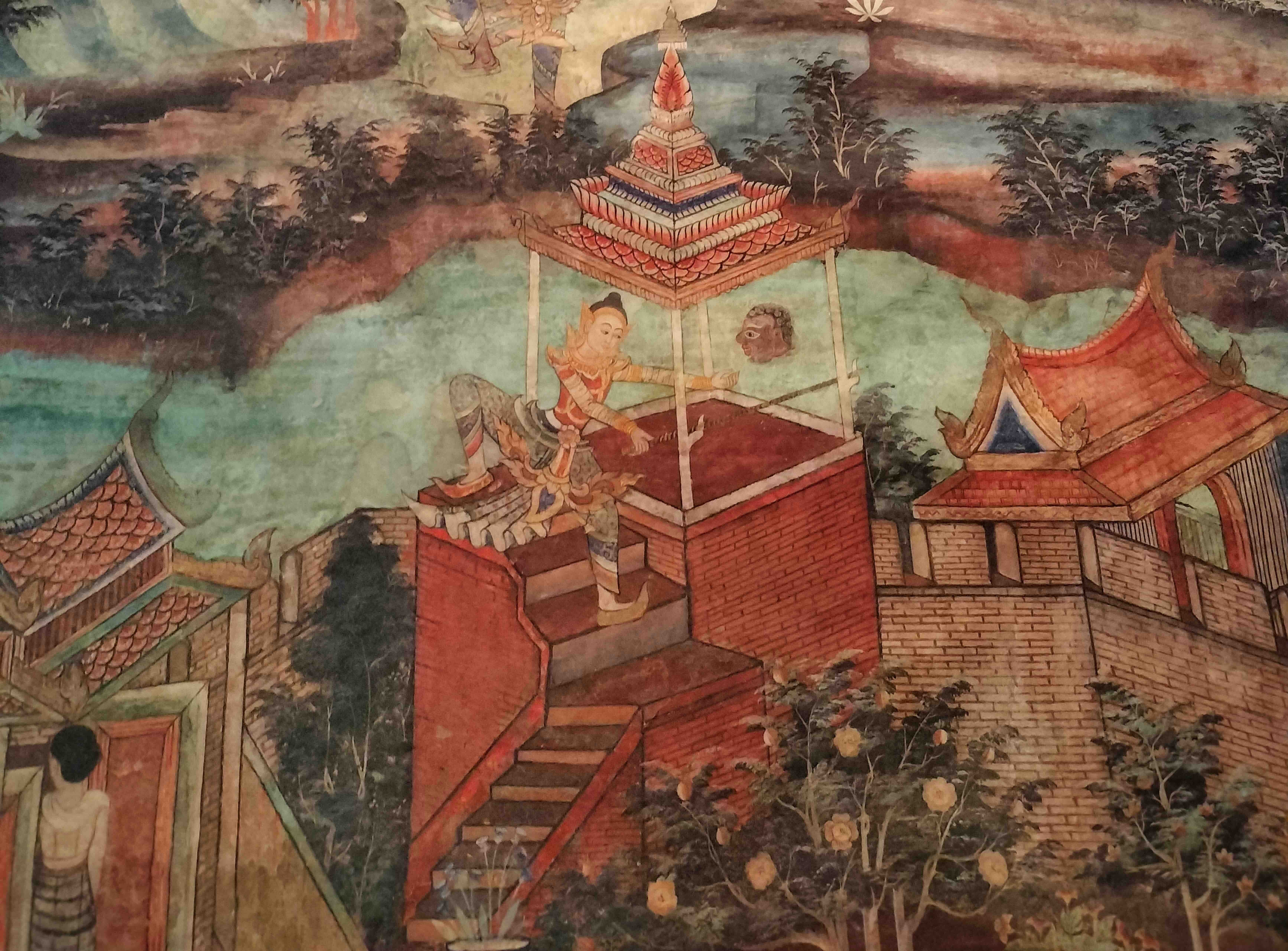

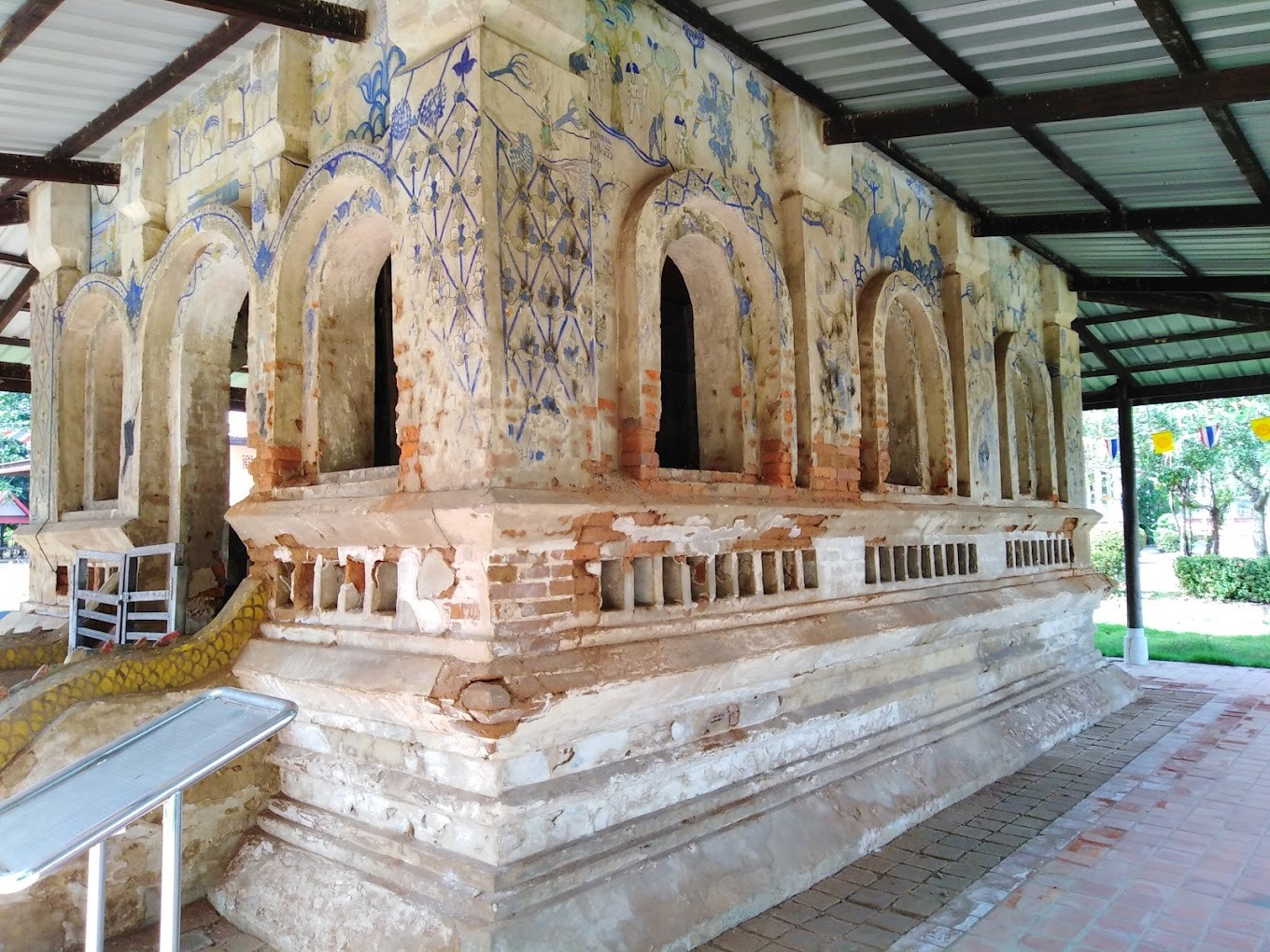
Murals from the Isan region, such as those at Wat Sanuan Wari, vividly capture the mid-air combat of the Vidyadharas. Their faces, contorted in desire, create a stark moral contrast with the serene fruit-maidens.

The Maiden Tree (Nariphon): Iconographic Evolution and Modern Art in Thailand (Part 2)

February 27, 2026

In Part 1, we explored the mythological roots of the Nariphon—the sacred Thai tree bearing fruit in the shape of young women—and its role as 'taboo software' within the Vessantara Jātaka. But how does a culture visually translate such a profound and provocative theological concept? In this second and final instalment, we trace the iconographic evolution of the fruit-maiden. From the rigid stylisation of classical temple murals in the Isan region to the tactile allure of modern amulets, and finally to the transformative feminist reinterpretations by contemporary artists, we examine how the Nariphon continues to adapt and thrive in the modern era.

Read the Article

Tree Iconography

From Temple Murals to Contemporary Canvas: The Visual Journey of the Fruit-Maiden

Arcangelo Di Paolo (M.Phil.)

February 27, 2026

In Part 1, we explored the mythological roots of the Nariphon—the sacred Thai tree bearing fruit in the shape of young women—and its role as 'taboo software' within the Vessantara Jātaka. But how does a culture visually translate such a profound and provocative theological concept? In this second and final instalment, we trace the iconographic evolution of the fruit-maiden. From the rigid stylisation of classical temple murals in the Isan region to the tactile allure of modern amulets, and finally to the transformative feminist reinterpretations by contemporary artists, we examine how the Nariphon continues to adapt and thrive in the modern era.

Classical Iconography: The Didactic Temple Murals

The earliest and most prominent visual manifestations of the Nariphon are found on the interior walls of Thai Buddhist temples (Wats). These murals were not merely decorative; they served as vital didactic tools for a largely agrarian, pre-literate society, bringing the complex cosmology of the Traibhumikatha (The Three Worlds) to vivid life.

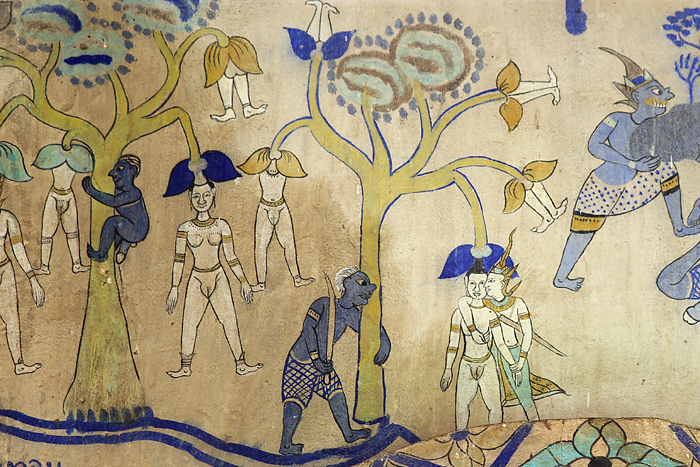
In classical Thai mural painting, the Nariphon is invariably situated within the dense, stylised foliage of the Himavanta forest. The iconographic rules governing her depiction were exceptionally strict. The fruit-maidens are painted with the idealised features of classical Thai beauty: serene expressions, elongated earlobes denoting spiritual elevation, and graceful, curved limbs. Crucially, they are depicted hanging from the branches by their heads, their bodies enveloped in a subtle, leafy modesty or adorned in ethereal, skin-tight garments.

Regional Variations: The Isan Murals

A closer iconographic analysis reveals fascinating regional variations, particularly in the Isan region (Northeastern Thailand). Temples such as Wat Sanuan Wari in Khon Kaen and Wat Photharam in Maha Sarakham provide striking examples of local artisans interpreting the royal court styles.

In these regional murals, the visual narrative often centres not on the peaceful growth of the tree, but on the frenetic chaos surrounding it. The murals present a striking visual dichotomy: the serene, passive beauty of the botanical maidens contrasts sharply with the aggressive, dynamic violence of the Vidyadharas (magical hermits).


"The classical murals capture a frenzied choreography of desire. Hermits are depicted flying through the air, clashing swords, or plummeting to the earth, having lost their magical powers the moment they succumb to lust."


Chiang Mai art Murals_wat Phra_Sing.jpeg

Contemporary Canvas: Reclaiming the Narrative

In the late 20th and early 21st centuries, the Nariphon motif entered the sphere of contemporary Thai art. This era is characterised by a critical re-evaluation of classical iconography, most notably by female artists who have begun to reclaim the narrative from its traditionally patriarchal perspective.

A prime example is the groundbreaking work of Phaptawan Suwannakudt, a pioneering female mural painter. Trained in the classical, male-dominated tradition of temple painting by her late father, Suwannakudt later deliberately deconstructed these traditional forms. In exhibitions and series such as Retold-Untold Stories and Catching the Moment, One Step at a Time, she extracts the Nariphon from the mythological Himavanta forest and places her squarely in the context of the modern world.

In Suwannakudt's work, the Nariphon is no longer merely a passive object of male temptation or a divine trap for lustful hermits. Instead, she uses the fruit-maiden to explore complex themes of female identity, bodily autonomy, and the constraints of traditional societal expectations in modern Thailand.

"In the hands of contemporary female artists, the Nariphon ceases to be a passive fruit to be consumed. She is reimagined as an active subject, challenging the viewer to reflect on the exoticisation and commodification of the female form in a globalised society."

Murals from the Isan region, such as those at Wat Sanuan Wari, vividly capture the mid-air combat of the Vidyadharas. Their faces, contorted in desire, create a stark moral contrast with the serene fruit-maidens.

Murals from the Isan region, such as those at Wat Sanuan Wari, vividly capture the mid-air combat of the Vidyadharas. Their faces, contorted in desire, create a stark moral contrast with the serene fruit-maidens.

Contemporary Canvas: Reclaiming the Narrative

In the late 20th and early 21st centuries, the Nariphon motif entered the sphere of contemporary Thai art. This era is characterised by a critical re-evaluation of classical iconography, most notably by female artists who have begun to reclaim the narrative from its traditionally patriarchal perspective.

A prime example is the groundbreaking work of Phaptawan Suwannakudt, a pioneering female mural painter. Trained in the classical, male-dominated tradition of temple painting by her late father, Suwannakudt later deliberately deconstructed these traditional forms. In exhibitions and series such as Retold-Untold Stories and Catching the Moment, One Step at a Time, she extracts the Nariphon from the mythological Himavanta forest and places her squarely in the context of the modern world.

In Suwannakudt's work, the Nariphon is no longer merely a passive object of male temptation or a divine trap for lustful hermits. Instead, she uses the fruit-maiden to explore complex themes of female identity, bodily autonomy, and the constraints of traditional societal expectations in modern Thailand.

"In the hands of contemporary female artists, the Nariphon ceases to be a passive fruit to be consumed. She is reimagined as an active subject, challenging the viewer to reflect on the exoticisation and commodification of the female form in a globalised society."
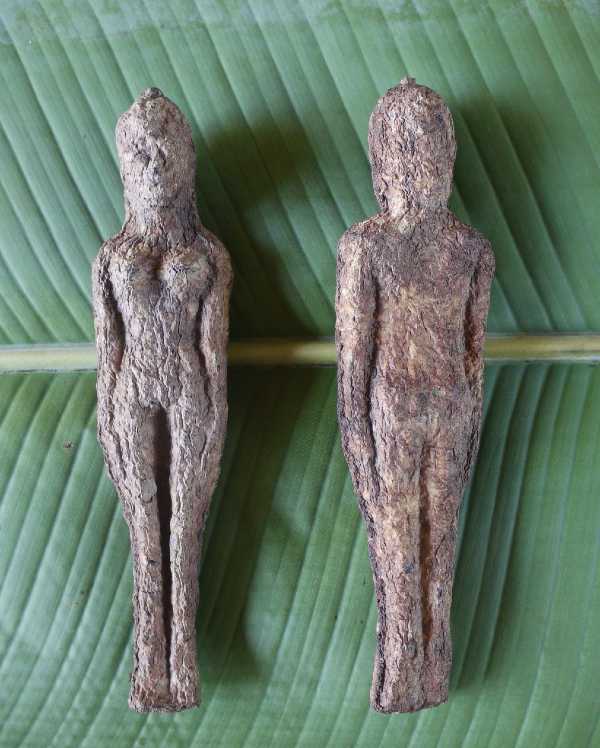

A modern Thai amulet depicting the Nariphon. In contemporary folk magic, the symbol has shifted from a warning against desire into a talisman actively used to cultivate charm and interpersonal attraction.

A modern Thai amulet depicting the Nariphon. In contemporary folk magic, the symbol has shifted from a warning against desire into a talisman actively used to cultivate charm and interpersonal attraction.

Conclusion: The Living Heritage of the Maiden Tree

The journey of the Nariphon—from the ancient South Asian Nāri-lāta vine to a towering fixture of Thai Buddhist cosmology, and finally to a subject of contemporary feminist art—demonstrates the remarkable resilience of indigenous mythologies.


The Maiden Tree is not a static relic of the past; it is a dynamic, living symbol. Whether painted on a 19th-century temple wall in Maha Sarakham to warn against the dangers of lust, worn around the neck in modern Bangkok to attract a lover, or painted on a contemporary canvas to question gender roles, the Nariphon remains a powerful testament to the enduring intersection of art, religion, and human desire in Southeast Asia.

Download the Full Research Paper

For a complete, in-depth academic analysis of the Nāri-lāta to Nariphon transition, including extensive citations, structural analysis, and visual comparisons, you can access the original peer-reviewed publication by Arcangelo Di Paolo.

📥 Download the Full PDF (SARJALL Journal) Here

brand

© 2021 - 2025 | Asian Heritage Silva : All rights reserved. a Website Created by matinee.icu

Murals from the Isan region, such as those at Wat Sanuan Wari, vividly capture the mid-air combat of the Vidyadharas. Their faces, contorted in desire, create a stark moral contrast with the serene fruit-maidens.

The Maiden Tree (Nariphon): Iconographic Evolution and Modern Art in Thailand (Part 2)

February 27, 2026

In Part 1, we explored the mythological roots of the Nariphon—the sacred Thai tree bearing fruit in the shape of young women—and its role as 'taboo software' within the Vessantara Jātaka. But how does a culture visually translate such a profound and provocative theological concept? In this second and final instalment, we trace the iconographic evolution of the fruit-maiden. From the rigid stylisation of classical temple murals in the Isan region to the tactile allure of modern amulets, and finally to the transformative feminist reinterpretations by contemporary artists, we examine how the Nariphon continues to adapt and thrive in the modern era.

Read the Article

Tree Iconography

From Temple Murals to Contemporary Canvas: The Visual Journey of the Fruit-Maiden

February 27, 2026

Arcangelo Di Paolo (M.Phil.)

In Part 1, we explored the mythological roots of the Nariphon—the sacred Thai tree bearing fruit in the shape of young women—and its role as 'taboo software' within the Vessantara Jātaka. But how does a culture visually translate such a profound and provocative theological concept? In this second and final instalment, we trace the iconographic evolution of the fruit-maiden. From the rigid stylisation of classical temple murals in the Isan region to the tactile allure of modern amulets, and finally to the transformative feminist reinterpretations by contemporary artists, we examine how the Nariphon continues to adapt and thrive in the modern era.

Classical Iconography: The Didactic Temple Murals

The earliest and most prominent visual manifestations of the Nariphon are found on the interior walls of Thai Buddhist temples (Wats). These murals were not merely decorative; they served as vital didactic tools for a largely agrarian, pre-literate society, bringing the complex cosmology of the Traibhumikatha (The Three Worlds) to vivid life.

In classical Thai mural painting, the Nariphon is invariably situated within the dense, stylised foliage of the Himavanta forest. The iconographic rules governing her depiction were exceptionally strict. The fruit-maidens are painted with the idealised features of classical Thai beauty: serene expressions, elongated earlobes denoting spiritual elevation, and graceful, curved limbs. Crucially, they are depicted hanging from the branches by their heads, their bodies enveloped in a subtle, leafy modesty or adorned in ethereal, skin-tight garments.

Regional Variations: The Isan Murals

A closer iconographic analysis reveals fascinating regional variations, particularly in the Isan region (Northeastern Thailand). Temples such as Wat Sanuan Wari in Khon Kaen and Wat Photharam in Maha Sarakham provide striking examples of local artisans interpreting the royal court styles.

In these regional murals, the visual narrative often centres not on the peaceful growth of the tree, but on the frenetic chaos surrounding it. The murals present a striking visual dichotomy: the serene, passive beauty of the botanical maidens contrasts sharply with the aggressive, dynamic violence of the Vidyadharas (magical hermits).


"The classical murals capture a frenzied choreography of desire. Hermits are depicted flying through the air, clashing swords, or plummeting to the earth, having lost their magical powers the moment they succumb to lust."


Chiang Mai art Murals_wat Phra_Sing.jpeg

Contemporary Canvas: Reclaiming the Narrative

In the late 20th and early 21st centuries, the Nariphon motif entered the sphere of contemporary Thai art. This era is characterised by a critical re-evaluation of classical iconography, most notably by female artists who have begun to reclaim the narrative from its traditionally patriarchal perspective.

A prime example is the groundbreaking work of Phaptawan Suwannakudt, a pioneering female mural painter. Trained in the classical, male-dominated tradition of temple painting by her late father, Suwannakudt later deliberately deconstructed these traditional forms. In exhibitions and series such as Retold-Untold Stories and Catching the Moment, One Step at a Time, she extracts the Nariphon from the mythological Himavanta forest and places her squarely in the context of the modern world.

In Suwannakudt's work, the Nariphon is no longer merely a passive object of male temptation or a divine trap for lustful hermits. Instead, she uses the fruit-maiden to explore complex themes of female identity, bodily autonomy, and the constraints of traditional societal expectations in modern Thailand.

"In the hands of contemporary female artists, the Nariphon ceases to be a passive fruit to be consumed. She is reimagined as an active subject, challenging the viewer to reflect on the exoticisation and commodification of the female form in a globalised society."


Murals from the Isan region, such as those at Wat Sanuan Wari, vividly capture the mid-air combat of the Vidyadharas. Their faces, contorted in desire, create a stark moral contrast with the serene fruit-maidens.

Murals from the Isan region, such as those at Wat Sanuan Wari, vividly capture the mid-air combat of the Vidyadharas. Their faces, contorted in desire, create a stark moral contrast with the serene fruit-maidens.

Contemporary Canvas: Reclaiming the Narrative

In the late 20th and early 21st centuries, the Nariphon motif entered the sphere of contemporary Thai art. This era is characterised by a critical re-evaluation of classical iconography, most notably by female artists who have begun to reclaim the narrative from its traditionally patriarchal perspective.

A prime example is the groundbreaking work of Phaptawan Suwannakudt, a pioneering female mural painter. Trained in the classical, male-dominated tradition of temple painting by her late father, Suwannakudt later deliberately deconstructed these traditional forms. In exhibitions and series such as Retold-Untold Stories and Catching the Moment, One Step at a Time, she extracts the Nariphon from the mythological Himavanta forest and places her squarely in the context of the modern world.

In Suwannakudt's work, the Nariphon is no longer merely a passive object of male temptation or a divine trap for lustful hermits. Instead, she uses the fruit-maiden to explore complex themes of female identity, bodily autonomy, and the constraints of traditional societal expectations in modern Thailand.

"In the hands of contemporary female artists, the Nariphon ceases to be a passive fruit to be consumed. She is reimagined as an active subject, challenging the viewer to reflect on the exoticisation and commodification of the female form in a globalised society."


A modern Thai amulet depicting the Nariphon. In contemporary folk magic, the symbol has shifted from a warning against desire into a talisman actively used to cultivate charm and interpersonal attraction.

A modern Thai amulet depicting the Nariphon. In contemporary folk magic, the symbol has shifted from a warning against desire into a talisman actively used to cultivate charm and interpersonal attraction.

Conclusion: The Living Heritage of the Maiden Tree

The journey of the Nariphon—from the ancient South Asian Nāri-lāta vine to a towering fixture of Thai Buddhist cosmology, and finally to a subject of contemporary feminist art—demonstrates the remarkable resilience of indigenous mythologies.


The Maiden Tree is not a static relic of the past; it is a dynamic, living symbol. Whether painted on a 19th-century temple wall in Maha Sarakham to warn against the dangers of lust, worn around the neck in modern Bangkok to attract a lover, or painted on a contemporary canvas to question gender roles, the Nariphon remains a powerful testament to the enduring intersection of art, religion, and human desire in Southeast Asia.

Download the Full Research Paper

For a complete, in-depth academic analysis of the Nāri-lāta to Nariphon transition, including extensive citations, structural analysis, and visual comparisons, you can access the original peer-reviewed publication by Arcangelo Di Paolo.

📥 Download the Full PDF (SARJALL Journal) Here

PAPER

Spatial Syntax of the Sacred Ficus

A. Di Paolo

January 12, 2026

PAPER

The Sentient Landscape: An Examination of Asia's Cosmological Vision of the Forest

A. Di Paolo

January 16, 2026

PAPER

An Eco-Dhammic Response: The Realignment of Soteriology and Conservation in Contemporary Thai Buddhism

A. Di Paolo

January 23, 2026

Donate Today

Support the costs of the project to keep it alive

DONATE

Explore More

About The Map Project

Learn Map Builder

Help Through GFW

Privacy Policy

About

Our Vision

Contact Us

CONNECT

Facebook Icn
bluesky icon
mastodon icon
brand

© 2021 - 2025 | Asian Heritage Silva : All rights reserved. a Website Created by matinee.icu

Murals from the Isan region, such as those at Wat Sanuan Wari, vividly capture the mid-air combat of the Vidyadharas. Their faces, contorted in desire, create a stark moral contrast with the serene fruit-maidens.

The Maiden Tree (Nariphon): Iconographic Evolution and Modern Art in Thailand (Part 2)

February 27, 2026

In Part 1, we explored the mythological roots of the Nariphon—the sacred Thai tree bearing fruit in the shape of young women—and its role as 'taboo software' within the Vessantara Jātaka. But how does a culture visually translate such a profound and provocative theological concept? In this second and final instalment, we trace the iconographic evolution of the fruit-maiden. From the rigid stylisation of classical temple murals in the Isan region to the tactile allure of modern amulets, and finally to the transformative feminist reinterpretations by contemporary artists, we examine how the Nariphon continues to adapt and thrive in the modern era.

Tree Iconography

From Temple Murals to Contemporary Canvas: The Visual Journey of the Fruit-Maiden

Arcangelo Di Paolo (M.Phil.)

February 27, 2026

In Part 1, we explored the mythological roots of the Nariphon—the sacred Thai tree bearing fruit in the shape of young women—and its role as 'taboo software' within the Vessantara Jātaka. But how does a culture visually translate such a profound and provocative theological concept? In this second and final instalment, we trace the iconographic evolution of the fruit-maiden. From the rigid stylisation of classical temple murals in the Isan region to the tactile allure of modern amulets, and finally to the transformative feminist reinterpretations by contemporary artists, we examine how the Nariphon continues to adapt and thrive in the modern era.

Classical Iconography: The Didactic Temple Murals

The earliest and most prominent visual manifestations of the Nariphon are found on the interior walls of Thai Buddhist temples (Wats). These murals were not merely decorative; they served as vital didactic tools for a largely agrarian, pre-literate society, bringing the complex cosmology of the Traibhumikatha (The Three Worlds) to vivid life.

In classical Thai mural painting, the Nariphon is invariably situated within the dense, stylised foliage of the Himavanta forest. The iconographic rules governing her depiction were exceptionally strict. The fruit-maidens are painted with the idealised features of classical Thai beauty: serene expressions, elongated earlobes denoting spiritual elevation, and graceful, curved limbs. Crucially, they are depicted hanging from the branches by their heads, their bodies enveloped in a subtle, leafy modesty or adorned in ethereal, skin-tight garments.

Regional Variations: The Isan Murals

A closer iconographic analysis reveals fascinating regional variations, particularly in the Isan region (Northeastern Thailand). Temples such as Wat Sanuan Wari in Khon Kaen and Wat Photharam in Maha Sarakham provide striking examples of local artisans interpreting the royal court styles.

In these regional murals, the visual narrative often centres not on the peaceful growth of the tree, but on the frenetic chaos surrounding it. The murals present a striking visual dichotomy: the serene, passive beauty of the botanical maidens contrasts sharply with the aggressive, dynamic violence of the Vidyadharas (magical hermits).


"The classical murals capture a frenzied choreography of desire. Hermits are depicted flying through the air, clashing swords, or plummeting to the earth, having lost their magical powers the moment they succumb to lust."


Chiang Mai art Murals_wat Phra_Sing.jpeg

The Shift to Three Dimensions: Sculptures and Talismans

As Thai religious practices evolved and merged heavily with local animism, the Nariphon transitioned from the two-dimensional realm of temple walls into the three-dimensional world of tactile objects. This shift marked a significant change in the myth's social and psychological function.

Wood carvings of the Nariphon began to appear as architectural embellishments, serving as physical boundary markers between the profane exterior and the sacred interior of temple pavilions. However, the most culturally pervasive three-dimensional evolution is the miniaturisation of the Nariphon into amulets and talismans.

In the realm of popular Thai folk magic, Nariphon amulets are carved from supposedly sacred woods, cast in metal, or moulded from auspicious herbal powders. Often, these miniature figures are encased in plastic and submerged in sacred oils (nam man prai or similar botanical consecrations).

These artefacts are highly sought after in the modern amulet markets for their supposed magical properties—specifically related to Metta Mahaniyom (loving-kindness and commercial popularity) and Maha Sanaeh (charm and romantic attraction).

By possessing a physical token of the ultimate mythological temptation, the wearer hopes to harness a fraction of its irresistible allure. Here lies a profound iconographic irony: a symbol originally designed to teach the Buddhist lesson of impermanence (Anicca) and the dangers of lust has been reappropriated as a practical, everyday tool to attract wealth and romance.

Murals from the Isan region, such as those at Wat Sanuan Wari, vividly capture the mid-air combat of the Vidyadharas. Their faces, contorted in desire, create a stark moral contrast with the serene fruit-maidens.

Contemporary Canvas: Reclaiming the Narrative

In the late 20th and early 21st centuries, the Nariphon motif entered the sphere of contemporary Thai art. This era is characterised by a critical re-evaluation of classical iconography, most notably by female artists who have begun to reclaim the narrative from its traditionally patriarchal perspective.

A prime example is the groundbreaking work of Phaptawan Suwannakudt, a pioneering female mural painter. Trained in the classical, male-dominated tradition of temple painting by her late father, Suwannakudt later deliberately deconstructed these traditional forms. In exhibitions and series such as Retold-Untold Stories and Catching the Moment, One Step at a Time, she extracts the Nariphon from the mythological Himavanta forest and places her squarely in the context of the modern world.

In Suwannakudt's work, the Nariphon is no longer merely a passive object of male temptation or a divine trap for lustful hermits. Instead, she uses the fruit-maiden to explore complex themes of female identity, bodily autonomy, and the constraints of traditional societal expectations in modern Thailand.

"In the hands of contemporary female artists, the Nariphon ceases to be a passive fruit to be consumed. She is reimagined as an active subject, challenging the viewer to reflect on the exoticisation and commodification of the female form in a globalised society."


A modern Thai amulet depicting the Nariphon. In contemporary folk magic, the symbol has shifted from a warning against desire into a talisman actively used to cultivate charm and interpersonal attraction.

Conclusion: The Living Heritage of the Maiden Tree

The journey of the Nariphon—from the ancient South Asian Nāri-lāta vine to a towering fixture of Thai Buddhist cosmology, and finally to a subject of contemporary feminist art—demonstrates the remarkable resilience of indigenous mythologies.


The Maiden Tree is not a static relic of the past; it is a dynamic, living symbol. Whether painted on a 19th-century temple wall in Maha Sarakham to warn against the dangers of lust, worn around the neck in modern Bangkok to attract a lover, or painted on a contemporary canvas to question gender roles, the Nariphon remains a powerful testament to the enduring intersection of art, religion, and human desire in Southeast Asia.

PAPER

Spatial Syntax of the Sacred Ficus

A. Di Paolo

January 12, 2026

PAPER

The Sentient Landscape: An Examination of Asia's Cosmological Vision of the Forest

A. Di Paolo

January 16, 2026

PAPER

An Eco-Dhammic Response: The Realignment of Soteriology and Conservation in Contemporary Thai Buddhism

A. Di Paolo

January 23, 2026

brand

© 2021 - 2025 | Asian Heritage Silva : All rights reserved. | A Website Created by matinee.icu