![A candid ethnographic photograph of a large Hmong community gathering outdoors in a [village/marketplace] setting in [Southeast Asia/Northern Vietnam/Laos]. Numerous individuals of different generations mingle, with many women wearing distinctive traditional Hmong embroidered attire, silver jewellery, and headdresses. The atmosphere appears engaged and communal.](/_assets/v11/f209fb2bc57c2c174712e07b344c5bf314547616.png)
Can ancient taboos succeed where modern forestry laws fail? In the heart of the Annamite Mountains, the Mnong Gar people (the 'Men of the Forest') operate a sophisticated Indigenous Conservation Framework known as 'Taboo Software.' This paper decodes the Mnong Gar ecocosmology, revealing how ritualised 'social consumption' of the forest—encapsulated in the phrase Hii saa brit—regulates biodiversity. By examining the role of 'Spirit-Hills' as ecological nodal points and the sacred groves protected by the croo weer (holy men), we argue for a paradigm shift in Vietnam's forestry policy. Discover how the transition from state-led policing to spiritual governance offers a resilient future for Southeast Asia’s most threatened biological corridors.
Vietnam Forestry
Beyond the Canopy: Mapping the 'Taboo Software' and Sentient Geography of the Central Highlands.

Asian Heritage Silva Research Team
February 13, 2026
Introduction: The Annamite Corridor as a Curated Sacred Landscape
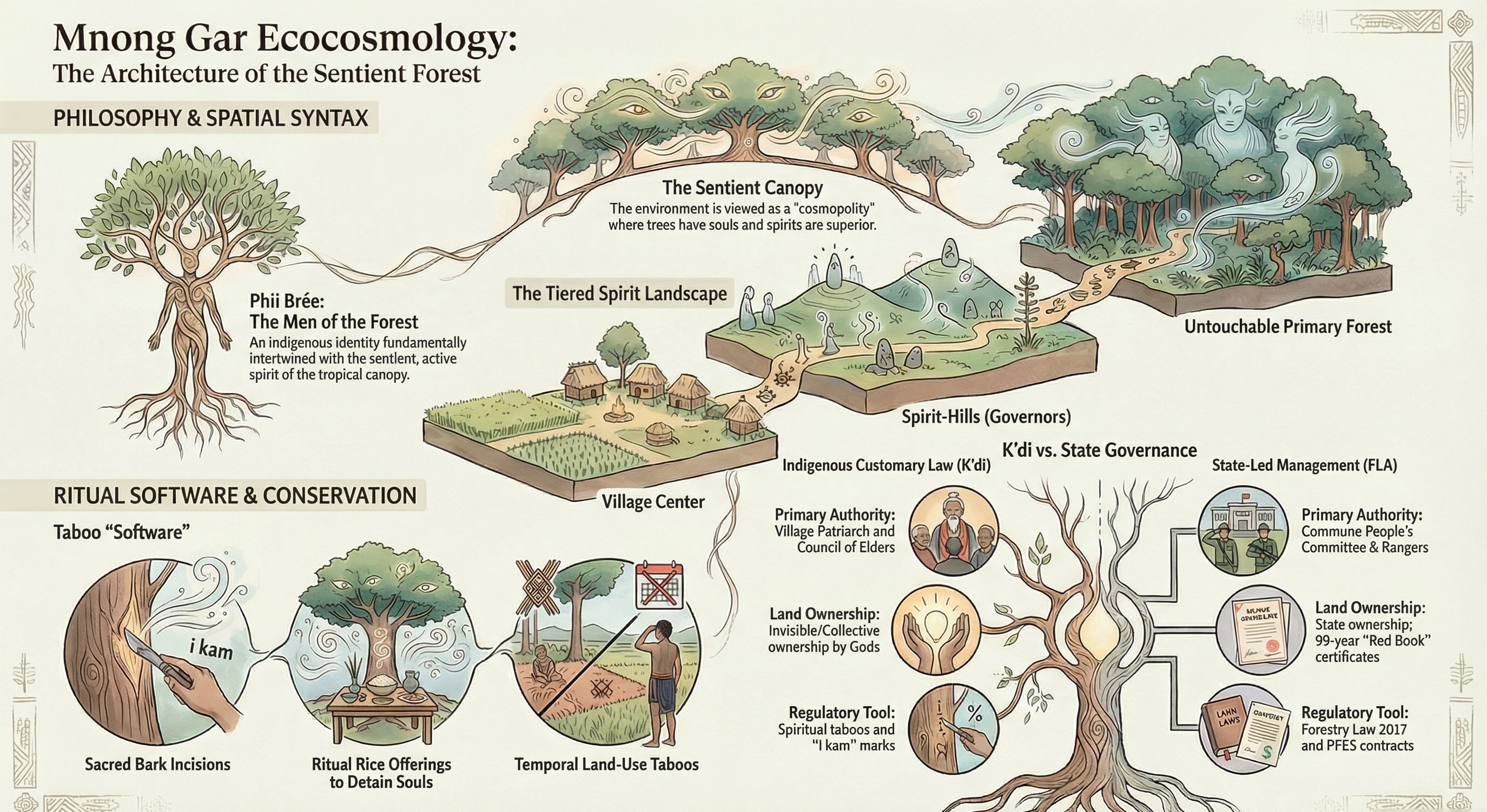
The Central Annamite Corridor is frequently mischaracterised in state discourse as a pristine "wilderness"; however, a rigorous visual anthropology reveals a "curated landscape" meticulously shaped by centuries of Phii Brée presence. To analyse the spatial dynamics of the Daak Kroong valley is to recognise that the forest is a social and spiritual entity. The inhabitants of Sar Luk do not merely reside in the landscape; they spatialise their history through it.
This is most vividly expressed in their temporal markers: the Mnong Gar log the passing of time by referring to the specific wooded areas they clear and burn. As documented in the foundational ethnographic fieldwork of Georges Condominas (1977), the phrase "Hii saa brit..." ("We ate the forest of...") followed by a specific spirit-name—such as the Stone Spirit Géo—serves as the primary method for designating an agricultural year.
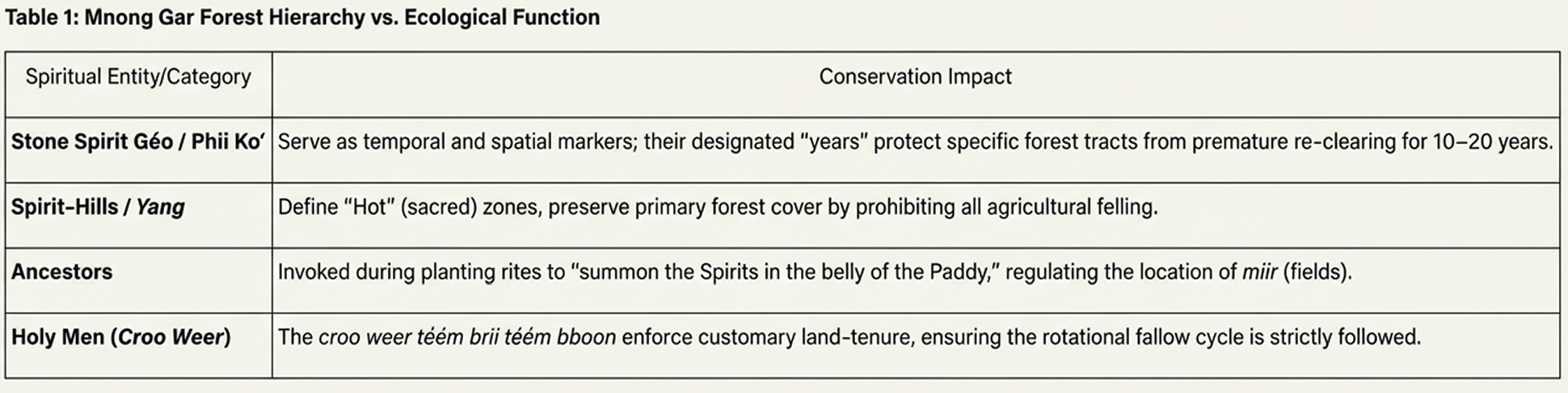
This "forest-eating" is a cyclical management programme rather than a destructive act. By clearing sections of the forest and returning to them only after a successional cycle of ten to twenty years, the Mnong Gar manage the forest’s regeneration. This lived-in environment is governed by a taxonomic hierarchy that dictates which areas are utilitarian miir (slash-and-burn fields) and which remain inviolate, ensuring that the "forest-eaters" maintain a symbiotic equilibrium with a sentient canopy.
Section II: The Ritual Grammar of Harvest – The Communion of the Ritual Pole
Ritual acts as a strategic "speed-bump" to over-exploitation by transforming extraction into a mediated exchange. Ethnographic fieldwork conducted by Condominas identified that no significant felling or planting occurs without a ritual sequence that acknowledges the tree and soil as sentient.
- Phase A: The Invocation. Before the forest is "eaten," the holy men must insert the drinking straw into the jar of rndém (rice beer) to invoke the ancestors. This phase serves as a formal inquiry to the spirits regarding the suitability of the land, preventing the clearing of "Hot" or spiritually prohibited zones.
- Phase B: The Anointing. The "ritual grammar" of the harvest is best seen in the anointing of the sacrificial posts and the "giant-bamboo pole masts" ( ndah rlaa ). Anointing these structures with blood or rice beer marks the transition of the forest from a standing timberland to a managed miir .
- Phase C: The Exchange. The "Exchange of Buffalo Sacrifices," such as those performed by Baap Can and Ndéh (Condominas, 1977, p. 19), functions as the economic engine of the forest. The sacrifice of the buffalo is the ultimate gift-exchange, where animal life is offered to the Spirits of the Soil to ensure the continued fertility of the "curated" forest.
Section II: The Ritual Grammar of Harvest – The Communion of the Ritual Pole
Ritual acts as a strategic "speed-bump" to over-exploitation by transforming extraction into a mediated exchange. Ethnographic fieldwork conducted by Condominas identified that no significant felling or planting occurs without a ritual sequence that acknowledges the tree and soil as sentient.
- Phase A: The Invocation. Before the forest is "eaten," the holy men must insert the drinking straw into the jar of rndém (rice beer) to invoke the ancestors. This phase serves as a formal inquiry to the spirits regarding the suitability of the land, preventing the clearing of "Hot" or spiritually prohibited zones.
- Phase B: The Anointing. The "ritual grammar" of the harvest is best seen in the anointing of the sacrificial posts and the "giant-bamboo pole masts" ( ndah rlaa ). Anointing these structures with blood or rice beer marks the transition of the forest from a standing timberland to a managed miir .
- Phase C: The Exchange. The "Exchange of Buffalo Sacrifices," such as those performed by Baap Can and Ndéh (Condominas, 1977, p. 19), functions as the economic engine of the forest. The sacrifice of the buffalo is the ultimate gift-exchange, where animal life is offered to the Spirits of the Soil to ensure the continued fertility of the "curated" forest.

The river as a spiritual and economic artery. B/W photography serves to highlight the textural relationship between the Katu people and the 'Water Mother' (Yang Dak), a central figure in the Annamite spirit landscape
Section III: Spatial Syntax & Taboo – "Taboo Software" as Biodiversity Management
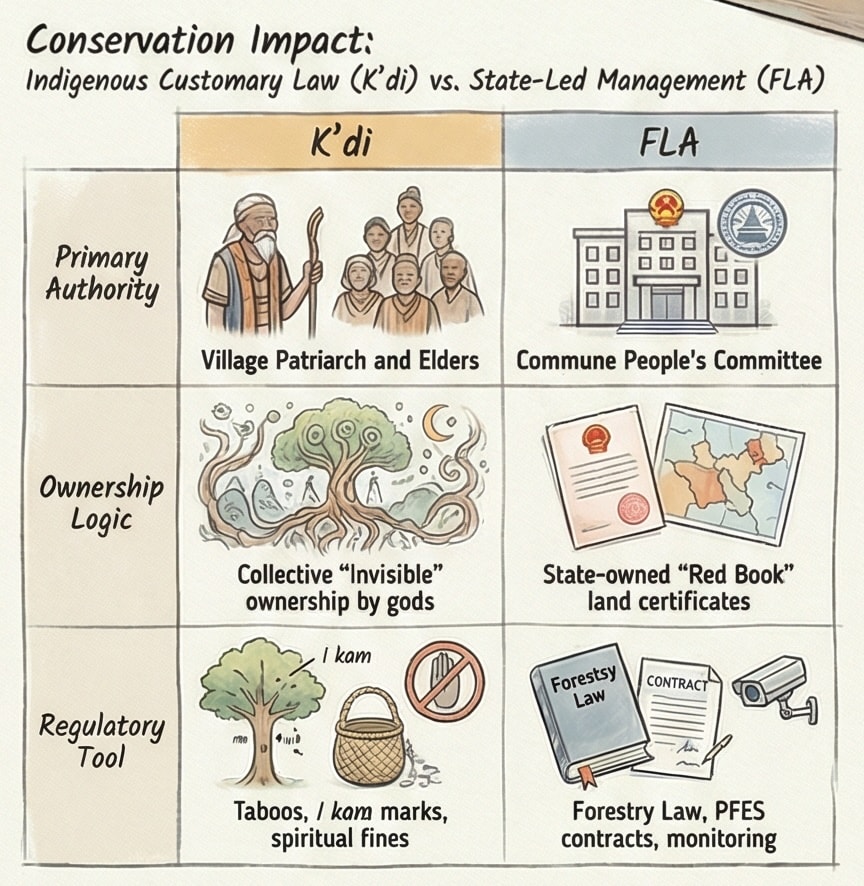
The Mnong Gar manage their environment through "Taboo Software"—a complex system of invisible boundaries that regulate human movement. This system possesses a strategic advantage over state-led conservation because it is enforced internally through spiritual sanction ( K’di ) rather than external physical policing.The "Spatial Syntax" of the forest divides the landscape into "Hot" (prohibited) and "Cold" (managed) zones.
"Hot" zones are the habitats of the Yang and the Spirit Nduu; disturbance in these areas is believed to bring illness or death. Conversely, "Cold" zones are the utilitarian areas where miir are permitted. These zones are governed by the three croo weer téém brii téém bboon, whose authority ensures that primary forest remains fragmented but connected through sacred corridors.
The Three Pillars of Mnong Gar Biodiversity Management
- Sacred Groves (Spirit-Hills): Permanent, inviolate tracts of full-grown timberland protected by the residency of spirits.
- Temporal Taboos ( Hii saa brit ): A successional programme that prevents the over-farming of soil by mandating 10–20 year fallow periods.
- Customary Enforcement: The application of indigenous law by the holy men to settle land-tenure disputes, ensuring the "rice planter’s axe" never crosses into sacred precincts.
Conclusion: The Resilience of Phii Brée Animism in Modernity
The Mnong Gar ecocosmology has demonstrated remarkable resilience despite the historical "ethnocide" and "uprooting" of populations. Condominas (1977) documented the "sorrowful" meeting in 1958 where the Diemist regime and subsequent military administrations attempted to suppress traditional customs—ridiculing loincloths and forbidding sacrifices—in an attempt to make their culture disappear.
The later creation of "Special Forces camps" and "Free Strike Zones" in the Daak Kroong valley represented a physical and cultural attempt to sever the people from the land they "commune with as if it were human."Despite these attempts at "uprooting," the underlying "Taboo Software" persists as a form of ecological resistance. For modern conservationists, the "So What?" layer is clear: the survival of the Annamite Corridor depends on integrating these indigenous land-tenure systems into state policy. To ignore the spiritual arbiter of the forest is to ignore the very mechanism that has preserved the biodiversity of Sar Luk for millennia.
References
------
- Århem, K. (n.d.). Spirit-hills and nodal governors: Ecosystem management in the Central Highlands.
- Condominas, G. (1977). We Have Eaten the Forest: The Story of a Montagnard Village in the Central Highlands of Vietnam . (A. Foulke, Trans.). New York, NY: Hill and Wang. (Original work published 1957 as Nous Avons Mangé la Forêt de la Pierre-Génie G6o ).
- Le, T. (n.d.). The Forest Mother: Indigenous frameworks of resource allocation.
- Phan, N. (n.d.). Emic ecological models and taxonomic hierarchies in the Annamite Corridor.

Paper
From Sacred Groves to Pop Culture: The Iconographic Evolution and Cultural Resonance of the Nariphon Fruit-Maiden
Asian Heritage Silva Research Team
March 13, 2026
Paper
The Maiden Tree (Nariphon): Iconographic Evolution and Modern Art in Thailand (Part 2)
Arcangelo Di Paolo (M.Phil.)
February 27, 2026
Paper
The Maiden Tree (Nariphon): Origins and Mythology in Thai Buddhist Cosmology (Part 1).
Arcangelo Di Paolo (M.Phil.)
February 21, 2026