The Nariphon, or Makkaliphon, represents a quintessential "Emic Iconographic Model" within the hagiographic and cosmological traditions of Theravada Buddhism. This entity is defined by its profound plant-human liminality—an ontological state of being "spiritually bone-less." Manifesting as the fruit of a mythical tree, the Nariphon possesses the exteriority of an adolescent human female whilst remaining fundamentally vegetative, lacking the "sentient scaffolding" of a skeletal structure. This lack of internal bone reflects a unique ontological instability, positioning the fruit-maiden as a bridge between the celestial Himavanta forest and the necessity for terrestrial moral discipline. Historically, the Nariphon has functioned as a didactic staging ground, designed to test the ascetic resolve of forest-dwelling hermits through sensory entrapment. As documented in the Traiphum Phra Ruang, these beings exhibit a beauty comparable to sixteen-year-old maidens, serving as a visceral illustration of the Buddhist concept of Anatta (non-self) through their hollow, vegetative mimicry of human form. However, the trajectory of this icon has evolved from fixed canonical texts to fluid visual interpretations. In contemporary visual anthropology, the Nariphon has undergone a radical semiotic metamorphosis. Recent critical reinterpretations, most notably the feminist critiques of artists such as Phaptawan Suwannakudt, have reframed the "fruit-maiden" as a poignant symbol of gendered oppression and the commodification of young girls. This transition from sacred devotion to secular critique demonstrates the enduring resilience of the Nariphon as it navigates the tensions between ancient hagiography and modern social conscience.
Tree Iconography
Exploring the plant-human liminality, Buddhist cosmology, and contemporary feminist reinterpretation of Thailand's mythical fruit-maiden.

Asian Heritage Silva Research Team
March 13, 2026
Introduction: The Curated Liminality of Himavanta
The Himavanta (or Himapaan) forest is not merely a topographical relic of ancient mythology; it is a curated, sacred, and liminal landscape situated precisely between the human realm and the heavens. As articulated in the visual narratives of the Siam Niramit context, the Himavanta functions as an "otherworldly jungle" where time remains suspended and mythical beings roam freely, untouched by the decay of the terrestrial world. This celestial grove serves as the essential staging ground for Buddhist didacticism, where the environment itself is encoded with moral imperatives.
The most enigmatic inhabitant of this sacred grove is the Nariphon. Unlike the hybrid Kinaree (bird-maiden) or the Khochasi (elephant-lion), whose identities are formed through the fusion of animal kingdoms, the Nariphon challenges the very biology of the natural world. It is a creature that grows as fruit yet mimics the human, possessing a visual allure that belies its lack of a soul or "bone-less" vegetative nature. Consequently, it remains the ultimate litmus test for those navigating the path to spiritual enlightenment amidst the fluid boundaries of the Himavanta.
II. The Chronology of Manuscripts and Murals
Visual media, from portable manuscripts to fixed temple murals, facilitate a "comparative visual analysis" that reveals significant regional tensions and historical shifts.
Manuscript Evaluation
Historical accounts provide varying perspectives on the iconographic representation of the Nariphon:
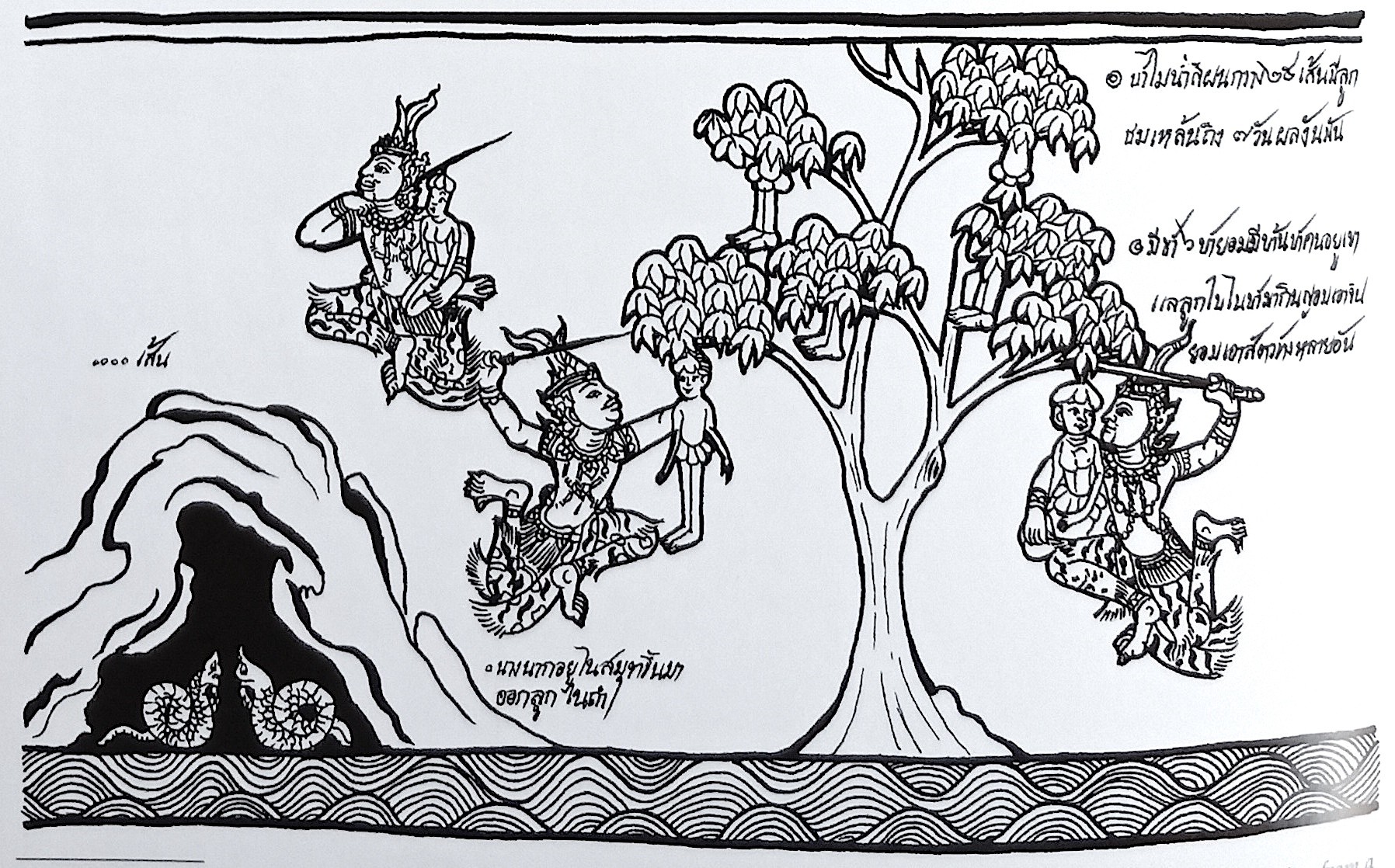
- James Low (1824): Documented the specific maturation stages of the fruit and the iconic presence of the hermit in tiger skin, who serves as a foil to the fruit’s vegetative beauty.
- Burmese Lawka-koon-char (1842): Employs the Thu-yong-thee terminology and provides the rare iconographic depiction of male fruits, expanding the botanical-human metaphor.
- Spencer Collection (Mahānipāta Jātaka): Illustrates the complex interactions between withiyathon celestials and terrestrial hermits, showcasing the Nariphon as a shared object of visual consumption across spiritual strata.
Mural Contrast: Heartland Vernacular vs. Standardised Realism
The "Isan Heartland" style of northeastern Thailand provides a stark contrast to the standardised realism promoted by the Fine Arts Department in Central Thailand.
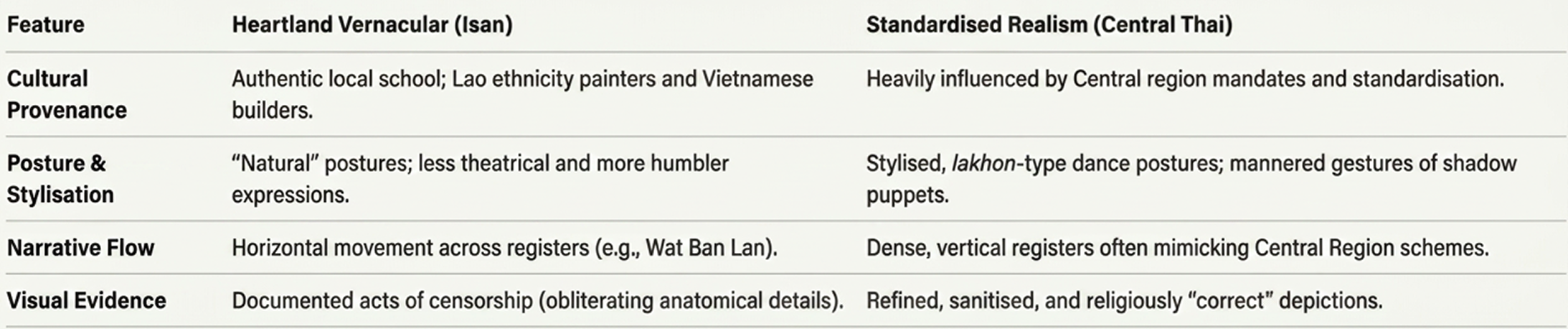
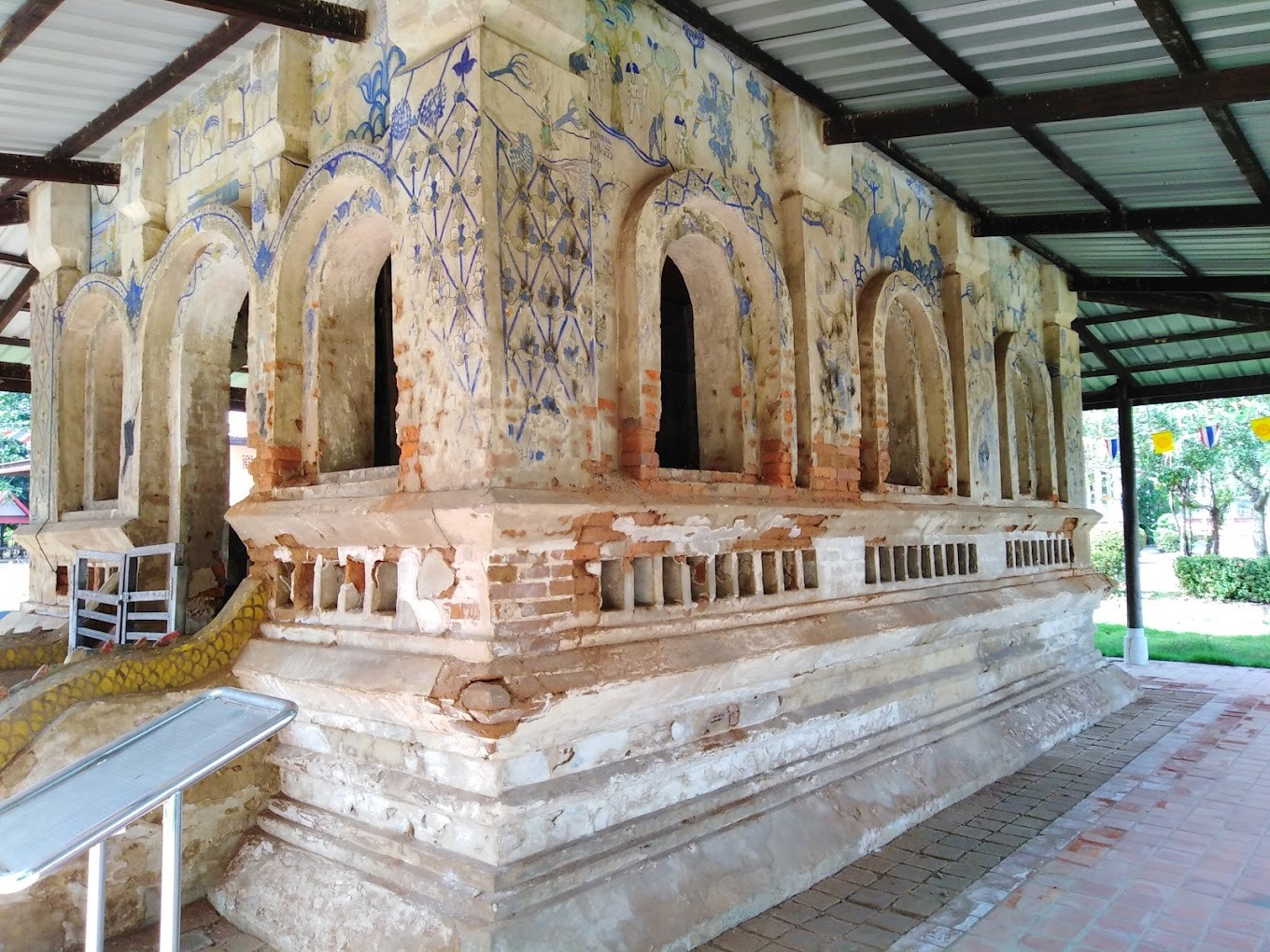
As Brereton (2010) observes, the murals at Wat Ban Lan and Wat Sanuan Wari exhibit a distinctiveness of the local Buddhist imagination. In these heartland scenes, withiyathon are often depicted ogling the Nariphon. Crucially, certain details have been deliberately damaged; scratches on the wall surface to obliterate the anatomy of a withiyathon lying on his back reflect a tension between local "bawdy" humour and formal monastic decorum. Furthermore, the presence of highly stylised figures, such as naga and singha guarding the stairs of the sim (ordination hall), suggests the apotropaic (protective) function of mythical beings in regional architecture.
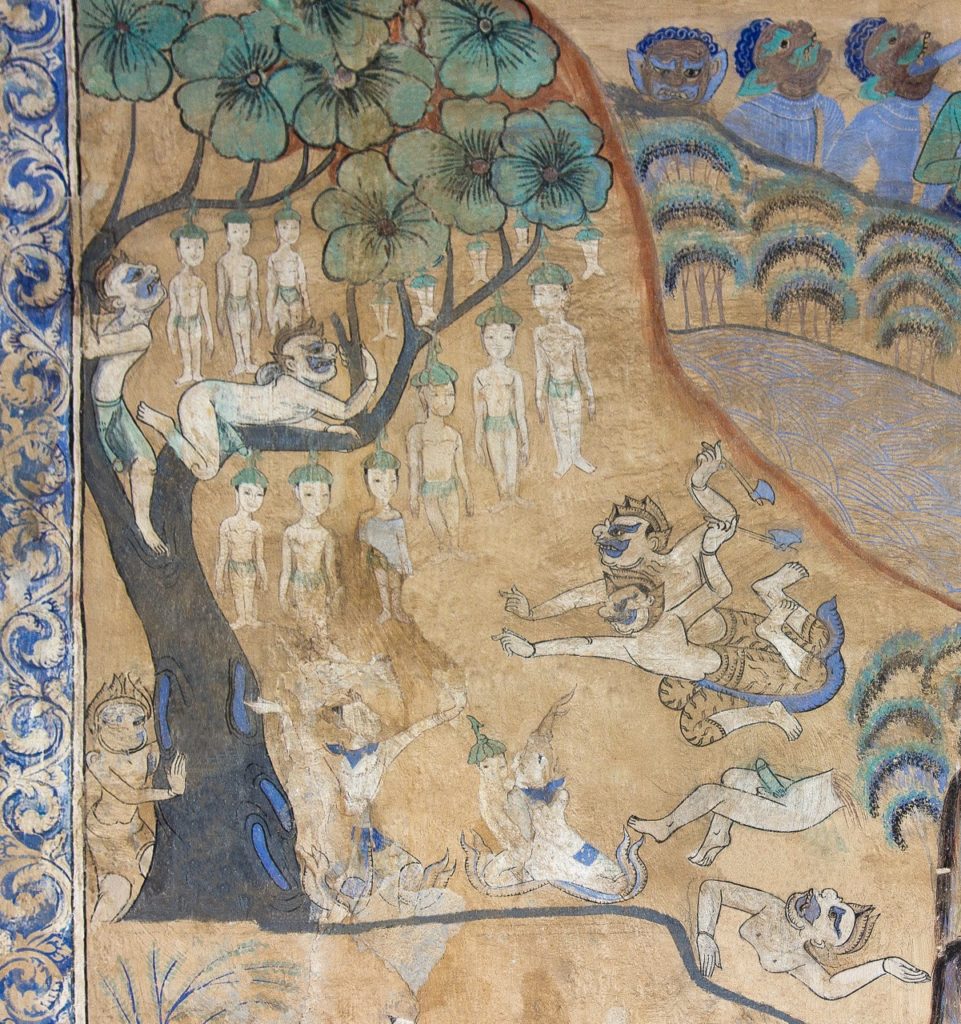
Wat Photaram in Maha Sarakham : 19th century or earlier.
II. The Chronology of Manuscripts and Murals
Visual media, from portable manuscripts to fixed temple murals, facilitate a "comparative visual analysis" that reveals significant regional tensions and historical shifts.
Manuscript Evaluation
Historical accounts provide varying perspectives on the iconographic representation of the Nariphon:
- James Low (1824): Documented the specific maturation stages of the fruit and the iconic presence of the hermit in tiger skin, who serves as a foil to the fruit’s vegetative beauty.
- Burmese Lawka-koon-char (1842): Employs the Thu-yong-thee terminology and provides the rare iconographic depiction of male fruits, expanding the botanical-human metaphor.
- Spencer Collection (Mahānipāta Jātaka): Illustrates the complex interactions between withiyathon celestials and terrestrial hermits, showcasing the Nariphon as a shared object of visual consumption across spiritual strata.
Mural Contrast: Heartland Vernacular vs. Standardised Realism
The "Isan Heartland" style of northeastern Thailand provides a stark contrast to the standardised realism promoted by the Fine Arts Department in Central Thailand.
As Brereton (2010) observes, the murals at Wat Ban Lan and Wat Sanuan Wari exhibit a distinctiveness of the local Buddhist imagination. In these heartland scenes, withiyathon are often depicted ogling the Nariphon. Crucially, certain details have been deliberately damaged; scratches on the wall surface to obliterate the anatomy of a withiyathon lying on his back reflect a tension between local "bawdy" humour and formal monastic decorum. Furthermore, the presence of highly stylised figures, such as naga and singha guarding the stairs of the sim (ordination hall), suggests the apotropaic (protective) function of mythical beings in regional architecture.
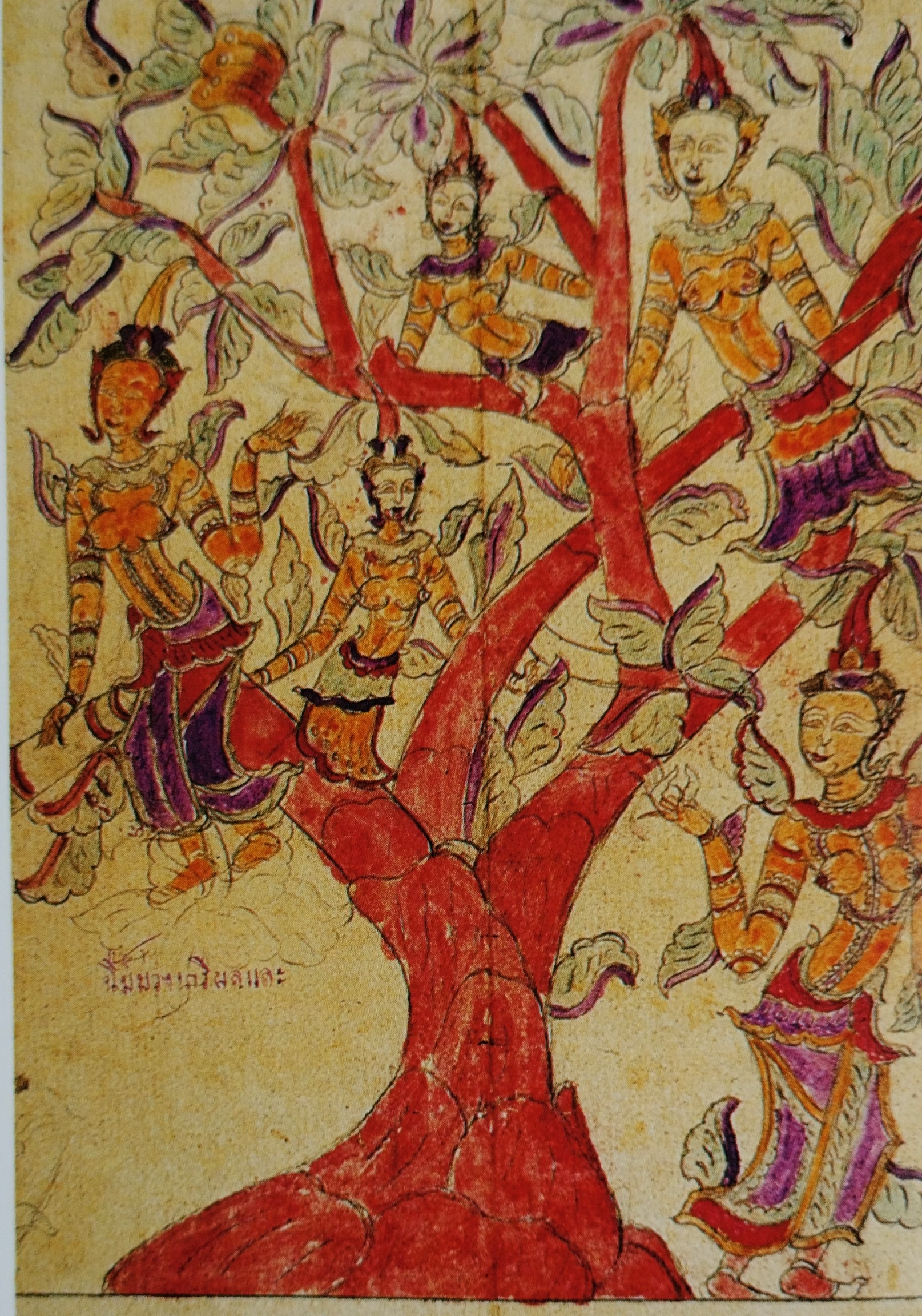
A Thai adaptation of the waq-waq tree, the landmark of an Indonesian island described in Arabic geographic texts. the tree was incorporated into Thai poetry as a "garden of fruits whose trees bear beautiful women as fruits” and the artist who executed this image, labeled it as a tree with "women mango fruits."
III. Doctrinal Allegory and Contemporary Metamorphosis
The Nariphon serves as a powerful semiotic tool used to illustrate core Buddhist tenets whilst reflecting modern societal anxieties.
Doctrinal Synthesis
- Ascetic Discipline: The Nariphon functions as a litmus test for the ruesi. By presenting a beautiful but "bone-less" form, it forces the practitioner to choose between sensory desire and the preservation of spiritual power.
- Anicca (Impermanence): The transient beauty of the fruit-maiden—who appears as a nubile sixteen-year-old before withering—is a vivid illustration of Anicca. It serves as a reminder of the futility of attachment to physical form and the vegetative entrapment of the mind.
Contemporary Critical Reinterpretation
In the modern era, the "Nariphon narrative" has been reclaimed through the lens of contemporary art history:
- Feminist Critique: The artist Phaptawan Suwannakudt, in her Nariphon series (1996), utilised the icon to critique gendered oppression. Suwannakudt explicitly linked the "girl-shaped fruit" to the commodification of children, such as the 12-year-old girl sold by her parents into the sex trade, as noted in the analysis by Patrick Flores.
- Digital Preservation: The HimmaphanVR project represents a modern manifestation of "sacred commercialism" and digital ethnography, mapping these myths into virtual spaces to preserve the semiotic mutability of the Himavanta for a secular audience.
Conclusion: The Resilience of the Fruit-Maiden
The evolution of the Nariphon demonstrates a remarkable "semiotic plasticity." It has successfully migrated from the peripheral botanical curiosities of the Traiphum Phra Ruang to become a central figure in both monastic didacticism and contemporary social critique.
The fruit-maiden navigates the boundary between sacred Theravada devotion and modern secular commercialism without losing its core cultural resonance. Whether serving as a test of an ancient hermit’s resolve or as a mirror for the vulnerability of a modern girl, the Nariphon remains the most provocative and enduring fruit of the Himavanta grove.
---
References
- Brereton, B. P. (2010). Towards a definition of Isan mural painting: Focus on the heartland. Journal of the Siam Society, 98, 185-204.
- Flores, P. D. (n.d.). Art history and the contemporary in Southeast Asia.
- Lawka-koon-char. (1842). Burmese cosmology manuscript.
- Low, J. (1824). Extracts from the Siamese cosmography.
- Reynolds, F. E., & Mani, B. B. (Trans.). (1982). Three worlds according to King Ruang: A Thai cosmology (Traiphum Phra Ruang). Berkeley: Asian Humanities Press.
- Suwannakudt, P. (1996). Nariphon series. [Acrylic and gold leaf on silk].

Paper
From Sacred Groves to Pop Culture: The Iconographic Evolution and Cultural Resonance of the Nariphon Fruit-Maiden
Asian Heritage Silva Research Team
March 13, 2026
Paper
The Maiden Tree (Nariphon): Iconographic Evolution and Modern Art in Thailand (Part 2)
Arcangelo Di Paolo (M.Phil.)
February 27, 2026
Paper
The Maiden Tree (Nariphon): Origins and Mythology in Thai Buddhist Cosmology (Part 1).
Arcangelo Di Paolo (M.Phil.)
February 21, 2026


